Where Music, Science, Faith, and Vocation Meet
October 18, 2026, by Dean Hoke – Northfield, Minnesota, is an unusual American college town. With approximately 21,000 residents, it is home to two nationally respected private liberal arts colleges: St. Olaf College and Carleton College. Together, they enroll more than 5,000 students. Yet their proximity is only part of the story: communities with distinctly different religious and cultural traditions founded the two institutions eight years apart.
Carleton was established in 1866 by Congregationalists with New England roots. In 1874, Norwegian Lutherans sought to establish their own school. Northfield’s citizens welcomed the proposal. At public meetings that October, residents pledged $5,400 to help bring the school to town, including $2,000 from merchant Harald Thorson. The new institution opened in January 1875 with 37 students in a former public-school building. A Carleton student attended the opening—a small sign of the intertwined histories to come.
Over time, St. Olaf and Carleton developed into nationally respected liberal arts colleges, each with its own traditions and institutional identity. Their athletic rivalry became part of Northfield’s culture, but so did an increasingly practical willingness to cooperate. That relationship remains a distinctive feature of this small Minnesota community.
For St. Olaf, those modest beginnings were the foundation of something its Norwegian Lutheran founders could scarcely have imagined. What began as a school of 37 students has grown into a nationally respected liberal arts college enrolling more than 3,000 undergraduates. Its Lutheran heritage and celebrated musical traditions remain central to its identity, but they tell only part of the story. St. Olaf has also built an impressive record in the sciences, international education, and student achievement, showing how an institution rooted in tradition can evolve without losing its sense of purpose.
From Norwegian Immigrants to a National Liberal Arts College
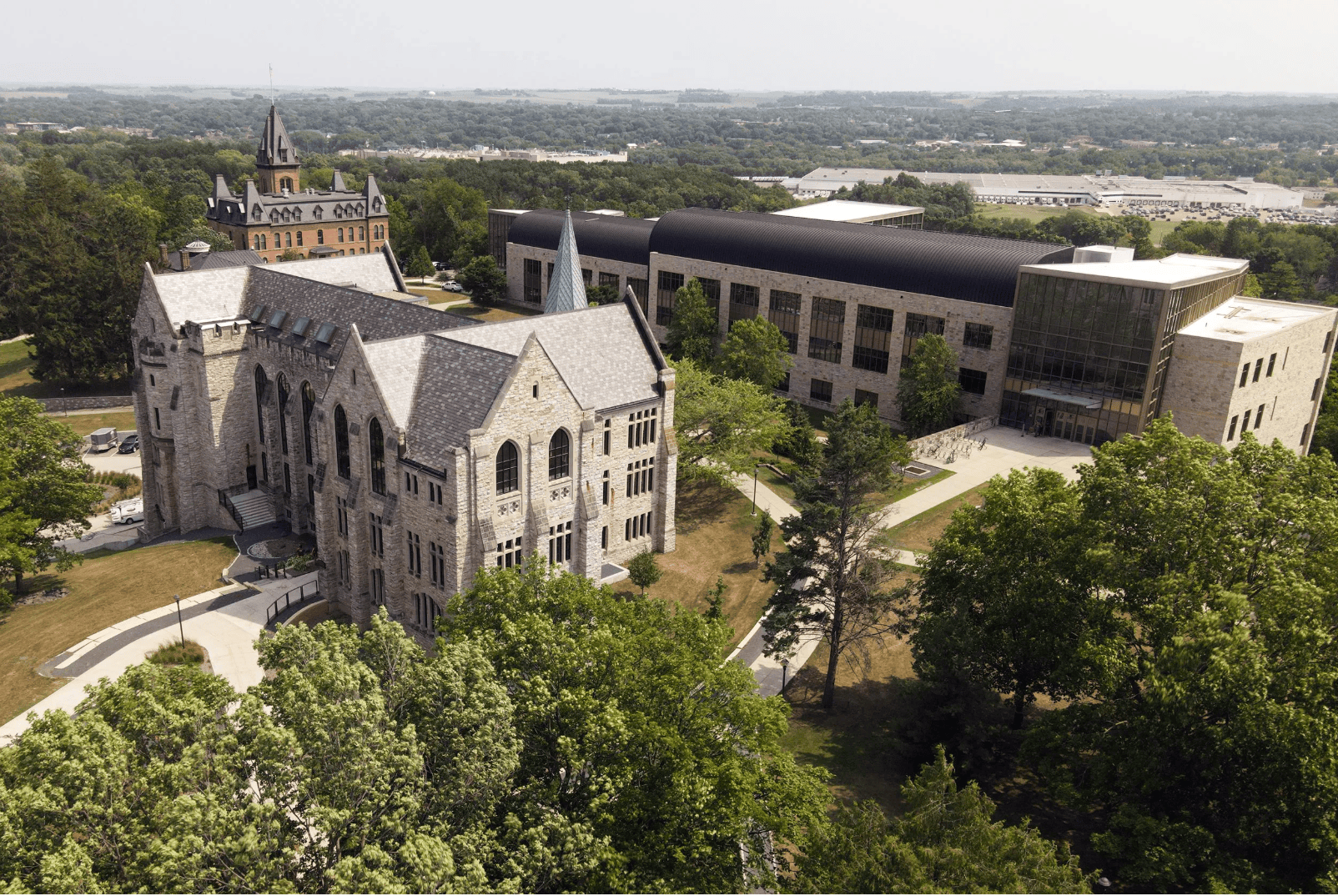
St. Olaf grew from its origins as a Norwegian Lutheran school into a nationally recognized liberal arts college. Its founders sought to prepare young people for leadership and service while sustaining a cultural and religious community. The college moved to Manitou Heights, known locally as the Hill, in 1878. Its setting above Northfield became part of the institution’s identity, even as its educational reach expanded far beyond Minnesota.
Northfield’s two-college identity gives St. Olaf a distinctive setting: a residential liberal arts campus on Manitou Heights, within a small city shaped by two independent institutions. Their contemporary partnership, explored later in this profile, reflects that history.
Enrollment: A Stable College with a Broad Recruiting Market
For small private colleges, academic reputation matters, but enrollment is often the most immediate measure of institutional sustainability. St. Olaf’s enrollment record stands out for its consistency.
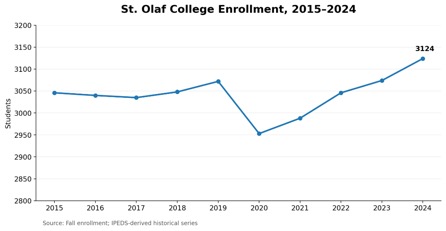
St. Olaf enrolled 3,114 students in fall 2025, up from about 3,046 in 2015. Enrollment has stayed near 3,000 over the past decade, with some variation during and after the pandemic.
First-year applications increased from 5,524 in 2022 to 7,521 in 2026, an increase of approximately 36 percent. Over the same period, the admission rate declined from approximately 56 percent to 41 percent. St. Olaf enrolled 840 new first-year students in fall 2026.
Approximately 45 percent of the newest entering class came from Minnesota, while the remaining 55 percent came from other states or countries. The class represented 44 states. International students account for approximately 10 percent of total enrollment, although the number of new international students has declined in recent entering classes.
The broader enrollment picture is one of relative consistency rather than contraction. That matters for a residential educational model in which campus life, housing, and extracurricular participation are closely connected.
Student Success: Retention and Completion
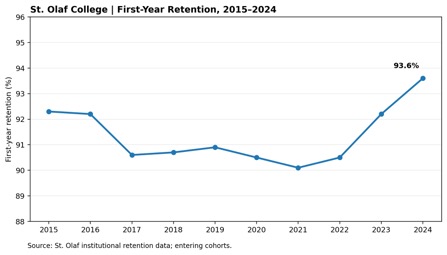
St. Olaf’s student-success measures are among its strongest institutional indicators. First-year retention has generally ranged from 90 to 94 percent. Among students who entered in fall 2024, 93.6 percent returned in fall 2025. (See retention chart.)
Its six-year graduation rates have generally been in the low- to mid-80-percent range, substantially above the broad national average for private nonprofit four-year institutions.
There are differences among student populations. For the 2019 entering cohort, the six-year graduation rate was approximately 80.7 percent for Pell Grant recipients, compared with 85.3 percent for students receiving neither Pell Grants nor federal subsidized loans. That difference deserves attention even though both figures compare favorably with broad national benchmarks.
Among Class of 2025 graduates, St. Olaf reported that 95 percent with known outcomes were employed, continuing their education, or participating in full-time service within seven months of graduation. The college reported outcomes information for approximately 90 percent of the class.
Taken together, retention, graduation, and early career outcomes suggest that most St. Olaf students make steady progress toward their degrees and next steps.
Lutheran Heritage, Contemporary Mission
Founded by Norwegian Lutheran immigrants, St. Olaf has maintained a strong connection to its religious heritage while welcoming students from a broad range of faiths and backgrounds. Today, about 15 percent of entering students identify as Lutheran, reflecting the changing religious composition of American higher education. More importantly, the college continues to incorporate its founding philosophy into its educational mission.
St. Olaf’s mission statement declares: “St. Olaf College challenges students to excel in the liberal arts, examine faith and values, and explore meaningful vocation in an inclusive, globally engaged community nourished by Lutheran tradition.”
The college gives that commitment substance through its academic curriculum. Students pursuing the Bachelor of Arts degree must complete general education requirements in Religion, Faith, and Values; Christian Theology in Dialogue; and Ethical Reasoning in Context. These courses encourage students to examine religious traditions, consider different perspectives, and engage with moral and philosophical questions. The emphasis is not on religious conformity but on developing the intellectual tools to understand faith, values, and human responsibility.
Central to this philosophy is the Lutheran concept of vocation. At St. Olaf, vocation means more than preparing for employment or choosing a profession. It asks students to consider how their knowledge, talents, and responsibilities can contribute to their communities and the broader world. This understanding extends naturally into the college’s emphasis on service, civic engagement, and international education.
The commitment is also evident in St. Olaf’s 2024–2030 strategic plan, Solution Seekers, which identifies elevating vocation, expanding innovation, and sustaining the community as its principal goals. The plan reinforces the idea that academic excellence and preparation for meaningful lives are closely connected.
The college’s Lutheran heritage remains visible in its attention to faith, ethics, and vocation, even as its curriculum and student body reflect a wider range of perspectives.
Academics: More Than a College Known for Music
Music is central to St. Olaf’s public identity, but its record of preparing students who eventually earn research doctorates reveals an equally important academic strength.
According to the National Science Foundation’s Survey of Earned Doctorates, 314 St. Olaf alumni earned research doctorates between 2020 and 2024. By total number, the college ranked sixth among comparable baccalaureate arts and sciences institutions, placing it alongside Oberlin, Carleton, Swarthmore, Williams, and other nationally recognized liberal arts colleges.
For 2015–2024, St. Olaf ranked second among comparable liberal arts colleges in the number of alumni earning doctorates in biological and biomedical sciences, third in chemistry, and third in mathematics and statistics. These rankings measure former undergraduates who later earned doctorates, not degrees awarded by St. Olaf; they are not adjusted for undergraduate enrollment.
Mathematics, biology, and chemistry are prominent fields, alongside economics and psychology. The instructional model is also relatively personal: in 2025–26, St. Olaf reported an 11.3-to-1 student-faculty ratio and 237 full-time instructional faculty. These figures help explain the capacity for faculty-guided research, although they are not, by themselves, measures of teaching quality.
Students have access to Regents Hall of Natural and Mathematical Sciences, a major academic facility that opened in 2008. The approximately $64 million building provides laboratories, classrooms, and interdisciplinary learning spaces and received LEED Platinum certification.
Through the Collaborative Undergraduate Research and Inquiry program, students work with faculty on projects in the natural sciences, social sciences, and humanities. During summer 2025, 82 students collaborated with 30 faculty and staff members.
This environment provides important context for President Susan Rundell Singer’s 2023 appointment. A biologist, Singer previously directed the National Science Foundation’s Division of Undergraduate Education and spent approximately three decades on the faculty at nearby Carleton College before becoming provost at Rollins College. She inherited a strong scientific tradition rather than one needing to be created from scratch.
That scientific record complicates the familiar picture of St. Olaf as primarily a music college. Its students can combine serious study in the sciences with performance, research, and other campus activities.
Music: A Tradition with Unusual Reach
In 1912, F. Melius Christiansen, founder of St. Olaf’s music department, organized a Christmas musical program for the college community. What began as a local event became a defining feature of the institution.
More than a century later, the St. Olaf Christmas Festival brings together over 500 student musicians from five choirs and the college orchestra. The annual celebration combines sacred music, orchestral performance, and the traditions of Advent, Christmas, and Epiphany. The festival reaches audiences beyond campus through performances, recordings, and broadcasts.
Yet the Christmas Festival represents only part of the college’s musical life. St. Olaf maintains choirs, orchestras, bands, jazz ensembles, and other performance opportunities. More than 1,000 students participate in its musical ensembles, a remarkable level of involvement for a college of approximately 3,100 undergraduates.
The St. Olaf Choir, established by Christiansen, is internationally recognized for its choral tradition. Its longtime conductor, Anton Armstrong, a 1978 graduate, has directed the ensemble since 1990.
Music extends well beyond the music major, which accounted for approximately 5 percent of declared majors in 2023–24. More than 1,000 students participate in ensembles, including those pursuing medicine, mathematics, business, and education.
Athletics and the Broadly Engaged Student
St. Olaf competes in NCAA Division III as a member of the Minnesota Intercollegiate Athletic Conference. Its teams are known as the Oles.
Nearly 600 St. Olaf undergraduates participate in the college’s 26 varsity sports. Club and intramural programs extend athletic opportunities to an even broader segment of the student body.
The scale of participation in athletics and music illustrates the range of experiences available alongside academic study.
International Education: Learning Beyond Northfield
Approximately 70 percent of St. Olaf’s Class of 2025 participated in study abroad or study away during their undergraduate years—an unusually extensive commitment to learning beyond campus. The Institute of International Education’s 2025 Open Doors ranked St. Olaf second nationally among baccalaureate colleges by the number of students studying abroad in 2023–24. The two measures differ: the class participation figure includes domestic study away, while Open Doors counts international study.
International experiences are supported through the Smith Center for Global Engagement. The college has received major philanthropic support from Louis and Mary Kay Smith, whose international experiences helped shape their interest in global education. A $20 million gift announced in 2026 followed earlier support for study abroad and international music touring.
Beginning in 2027, St. Olaf plans to offer qualifying semester-long study abroad programs at the same institutional cost as studying on campus, reducing a potential financial barrier to participation.
Philanthropy has also supported a clearly defined academic priority in international education. St. Olaf’s unusually high participation and national Open Doors distinction make it one of the college’s most consequential strengths.
Financial Strength and the Cost of the Model
At the end of fiscal year 2025, St. Olaf’s endowment stood at approximately $863.9 million, up from $711.7 million two years earlier. Total net assets exceeded $1 billion.
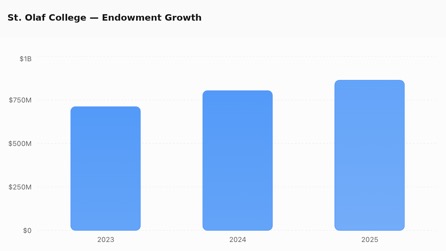
The college’s financial strength reflects generations of philanthropic support, investment returns, and institutional planning. The For the Hill and Beyond campaign, completed in 2020, raised approximately $252 million in commitments against a $200 million goal, including substantial support for endowed scholarships.
The financial story, however, is more complicated than the size of the endowment suggests. Audited statements report approximately $154.7 million in operating revenue and support and $155.1 million in operating expenses for FY2025, a modest deficit of about $360,000. FY2024 produced a small operating surplus. These narrow annual margins illustrate the ongoing cost of sustaining a residential liberal arts college, even one with considerable accumulated resources.
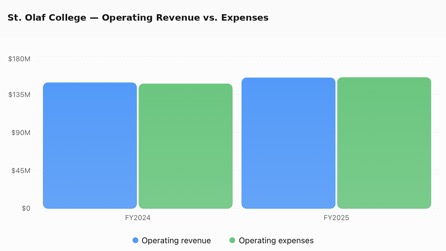
Endowment distributions totaled about $33.1 million in FY2025, or 21.4 percent of reported operating revenue and support. Such distributions are a planned component of the operating model rather than evidence of distress. They do, however, underscore the importance of investment returns, disciplined spending policies, and donor restrictions on endowed funds.
For 2026–27, St. Olaf’s published comprehensive fee—tuition, housing, meals, and student activity charges—is approximately $81,200. Most students pay less after financial aid. According to the U.S. Department of Education’s College Scorecard, the average net price for first-time, full-time undergraduates receiving federal Title IV aid was approximately $23,874 in 2023–24; an individual family’s cost varies.
The difference between the published price and the revenue St. Olaf actually collects is substantial. In FY2025, approximately $138.5 million in scholarships and grants reduced $226.6 million in combined tuition, room, and board charges to about $88.0 million in net revenue. Scholarship assistance thus offset about 61 percent of those combined charges, compared with about 59 percent the previous year. This is not a NACUBO-equivalent tuition discount rate, because the charges include housing and meals. Net revenue from tuition, room, and board increased modestly from $85.7 million in FY2024, even as scholarship commitments grew. The figures show both the extent of student assistance and the resources required to maintain St. Olaf’s educational model.
Collaboration Across the Cannon
St. Olaf and Carleton are two respected, well-resourced liberal arts colleges sharing one small Minnesota community. They have different histories, traditions, and institutional identities, and they compete for students, faculty, philanthropic support, and football victories. Yet their relationship also shows that competition need not prevent meaningful cooperation.
Their libraries began collaborating in 2003 through a cross-library borrowing system. A $1.4 million Andrew W. Mellon Foundation grant awarded in 2013 expanded their work in library services, academic programs, and information technology. The partnership has included shared library systems and staffing arrangements, collaborative courses, and jointly supported information-security and environmental health and safety functions.
The collaboration remains active. St. Olaf’s 2024–2030 strategic plan identifies Carleton and the City of Northfield as partners in shared sustainability goals. The colleges also share the Campus-Go shuttle service, which helps students reach appointments, volunteer opportunities, and jobs in Northfield and nearby Dundas. Northfield’s own long-range plan identifies stronger relationships with both colleges as a community priority.
There are limits: admissions and fundraising remain independent, and the colleges have not published comprehensive estimates of financial savings. But this is not a rescue arrangement. Two strong institutions have chosen to share selected capabilities while retaining the independence and traditions they value. For other small colleges, Northfield offers an encouraging example of cooperation that can serve students and the surrounding community without requiring a merger.
Leadership and Institutional Continuity
St. Olaf’s recent leadership history contrasts with institutions experiencing frequent presidential turnover. David R. Anderson, a 1974 St. Olaf graduate, served as president from 2006 until 2023. His 17-year tenure included major fundraising initiatives, campus investments, and continued efforts to build the college’s national reputation.
In June 2023, Susan Rundell Singer succeeded him as St. Olaf’s first woman president. Singer brought experience from Carleton College, the National Science Foundation, and Rollins College. The transition was planned well in advance, not prompted by an institutional emergency.
Singer’s administration introduced Solution Seekers, the strategic plan for 2024–2030, with priorities including vocation, innovation, and community sustainability.
Alumni: A Strong Network with Deep Minnesota Roots
St. Olaf reports an alumni network of more than 35,000 people. LinkedIn identifies approximately 28,700 profiles associated with the institution. Nearly half of those profiles are located in Minnesota, including approximately 13,400 in the Greater Minneapolis–St. Paul metropolitan area.
The college’s concentration of Minnesota alumni also provides a professional network for graduates seeking opportunities in the region.
The metropolitan area provides opportunities across healthcare, business, education, technology, finance, and nonprofit organizations. Employers represented among St. Olaf’s LinkedIn alumni include Mayo Clinic, the University of Minnesota, Target, and U.S. Bank.
Notable graduates illustrate the breadth of the college’s educational tradition. Ole E. Rølvaag (1905) became an influential Norwegian-American novelist and St. Olaf professor, and his novel Giants in the Earth explored immigrant life on the frontier. James Reeb (1950), a Unitarian Universalist minister and civil rights activist, was fatally attacked in Selma, Alabama, in 1965 while supporting voting rights.
Dean Buntrock (1955), founder and longtime leader of Waste Management, became one of St. Olaf’s most consequential benefactors; his family’s philanthropic commitments exceeded $66 million. He died in April 2026. Siri Hustvedt (1977) became an internationally recognized novelist and essayist exploring identity, psychology, memory, and science. Anton Armstrong (1978) returned to lead the St. Olaf Choir in 1990 and helped preserve its international reputation. Cheryl Willman (1977) became a prominent physician-scientist and cancer researcher.
These alumni represent literature, civil rights, business, music, and medical research—very different fields connected by a common undergraduate institution.
Beyond the Brochure: Jay Gatsby and the Hill
St. Olaf has an unexpected place in one of the best-known American novels. In F. Scott Fitzgerald’s The Great Gatsby, the fictional Jay Gatsby attends St. Olaf for only two weeks before leaving, dissatisfied with his circumstances. The reference gives the college an unusual footnote in American literary history.
Northfield has an equally memorable story beyond the campus. On September 7, 1876, the James–Younger Gang attempted to rob the First National Bank. Townspeople resisted, and the robbery failed, though bank cashier Joseph Lee Heywood and resident Nicolaus Gustafson were killed. The episode remains part of the city’s identity through its annual Defeat of Jesse James Days celebration. On campus, generations of students have had their own rallying cry: the exuberant “Um! Yah! Yah!” cheer.
What St. Olaf Tells Us About Small Colleges
St. Olaf’s reputation for music and its Lutheran heritage tell only part of the story. Its record of preparing graduates for scientific research, its international education programs, and the breadth of student participation demonstrate how a small college can sustain more than one institutional strength.
The resources behind that breadth matter. Strong retention and graduation outcomes accompany substantial commitments to scholarships, academic facilities, and student opportunities. Endowment support makes those commitments possible, but it does not eliminate the need for careful financial choices.
For other small colleges, the lesson is not to replicate St. Olaf’s endowment or programs. It is to recognize which inherited strengths can serve contemporary educational purposes—and to understand the financial commitments required to sustain them.
In Northfield, two institutions have also demonstrated that preserving a distinctive identity need not rule out cooperation. St. Olaf’s experience suggests that a college’s traditions are most valuable when they open opportunities for students rather than limit what the institution can become.
About This Series
This profile is part of Small College America, an ongoing series of independently researched articles examining the history, distinctive characteristics, academic strengths, financial condition, and future prospects of private nonprofit colleges across the United States. The series is intended to inform college leaders, trustees, alumni, and others interested in the challenges and opportunities facing small colleges.