
 By Tom Davisson February 10, 2020 – Who and how a person becomes a university president has always been something of an enigma, and what are their day-to-day activities? The answer is generally as varied as the number of presidents. Here are some profile facts from the 2017 American College President Study from the American Council of Education.
The fact is a modern-day President comes from a wide variety of career tracks, and the position is highly demanding and stressful, which requires the ability to navigate the internal and external worlds addressing students, parents, faculty, industry, politicians, media, and a wide variety of funders. It is not surprising the average tenure of a President is declining.
So why does one aspire to such a time-consuming, and often strenuous position, and what path does one take to achieve such a position? Historically a President was usually filled by a member of the faculty. Since most colleges/universities were started to increase the knowledge of the population, it made sense that members of the academy would be best suited to lead the institution. Occasionally non-faculty would ascend to the position through alternate paths, but that was an exception.
Today we are seeing the model change significantly. As the chart below shows, faculty is still the top recruiting ground however alternative pathways are now routinely used. External candidates such as politicians, business leaders, fundraisers, and marketing professionals are often finalists, as are academic administrators and Dean’s. The thinking is that the position is not as academically related as it was previously, and new skill sets are now needed. Skills such as fundraising, lobbying, public relations, recruiting, and management skills are critical to a president’s and university’s success.
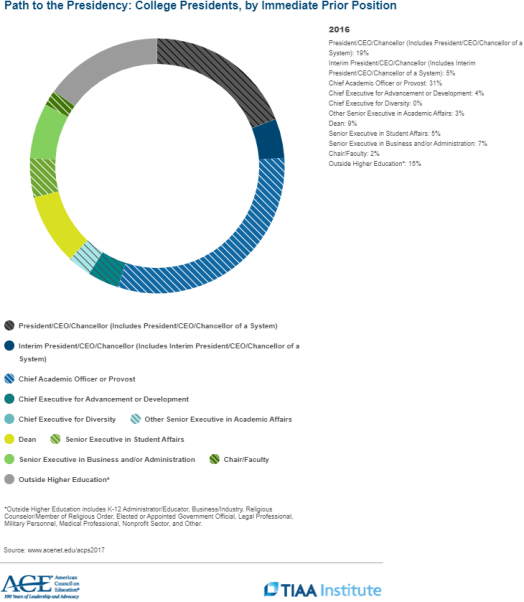
There is an internal administrative avenue that is often overlooked, and that is the Student Services track in which only 5% of the current President’s held a senior student services position. I can speak personally of such a journey.
Each President has their own unique journey to the position, here is my path. I was a first-generation college student from a lower-income family from a small town in Ohio. I began my studies at the University of Rio Grande in Ohio in 1968 and graduated in 1972 with a degree in secondary education. While I did have plenty of emotional support from my family, financial support was minimal. Thank goodness for student loans, institutional scholarship dollars, and on-campus employment was available. I was a residence hall counselor for room and board, worked in the bookstore for free used books, a sports editor for the college newspaper, and worked at a local restaurant for free food and pocket money. For many first-generation college students having to work multiple jobs and be a full-time student is a normal way of life and has been that way for generations.
I say this as it laid the groundwork for my professional career. After working for the state on workforce training programs, I was hired by a national higher education organization. I started in the student services area. The position was responsible for student housing, student activities, helping students find p/t employment, etc. I found student services, something I really loved to do. The majority of trustees and faculty have little understanding of student services and its complexity. Students’ issues range from fear of failure, problems at home, financial, mental health and student services officers are on the front line.
I was fortunate my career path came from this area in which I received promotions become a Dean of Students before moving to an Executive Vice President and eventually a President.
As Dean of Students, I became aware of how little authority I had to make needed changes. How was I going to tell faculty or Registrar to do something I felt needed to happen to help a student? I had the responsibility of assisting students to overcome their obstacles and complete their educational goals, but I had little authority to make needed changes. I was very naïve! So, what was I to do? This is where I began my journey of learning how to request not demand, to implore not threaten, and to be patient. I had to learn to “sell,” not “tell” people. That skill, I was to learn, was going to be one of my best friends throughout my 47-year career in higher education. It allowed me to move up the organizational ladders to VP, SR. VP., Exec. VP. C.O.O., and President.
When finally reaching the position of President, I found these skills to be as, if not more, important than my Student Services days. While I did have the administrative authority to direct people to do my “bidding,” working in Student Services taught me it is much better to “sell” than simply “tell”! Letting people in on the “why,” and allowing them to help me find the “how” has been one of my best tools over the years. These same skills transferred into the new areas of fundraising and the political arena. As a President’s time is split between the issues of internal and external and the experience of a well-rounded leader provides a foundation for success.
That critical lesson was ingrained in me during my Student Services days. So, as Boards of Trustees and search firms look to fill this key position, I strongly recommend they not overlook the answer that may be right in front of them, their Student Services Department.
So, if you are considering a path to a Presidency, think about Student Services as one-stop along that journey. If you are now a President, or in senior leadership, don’t overlook your leaders in your Student Services area. They can give you great insight about your students and their thinking that could help you learn where and how to find more students just like them.
Tom Davisson is a Partner with Edu Alliance Group, Inc a international higher education consultancy firm. He recently retired from Sullivan University System as 30 years, as Executive VP and COO. Prior to joining Sullivan, Tom was President of DeVry University DuPage and Area President of all DeVry Chicago area Campuses.
Tom is one of the leading experts in the area of higher education institutions, bridging the gap between education and the workforce. He has served on and chaired visiting committees for the Southern Association of Colleges and Schools, Commission on Colleges both in the US and in 5 other countries. He is a Trustee Emeritus the University of Rio Grande in Ohio.
Tom has more than 47 years of experience in senior higher education administration experience. He also serves on numerous non-profit boards.
 By Dean Hoke January 13, 2020 – Since Edu Alliance was founded in 2014, we have published a bi-weekly newsletter and the Edu Alliance Journal, a blog that included original articles related to higher education. In 2018 -19 we produced a series titled “Things that Keep Higher Education Leaders Awake at Night.” We published over 20 articles on a variety of issues that pointed out higher education challenges concerning economics, international recruitment, and declining public perception of the value of education.
 Edu Alliance Journal