
March 10, 2025, by Dean Hoke: This profile of Gettysburg College is the fifth in a series presenting small colleges throughout the United States.
Background
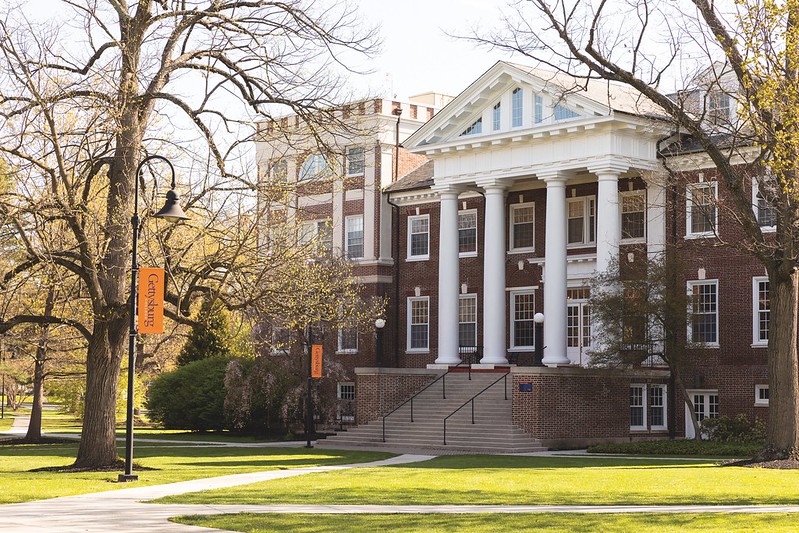
Founded in 1832, Gettysburg College is a private liberal arts institution located in Gettysburg, Pennsylvania. The 225-acre campus is steeped in history, having served as a field hospital during the Battle of Gettysburg. An alumnus (David Wills, Class of 1851) invited President Abraham Lincoln to deliver the Gettysburg Address in 1863, tying the college to this pivotal moment in American history. Gettysburg’s historical significance (from its Civil War connections to President Dwight D. Eisenhower’s post-presidency involvement on its Board of Trustees) contributes to its distinctive identity.
The college is known for its rigorous academics, close faculty-student mentorship, and emphasis on leadership development. Gettysburg maintains a 10:1 student-to-faculty ratio, ensuring personalized instruction. It enrolls approximately 2,200 students from across the country and abroad, fostering a diverse and engaged learning community.
Curricula
Gettysburg College offers more than 40 majors and 40 minors, spanning the arts, humanities, sciences, and social sciences. Popular programs include Business, Political Science, Economics, Psychology, and Health Sciences. The college is home to the Eisenhower Institute provides students with opportunities to engage in public policy and leadership development, while the Civil War Era Studies minor leverages the college’s historical location for in-depth academic exploration. Five years after graduation (as of Fall 2021), 45 percent of this graduating class had received and/or were enrolled in a graduate/professional degree program five years after graduating from Gettysburg. Graduation rates have remained high. The latest 6-year graduation rate was 83%
Strengths
- Strong Post-Graduate Outcomes: 98% of graduates are employed or enrolled in graduate school within a year of graduation.
- Experiential Learning: Over 78% of students complete at least one internship, and 55% participate in faculty-mentored research.
- Leadership Development: Programs such as the Eisenhower Institute provide hands-on training in policy and governance.
- Historical and Civic Engagement: The college’s proximity to the Gettysburg Battlefield and its Civil War Era Studies program offer students a unique educational experience.
Weaknesses
- Financial Resources: Gettysburg’s endowment is moderate compared to some peer institutions, affecting the availability of internal funding for scholarships and program expansion.
- Enrollment Challenges: The college has seen a gradual decline in student enrollment over the past decade, from a peak of over 2,700 students in 2013 to approximately 2,207 in 2024. Gettysburg’s rural location and relatively small town setting may also be a hurdle in recruiting students who prefer an urban environment or a more expansive social scene.
- Diversity Initiatives: About 21% of undergraduates are domestic students of color, and 14% are international. While improving, the college’s domestic student diversity (21%) lags behind national averages.
Economic Impact
Gettysburg College serves as a major economic engine in its local and regional economy. As one of the largest employers in Adams County, the college provides hundreds of jobs for faculty, administrators, and staff, injecting substantial income into the community through payroll and benefits. The college also attracts thousands of visitors annually for events like Orientation, Family Weekend, Homecoming, and Commencement, as well as academic conferences and cultural events at its facilities (such as the Majestic Theater, a college-owned performing arts center). Also, Gettysburg College’s investment in revitalizing downtown Gettysburg through projects like the Majestic Theater restoration and its support of local internships/service programs help strengthen the social and economic fabric of the area.
Broader economic analyses highlight the significant spillover effects of colleges like Gettysburg. Many graduates remain in or return to Pennsylvania, joining the workforce and paying taxes. (Statewide data from the Association of Independent Colleges & Universities of PA suggests that if ~57% of one graduating class stays in Pennsylvania to work, that cohort would add about $1.5 billion to the state economy over their careers.
Enrollment Trends
As of Fall 2024, Gettysburg College enrolls approximately 2,207 students. Over the past five years, undergraduate enrollment has declined from a peak of 2,500 to 2,200. The shift is attributed to demographic changes and increasing competition among liberal arts colleges. Efforts to stabilize enrollment include enhanced recruitment strategies and expanded financial aid options.
In the Fall of 2022, Gettysburg College launched and began offering classes for its first part-time master’s degree program, the Master of Arts in American History, in partnership with the Gilder Lehrman Institute of American History. This fully online, 30-credit program is designed for K-12 educators, district supervisors, librarians, museum professionals, and National Park Service employees affiliated with the Gilder Lehrman Institute. It is growing; new graduate programs are in the process of being offered.

Degrees Awarded by Major
In the 2023 graduating class, Gettysburg College conferred degrees across the various disciplines.

Alumni
According to the college, Gettysburg College has an alumni network of over 32,000 graduates. Approximately 25% of alumni reside in Pennsylvania, with a significant concentration in the greater Washington, D.C., and Philadelphia areas. The college’s alumni are well-represented in fields such as business, law, government, education, and the arts. Career services and networking opportunities ensure that graduates remain engaged and professionally supported.
Notable Alumni
- Michael Bishop (Class of 1957): Nobel Prize-winning biomedical researcher in virology and cancer research.
- Fred Fielding (Class of 1961): 9/11commissioner and White House Council for President Ronald Regan and George W. Bush.
- Carol Bellamy (Class of 1963): Former Executive Director of UNICEF and Peace Corps Director.
- Bruce S. Gordon (Class of 1968): Former President of the NAACP.
- Kathryn Wolford (Class of 1979: Former President of the McKnight Foundation and Past President of Lutheran World Relief.
- Carson Kressley (Class of 1991): Television personality, fashion expert, and actor.
Endowment and Financial Standing
As of 2023, Gettysburg College’s endowment stands at approximately $380–$400 million. While this represents growth over the past five years, the college remains tuition-dependent, with about 80% of its operating budget coming from student fees. Gettysburg College is stable but budget-conscious. Forbes’ 2023 financial health evaluation gave Gettysburg an approximate “B–” grade, with a financial GPA of around 2.71 on a 4.5 scale, indicating that while the college is not financially distressed.

Why is Gettysburg College Important
- Academic Excellence: The college provides a strong liberal arts foundation with small class sizes and individualized instruction.
- High Graduate Success Rates: With 98% of graduates employed or in graduate school within a year, Gettysburg’s outcomes are among the best for liberal arts colleges.
- Leadership Development: Programs such as the Eisenhower Institute and Center for Public Service prepare students for civic engagement and public service careers.
- Historical Significance and Cultural Impact: Its Civil War connections and Lincoln’s legacy make it a unique institution with a strong civic mission. Also Gettysburg College plays a key role in supporting local businesses, employment, and tourism in Gettysburg and beyond.
With its strong commitment to liberal arts education, leadership development, and historical legacy, Gettysburg College remains a distinguished institution that prepares students for success in an ever-changing world.
Dean Hoke is Managing Partner of Edu Alliance Group, a higher education consultancy, and a Senior Fellow with the Sagamore Institute. He formerly served as President/CEO of the American Association of University Administrators (AAUA). With decades of experience in higher education leadership, consulting, and institutional strategy, he brings a wealth of knowledge on small colleges’ challenges and opportunities. Dean, along with Kent Barnds, are co-hosts for the podcast series Small College America. Season two begins on March 11, 2025.


 Edu Alliance Journal