
Hoke’s Notes – The Plight of Small Colleges

January 27, 2025

It has been two years since I last wrote a blog post for the Edu Alliance Journal. During that time, I took on the role of President/CEO of the American Association of University Administrators (AAUA) and dedicated myself fully to the organization. I set ambitious goals, including:

  1. Launching a marketing and branding campaign to elevate AAUA’s visibility,
  2. Increasing institutional and individual membership,
  3. Establishing a high-profile multi-day conference, and
  4. Stabilizing the organization’s finances to allow the hiring of a paid executive director.

While I initially anticipated achieving these milestones within three years, the board and I managed to accomplish them in just 18 months.

Reaching these goals was a significant achievement, and it signaled to me that it was time to focus on other priorities. As such, I submitted my resignation, effective January 1st, and “retired” from my leadership role at AAUA. However, I’ve always felt that retirement, in the traditional sense, isn’t for me. At 74, I still have ideas to share and contributions to make in the field of higher education.

I aim to address several projects and issues moving forward, such as returning to my work as an international higher education consultant and re-launching two podcast series. However, one other area is especially close to my heart: the plight of small colleges.


The Plight of Small Colleges

If you’ve followed my journey, you know that I earned my undergraduate degree from Urbana University, a small private college in Urbana, Ohio—a city with a current population of 11,161. In 1975, I designed my own major in College Administration, combining courses in business, history/political science, and psychology. During my senior year, I also completed a year-long internship in admissions.

As a nontraditional student (having started at the University of Dayton in 1968), it took me 6 ½ years and over 30 part-time jobs to complete my degree. Urbana gave me the opportunity to figure out what I wanted to do and how I could contribute to the world. It taught me adaptability and the goodness in people, which led me to the field I love—higher education.

Unfortunately, Urbana University didn’t survive. After being acquired by Franklin College in 2014, it closed its doors in May 2020 due to challenges brought on by the coronavirus pandemic and years of low enrollment.

Urbana had been an integral part of the community since 1850, serving as a significant economic engine. A 2017 study by the Southwestern Ohio Council for Higher Education estimated that Urbana contributed over $60 million annually to the economies of Champaign and Logan counties and employed 111 full-time staff during the 2015-2016 academic year. Its closure was devastating—not only for the university but also for the local businesses that depended on the foot traffic of students, visitors, and sports spectators.

Rural colleges like Urbana serve as vital economic and social hubs for their communities. However, the increasing trend of college closures poses significant risks, including economic downturns, reduced social engagement, and the loss of cultural identity.


Moving Forward

To address this issue, I’m developing a funding proposal to analyze the multifaceted impacts of struggling colleges in rural areas. My goal is to propose actionable solutions and share findings that empower policymakers and community leaders. By combining innovative research, advocacy, and problem-solving, this initiative seeks to provide practical tools for fostering resilient rural communities.

The research will focus on rural communities in Indiana, Ohio, and Pennsylvania. I’ve already received encouragement from regional leaders and am optimistic about finding partners to support this initiative. I’m seeking foundations, corporations, and government agencies to help fund this project, which aims to mitigate the ripple effects of college closures in rural America.

If you have thoughts or suggestions on this topic—or know of potential funders—please feel free to contact me at deanhoke@gmail.com.

Stay tuned for updates on this and other projects I’m passionate about.


Dean Hoke is Co-Founder and Managing Partner of Edu Alliance, an international higher education consultancy and podcast co-host of Higher Ed Without Borders and Small College America. He recently served as President/CEO of the American Association of University Administrators.

Dean began his professional career in 1975 with Bellarmine University, working in a variety of roles, including Admissions and External Relations. In 1983, he entered the broadcasting field, serving as a senior executive for Public Broadcasting System stations and a cable network. In 1998, he co-founded The Connected Learning Network, a full-service online learning company. In 2009, he accepted an invitation to move to the United Arab Emirates, serving in senior positions at Higher Colleges of Technology and Khalifa University before co-founding Edu Alliance in Abu Dhabi in 2014.

Hoke is passionate about advancing academic excellence and innovation worldwide.  He participates in numerous advisory and consulting projects on international branch campuses, marketing/branding, and business intelligence. Dean has consulted, presented, and written on leadership, higher education, and distance learning in the United States, Bahrain, Kazakhstan, Lebanon, Oman, Nigeria, Spain, and the United Arab Emirates.

Hoke has a B.A. from Urbana University, an M.S. from the University of Louisville, and a Certificate in Executive Management from the University of Pennsylvania Wharton School. Dean currently resides in Bloomington, Indiana.

Things that Keep Higher Education Leaders Awake at Night

By Dean E. Hoke Co-Founder Edu Alliance:  2017 has been a very difficult year if you are a higher education leader. With enrollment declines, changes in tax laws, and numerous articles by pundits and politicians stating higher education is out of touch with its community, no wonder you stay awake at night.  However, if you were surprised, you haven’t been paying attention.

There have been many warning signs that a change in attitude toward higher education was coming. For example, Michael McDonald of Bloomberg in early 2014 wrote an article with the headline “Small U.S. Colleges Battle Death Spiral as Enrollment Drops” in which he reviewed the Moody’s Investor Service ratings of higher education and warned of an increase of small U.S. colleges and universities who would close or merge.  Others expressed concerns, and some political candidates  (local and national) started questioning if higher education was worth the time and money. Was there a positive Return on Investment if you went for your bachelor’s degree?

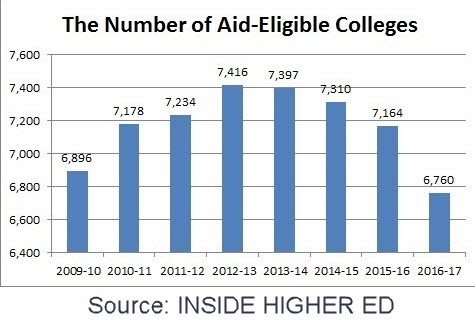
iNSIDE HIGHER eD GRAPHDoug Lederman, the editor of Inside Higher Education wrote in July 2017 an article called “The Culling of Higher Ed Begins” in which he said,  “It has become trendy to predict that higher education is on the verge of a major collapse, what with enrollments falling as loan debt and rising tuition cause students and families to ask harder questions about the value of a college credential.”
In December 2017 Moody’s Investors Service revised the 2018 outlook for US higher education from stable to negative. The revised outlook is due to indicators of adverse fundamental business conditions over the next 12-18 months. “The annual change in aggregate operating revenue for four-year colleges and universities will soften to about 3.5% increase and not keep pace with expense growth, which we expect to be almost 4%,” according to Moody’s Vice President Susan E Shaffer. “Excluding academic medical centers, sector-wide revenue growth is projected to be under 3% for the outlook period.”  At least 15% of universities will be forced to cut costs in response to stagnant or weak revenue growth.

Higher education institutions depend on a number of resources to generate funds, and it is clear the new federal tax laws, will negatively affect philanthropy and some endowments. In enrollment, we are seeing a slow decline in first time full time freshmen and foreign students. On the legislative front, Congress is moving forward to reauthorize the Higher Education Act, which governs all financial aid programs. Potential changes to Pell Grants and the direct student loan program could impact higher education affordability and access, and cuts would further suppress net tuition revenue growth.

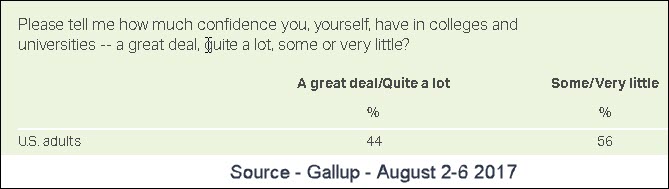
In the August 2017 public opinion poll by the Gallup organization,  people are increasingly questioning the confidence of higher education. If you have lost sleep thinking about the future of higher education, I can’t really blame you.

Gallup Poll US adults

Yet, when I talk to people in the US who do not work in the higher education field and have children in secondary school or attending college, most if not all believe higher education is worth the investment. They may complain about the tuition and future debt or worry their child may not get the job they want but they all still believe in higher education is worth the money and sacrifice for their children.  As a person who worked for years outside the US, I can guarantee you parents everywhere believe that their child earning a higher education degree is vital to their future and knows the path for a good paying job and lifestyle.

Our firm Edu Alliance, which is a boutique consultancy focusing on higher education believes everyone deserves the opportunity to get a post secondary degree.  The facts are the higher the level of education; the more likely a person will economically succeed, be a productive citizen, and make their country better.  Those in the corporate world will tell you a primary consideration in expansion is the availability of educated workers.

We believe higher education institutions need to become more aggressive in showing its importance to its community, region, and country.  We believe their needs to be a mix of institutions, big, small, private, public and even for-profit.  We also believe schools need fresh thinking in how they operate and present themselves to the public and government leaders.

In 2018 we will present our views on meeting theses challenges and path forward in the following areas:

  1. Student Recruitment
  2. Retention
  3. Finances
  4. Marketing – Branding
  5. Fund Raising
  6. Community Engagement
  7. Corporation-Community Partnerships
  8. Accreditation
  9. Staff Recruitment
  10. Legislation
  11. Governance
  12. Student Services
  13. Distance Education
  14. Educational Technology
  15. Optimization of Institutional Research
  16. Rankings and Ratings

We have asked our advisors and close colleagues to write on these areas and what they see as the challenges and possible solutions.  We hope you will join the conversation by giving us your views to each article.

Edu Alliance will become much more active in speaking at conferences, presenting workshops at higher education institutions, and writing opinion pieces for the media both in the United States and internationally.  Our co-founder partner Dr. Senthil Nathan will be at the UAE Policy Forum in Dubai, the United Arab Emirates on January 15th serving as Moderator for a Round table discussion titled “PPPs, a catalyst for reform or commercialization of a public service?” Our US partner Dr. Chet Haskell will be moderating the closing session for the Council for Higher Education Accreditation on February 1st in Washington DC, and I will be presenting at the American Association of University Administrators annual Leadership seminar in Philadelphia in early June.

If you have suggestions for subjects, we should address, or if we can be of service to your institution, please feel free to write to Edu Alliance with your thoughts.


Edu Alliance is a higher education consultancy firm with offices in the United States and the United Arab Emirates. The founders and its advisory members have assisted higher education institutions on a variety of projects, and many have held senior positions in higher education in the United States and internationally. Our specific mission is to assist universities, colleges and educational institutions to develop capacity and enhance their effectiveness.

Client services

  • Developing market intelligence for the university / college in focus, studying past enrollment trends of major demographic groups of students typically enrolling in that institution to project enrollment scenarios for the next 2 to 3 years.
  • Improve student retention
  • Provide business intelligence and strategies to enhance marketability, branding, and communications
  • Improve your image and message with your local community, alumni, and government
  • Improve revenue generation including fundraising
  • Executive Recruitment of senior academic and administrative members
  • The US and international accreditation assistance
  • Workshops with key and leading staff to brainstorm and develop strategies to assist internal team in specific subject
  • Institutional Task Force audit team to determine state of institution, strengths, and weakness and next steps
  • Specific issues as identified by the institution and design a go forward plan with implementation steps
  • Improve your institution’s Internationalization plans

Contact: Dean E. Hoke 502-257-1063