

How Small Colleges and Small Towns Can Save Each Other
April 6, 2026, By Dean Hoke – I chose a small college for what a large university couldn’t offer—smaller classes, close faculty interaction, and freedom to explore my path. My experience revealed a bigger truth: small colleges and their towns are deeply linked, and their survival depends on collaboration, not isolation.
For me, that place was Urbana College in Ohio, with about 500 students when I enrolled in the late 1960s. It was where I learned to study, ask questions freely, and begin a career.
I’ve always been grateful for what that college gave me. Which is why it stayed with me when it disappeared.
Like many small institutions in recent years, Urbana was absorbed through a merger and ultimately closed. My alma mater is gone, and that loss has never left me. This is why I’ve spent the last several years trying to understand what’s happening to small colleges nationwide—and what it means for their communities.
Since 2022, I’ve conducted more than 75 podcast interviews—over 40 with presidents, provosts, and senior leaders at small colleges. I’ve also spent two years researching and writing about the economics of closures, leadership challenges, and the most at-risk communities.
After all those conversations, data, and lived experiences, one answer stands out: lasting success happens not by saving just the college, but by ensuring the college and town intentionally unite to secure each other’s futures. That partnership is the core way forward.
The Crisis We’re Not Talking About
I produce and co-host Small College America because I believe small private colleges are one of the most underreported—and undervalued—parts of American civic life.
We spend a lot of time talking about the elites, flagship state universities, and major research institutions. We spend far less time talking about the 1,700+ small private colleges that serve students who often don’t have access to those institutions and that anchor communities with few, if any, alternative economic drivers. However, these colleges are disappearing at a pace that should concern policymakers, philanthropists, and community leaders.
The numbers are moving in the wrong direction—and quickly. In 2024, Forbes assessed more than 900 private nonprofit colleges and found that 182 received a financial grade of D. Just three years earlier, that number was 20.
Huron Consulting Group, analyzing more than a decade of financial and enrollment data, projects that as many as 370 of the nation’s 1,700 private nonprofit colleges will close or merge within the next decade—more than triple the closure and merger rate of the previous ten years. An additional 430 institutions face moderate existential threats. Taken together, that is nearly half of all private colleges in the country.
And the demographic cliff driving these projections—a 13 percent drop in high school graduates expected between 2025 and 2041, hitting the Midwest and Northeast hardest—has not yet fully arrived.
I also want to be clear about something: not every small college should be saved. Some institutions are financially too far gone, too disconnected from their communities, or too duplicative of what already exists nearby. Closures and mergers will happen—and in some cases, they should. What concerns me is not the unavoidable consolidation of a sector under genuine pressure. It is the preventable loss of institutions that still have the assets, the relationships, and the community need to survive—if they and their towns are willing to act together while there is still time.
Closures are already happening, but this isn’t just a higher education story; it’s a community story. In many cases, the college and the town are bound in ways that only become apparent when one starts to falter.
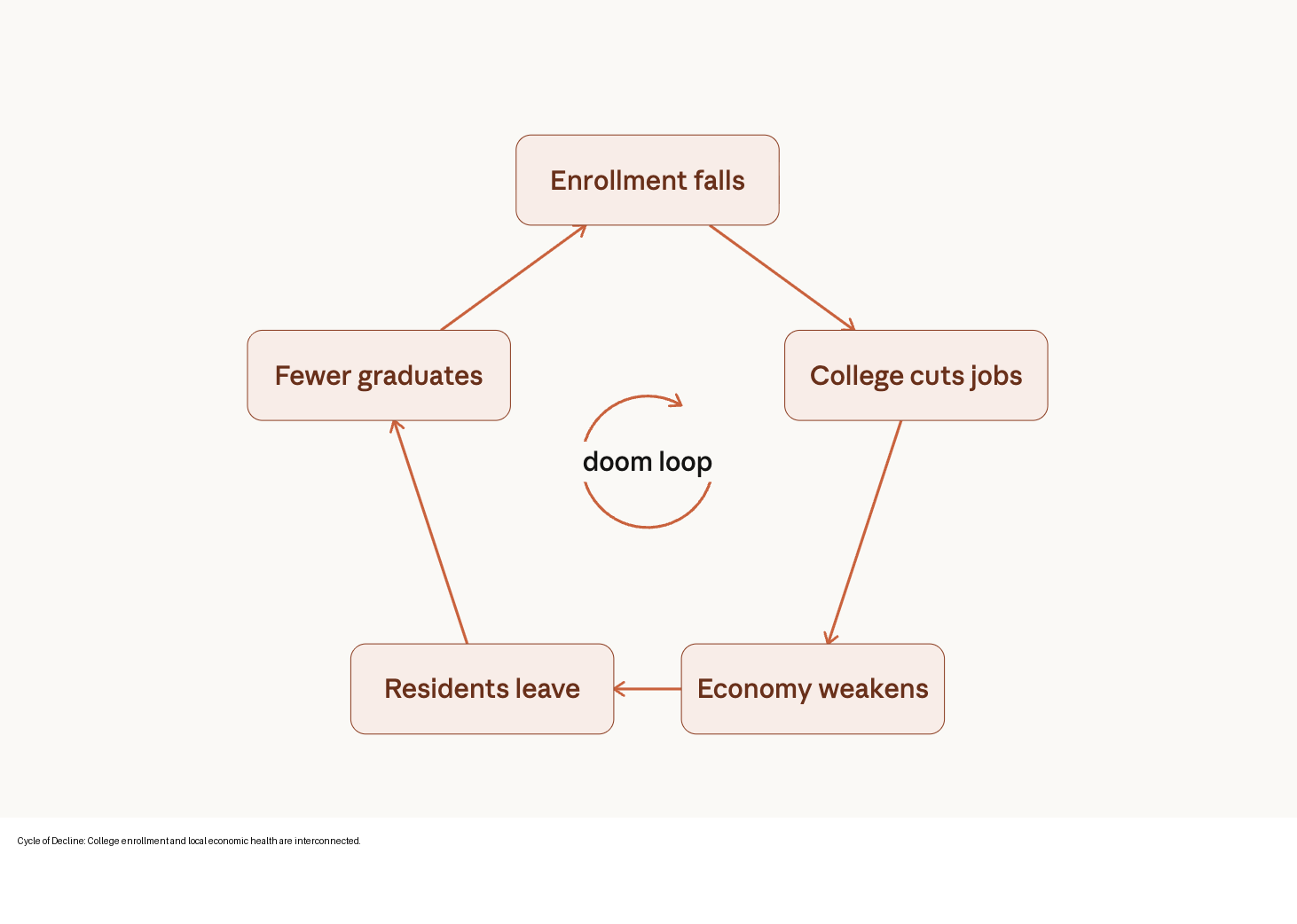
When a town loses population, the college loses a natural pipeline of students. When the college contracts, it cuts jobs and spending, which weakens the local economy. That, in turn, accelerates population decline. It becomes a cycle—and once it starts, it’s difficult to reverse.
The impact is immediate—and significant. IMPLAN models show that the average college closure results in the loss of 265 jobs, $14 million in labor income, $21 million in GDP, and $32 million in total economic output.
- $14 million in labor income
- $21 million in GDP
- $32 million in total economic output
In individual communities, the effects can be even more pronounced.
When Iowa Wesleyan University closed in 2023, Mount Pleasant, Iowa, lost about $55 million in annual revenue. In Rensselaer, Indiana, the closure of St. Joseph’s College resulted in the loss of 180-200 jobs. For a small city, that’s not a minor disruption.
It’s the equivalent of losing a major employer, except the institution that disappears is also educating students, training nurses and teachers, supporting local businesses, and contributing to the community’s civic and cultural life.
As Gallup economist Jonathan Rothwell has noted, the effects of college closures on communities may parallel what we’ve seen in regions that lost manufacturing.
I’ve seen that impact firsthand. It’s why I’ve come to believe that the way we frame this conversation—“how do we save the college?”—is fundamentally incomplete.
We’re Asking the Wrong Question
It’s understandable. College leaders are under pressure—from boards, from accrediting bodies, from bondholders, from their own faculty and staff. The instinct is to focus inward: cut programs, adjust pricing, increase discount rates, and find new enrollment markets.
But together, those actions are mostly defensive and don’t address the underlying problem. A small college trying to solve its challenges on its own is up against forces it can’t control—demographics, regional population shifts, declining birth rates, and increasing competition from larger and better-resourced institutions. That’s a difficult equation to solve in isolation.
The better question is this: What actions can the college and its town take together, starting now, to secure a sustainable future for both? It’s time to move beyond conversation and toward concrete, shared steps.
That shift may sound subtle, but it changes everything. Because once a college defines its future as tied to its community’s future, the range of possible strategies expands immediately. Instead of operating as a standalone institution, the college becomes part of a broader local system—one that includes the city, major employers, healthcare providers, and regional economic development efforts.
And with that shift comes access to new tools:
- Public-private partnerships
- State and local economic development funding
- Philanthropic investment tied to community outcomes
- Workforce development initiatives
At the same time, the community gains something just as valuable: a permanent institution with physical space, intellectual capital, and long-term credibility. Not many organizations in a small city can play that role. A college can.
This Isn’t a New Idea—But It Is a New Scale
Large urban universities have been doing this for years.
The University of Pennsylvania’s investment in West Philadelphia is one of the most cited examples.
The University of Notre Dame has played a central role in the redevelopment of South Bend.
Closer to where I live, Indiana University’s investment in Bloomington’s Trades District offers a recent example. Working alongside the City of Bloomington and The Mill co-working space, IU secured a $16 million Lilly Endowment grant that is expected to leverage more than $80 million in total investment—developing an innovation district, attracting high-wage employers, and creating the kind of town-gown partnership that keeps talent in the region. The keystone partners in that effort—IU, the city, and Cook Medical Group—look remarkably like the four-partner model this article advocates at a smaller scale.
These are well-documented, well-resourced efforts. But they’re also not easily replicable for the kinds of institutions we’re talking about here. What’s different—and where the opportunity lies—is applying that same “anchor institution” model to a much smaller scale:
We’re talking about a college of 1,000 to 3,000 students in a town of 10,000 to 75,000 people.
That’s where this conversation needs to move. If you are a college leader or community stakeholder, act now: form partnerships, seek creative investment, and build shared, collaborative strategies. The case is clear: the future of small colleges and towns depends on working in tandem.
Because that’s where the risk is highest—and where the potential impact is greatest.
The Third Crisis We’re Missing
There’s another piece of this story that isn’t getting enough attention. While small colleges are under pressure, so are rural hospitals. And in many communities, those two institutions are the largest employers and the most important anchors.
According to the Chartis Center for Rural Health’s February 2026 update, 41.2 percent of rural hospitals are currently operating with negative margins. Four hundred seventeen are considered vulnerable to closure.
Since 2010, more than 180 rural communities have lost inpatient hospital care entirely. The Medicaid funding cuts enacted in 2025 are expected to put even more pressure on these systems—with some analyses projecting that as many as 700 additional rural hospitals could face closure risk.
Even hospitals that remain open are withdrawing critical services. Between 2014 and 2023, according to the Commonwealth Fund, 424 rural hospitals stopped offering chemotherapy, forcing cancer patients to travel farther for care.
What’s important here isn’t just the numbers. It’s the overlap. In many towns:
- The college and the hospital share the same workforce pipeline
- They rely on the same donor base
- They depend on the same local and regional economic conditions
The towns face the same structural challenge: They are both place-based institutions in regions that are losing population.
Research reinforces this connection. When a rural hospital closes, the impact extends well beyond healthcare:
- Employment declines—with one study finding a 13.8 percent drop in healthcare jobs in counties experiencing closure
- Labor force participation drops—research shows an average 1.4% reduction in the total labor force
- Population loss accelerates—counties that lose their only hospital see an average decline of 1.1 percent in total population
In some cases, the economic downturn begins before the hospital closes—which suggests the closure is a symptom, not the cause. That’s a critical insight. Because it means you can’t solve the hospital’s problem by focusing only on the hospital, and you can’t solve the college’s problem by focusing only on the college.
One System, Not Three Problems
The college, the hospital, and the community are often treated as separate entities. In reality, they function as parts of the same system. When one weakens, the others feel it. When one stabilizes or grows, the benefits ripple outward.
That’s why the most promising path forward isn’t institutional independence. It’s institutional alignment.
Not loose collaboration.
Not an occasional partnership.
But a shared understanding that their futures are connected, and that acting separately is no longer a viable strategy.
Where This Is Already Working
This isn’t theoretical. There are already examples—at different scales—of institutions making this shift and seeing results.
At Colby College in Waterville, Maine, leadership deliberately aligned the college’s future with the city’s. That meant investing directly in downtown development—housing, a hotel, arts infrastructure—and measuring the results. An independent economic study covering 2019 to 2024 found that Colby supported $1.3 billion in economic activity in the greater Waterville area, while the city’s population grew by more than 9 percent—outpacing both the county (4.5 percent) and the state (3.5 percent). Forty new businesses opened downtown. The college didn’t just survive. It became central to the city’s renewal, and the Harold Alfond Foundation called the result a national model for communities working together for the greater good.
A different version of this can be seen at Gannon University in Erie, Pennsylvania. There, the university became a formal partner in the Erie Downtown Development Corporation alongside major employers and foundations, committing $2.5 million to join the governance of a downtown revitalization effort that has since raised more than $70 million. By aligning itself with regional economic priorities—particularly in life sciences and workforce development—Gannon helped drive investment and job creation while strengthening its own institutional position. Its annual economic impact on the Erie region is now estimated at $300 million.
At a smaller scale, Huntington University in Huntington, Indiana, offers a useful model.
Rather than treating community engagement as a secondary activity, Huntington has integrated it into its academic and institutional strategy. Through initiatives that connect students, faculty, and regional leaders around economic development and sustainability, the university has positioned itself as a contributor to the community’s future—not just a resident within it. In a city of roughly 17,000 people, that distinction matters: a college of 1,100 students that is visibly invested in the region’s economic future is a different kind of institution than one that simply occupies space within it.
And in Washington State, Pacific Lutheran University has taken a particularly innovative approach by building a formal three-way partnership with MultiCare Health System and Washington State University’s College of Medicine. MultiCare is committed to constructing a medical center on PLU’s campus. WSU placed medical students throughout the surrounding community, providing care to residents while living on PLU’s campus and using both institutions’ clinical facilities. The result is a small private college that is not merely training healthcare workers for jobs elsewhere—it is serving as the physical and organizational hub for healthcare delivery in its own community.
A New Model for Shared Success
Four Partners. One Shared Future.
None of the institutions we’ve talked about—Colby, Gannon, Huntington, Pacific Lutheran—moved forward by focusing only on themselves. They made a different decision, and they aligned their future with the future of the place they call home.
What’s emerging from these examples is a model that already exists in most small communities—but hasn’t yet been fully connected:
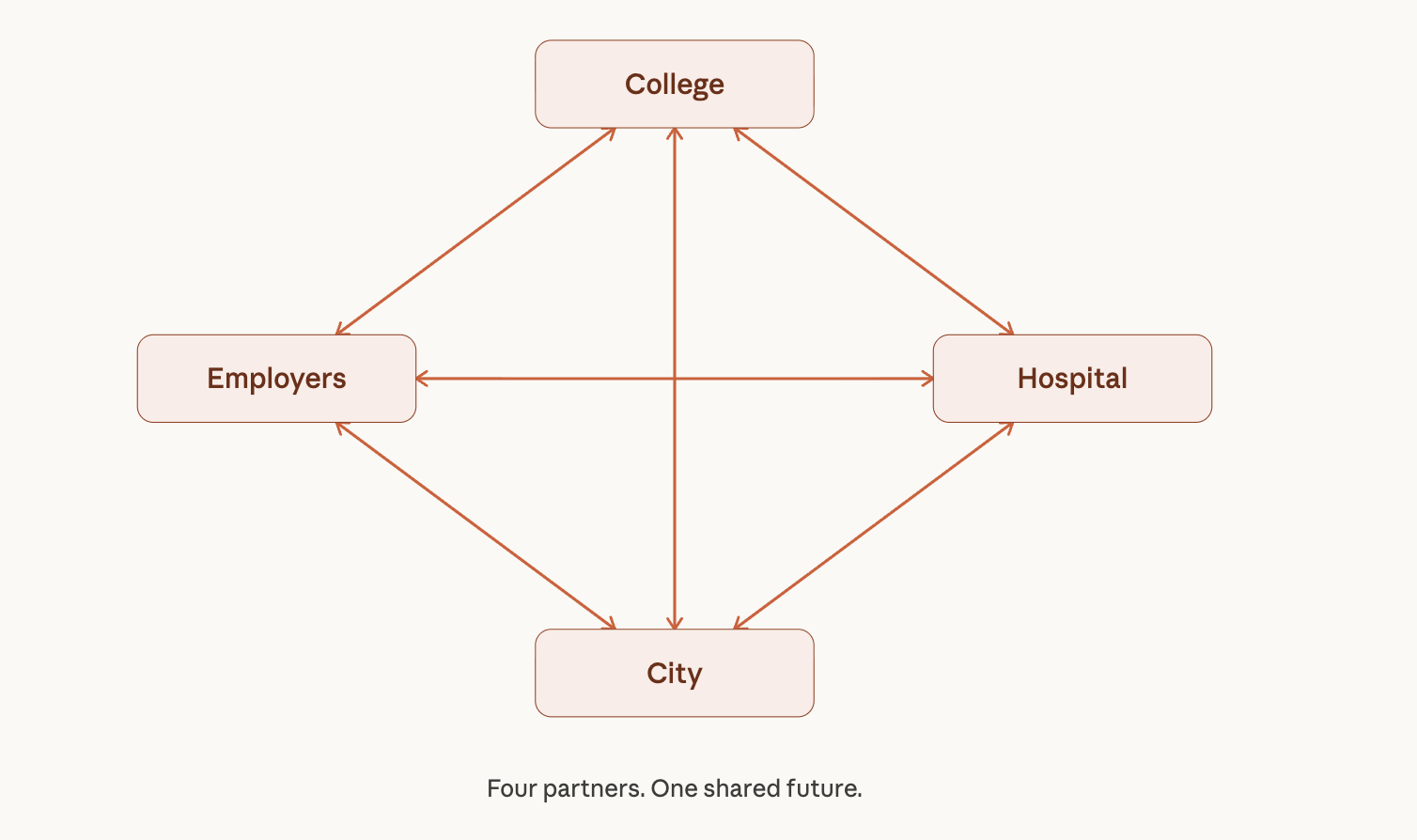
- The college
- The hospital
- The city
- A small group of key local employers
Not a loose collaboration, not a periodic meeting, but a formal, sustained partnership built around a shared reality:
If one struggles, all are affected. If one grows, all benefit.
So what does that actually look like? It starts with a few clear commitments.
A college opens underused space as a public-facing co-working hub, becoming the anchor for a remote-worker attraction strategy developed with the city and supported by state economic development funding.
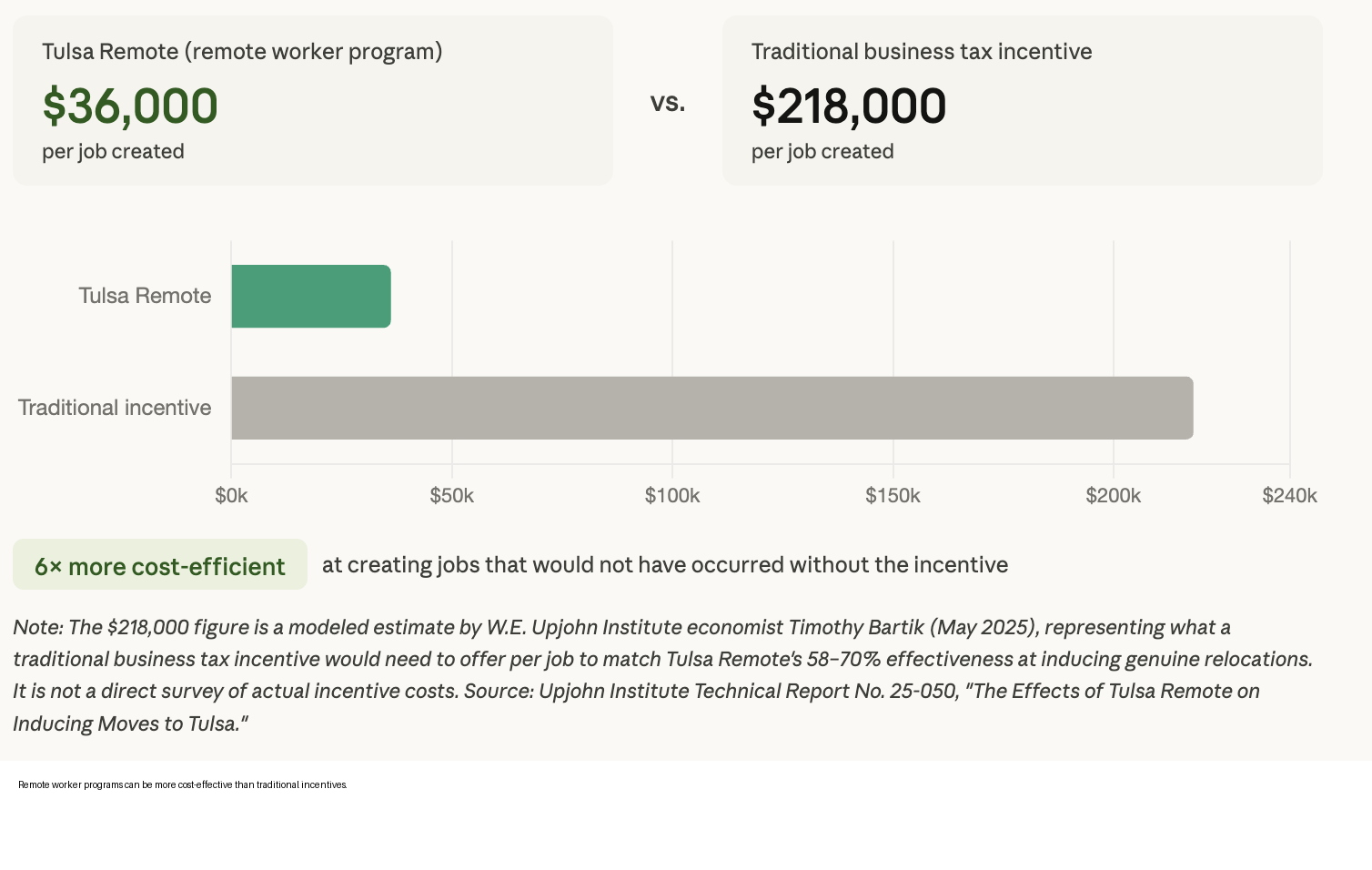
The evidence that this works is substantial. Tulsa Remote, the most rigorously studied remote worker program in the country, has grown from 70 participants in 2018 to more than 3,400 as of 2024, generating $622 million in direct employment income. An independent study by the W.E. Upjohn Institute found the program to be six times more efficient at creating jobs than a traditional business tax incentive of equivalent cost—$36,000 per job versus an estimated $218,000 for a typical business incentive. Indiana alone has 55 communities now participating in similar programs with state matching funds. The city of Noblesville spent less than $1 million to attract 250 new residents who will contribute an estimated $40 million over five years. Ninety-one percent of those residents stayed. The $218,000 figure is a modeled estimate by W.E. Upjohn Institute economist Timothy Bartik, representing what a traditional business incentive would need to offer per job to match Tulsa Remote’s effectiveness—not a direct survey of actual incentive costs.
The hospital and the college create a formal workforce pipeline—training nurses, social workers, and allied health professionals in ways that both meet community need and strengthen the hospital’s long-term viability. Local employers invest in their workforce through the college, supporting degree-completion and continuing-education programs that provide more stable, predictable revenue than traditional enrollment alone. The college reconnects with its alumni—not just as donors, but as potential residents, mentors, and participants in the life of the community.
There’s one more piece that matters: Measurement.
Every successful example we’ve seen has made a point of documenting impact—through independent economic studies, public reporting, and clear outcomes tied to community growth. That’s not just about accountability, it’s about credibility.
A college that can demonstrate it helped bring new residents into a community, supported a hospital, or contributed to local economic growth becomes very difficult to ignore—and even harder to replace.
There is also a funding argument that has not yet been made loudly enough. Government incentive programs—grants, loans, tax abatements, workforce development dollars—exist precisely to attract new employers and grow local economies. Foundations and, increasingly, impact investors are searching for exactly the kind of structured, multi-institutional partnerships described here. A coalition that can present a college, a hospital, a city, and a group of employers as a unified investment case is fundamentally different from any one of those institutions applying alone. The combined balance sheet, the shared workforce pipeline, the co-located infrastructure—these are the elements that transform a grant application from a request into a compelling opportunity.
Small college towns have genuine competitive advantages to offer incoming employers and new residents alike: an educated local workforce, a cost of living substantially lower than in urban markets, and a quality of life that larger cities increasingly struggle to provide. The question is whether communities will organize themselves to make that case collectively—or continue to let those advantages go unmarketed while competing against each other for the same shrinking pool of investment dollars.
A Choice, Not a Fate
I started the Small College America podcast series because I believe these institutions matter, not as relics of the past, but as essential parts of the communities they serve. I’ve seen what happens when they close, but I’ve also seen what’s possible when leadership makes a different choice.
When Colby College president David Greene went to his board to make the case for investing in downtown Waterville, he framed it simply: Waterville had been there for Colby when the college needed it. Now it was time for Colby to be there for Waterville.
That idea, simple as it is, captures the entire argument. Small colleges in small towns are not problems to be managed. They are not institutions waiting to be consolidated, absorbed, or quietly closed. In many cases, they are the most important assets their communities have.
The pressures facing them are real.
The demographic cliff has arrived.
Healthcare systems are under strain.
Enrollment challenges are not going away.
None of that changes on its own. But the evidence is increasingly clear. From economic modeling, from community data, and from the institutions already doing this work: The places that find a path forward will be the ones where colleges, hospitals, cities, and employers stop operating independently—and start acting as partners.
This isn’t theoretical. It’s already happening. The question now isn’t whether this model can work; it’s whether more communities will choose to act on it, while there is still time to do so.
Dean Hoke is the Executive Producer and co-host for the podcast series Small College America and Managing Partner of Edu Alliance Group, a higher education consultancy firm based in Bloomington, Indiana, and Abu Dhabi in the United Arab Emirates. He formerly served as President/CEO of the American Association of University Administrators (AAUA). Dean has worked with higher education institutions worldwide. With decades of experience in higher education leadership, consulting, and institutional strategy, he brings a wealth of knowledge on colleges’ challenges and opportunities.
Dean also serves as a Senior Fellow at the Sagamore Institute based in Indianapolis, Indiana, where he is currently researching the Economic and Social Impact of Small Colleges in Rural Communities.


