October 4, 2026, by Dean Hoke: In 1775, Daniel Boone helped open the Wilderness Road through the Cumberland Gap. Settlers followed that route into Kentucky, where Indigenous peoples had lived, traveled, and hunted for generations. The westward movement brought both new communities and dispossession. Among the newcomers’ ambitions was something that might seem improbable in a place still far from the nation’s established centers of learning: a college.
Five years later, in 1780, while the American Revolution was still being fought, Virginia’s legislature chartered Transylvania Seminary with Governor Thomas Jefferson’s support. Kentucky was still part of Virginia, the United States Constitution was seven years away, and yet here, west of the Allegheny Mountains, an institution of higher learning had been set in motion.
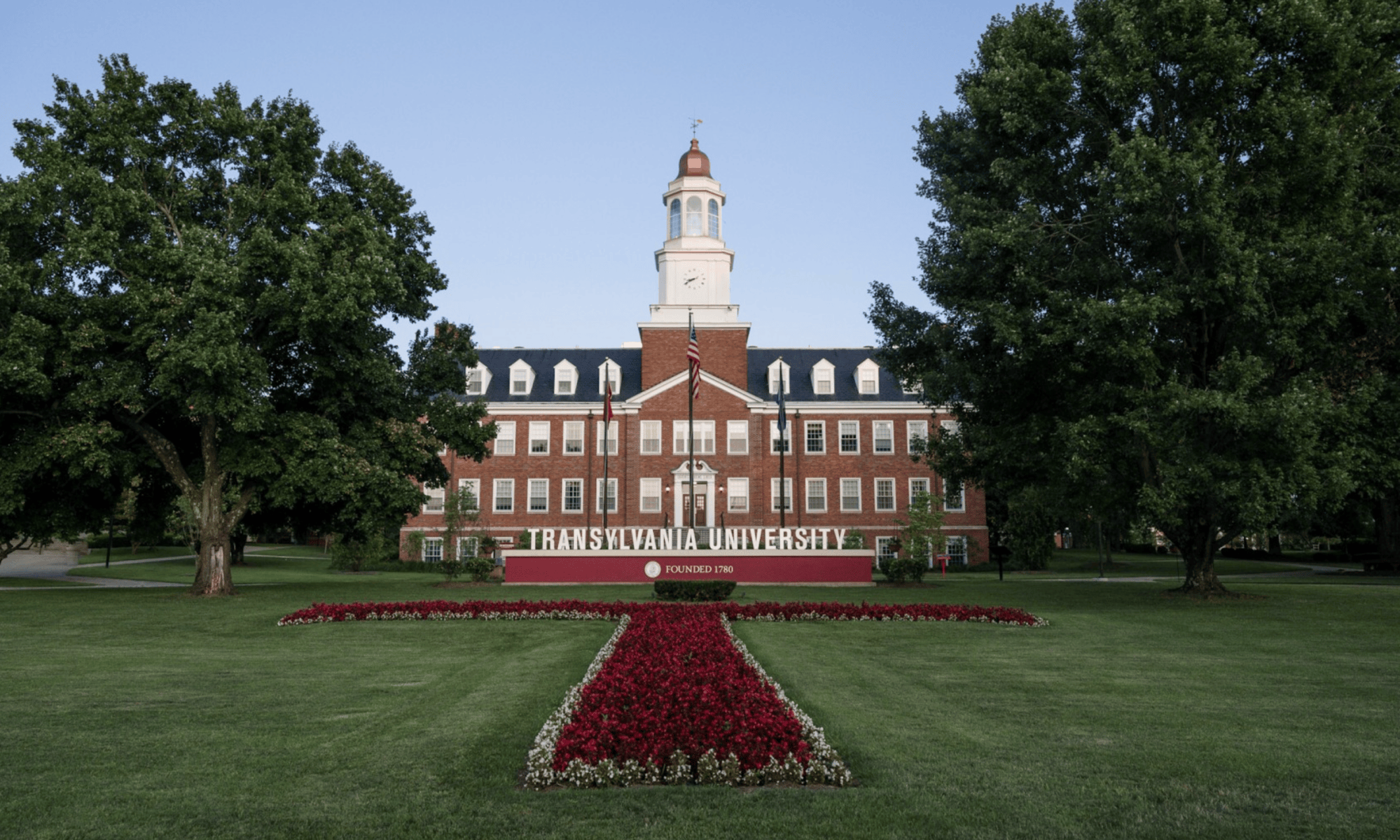
Today, Transylvania University enrolls 937 students on a downtown Lexington campus. It is among the oldest institutions of higher education in the country and one of the smallest universities to possess such a remarkable national history. That contrast makes Transylvania a particularly revealing subject for Small College America. Its past explains why the university matters historically; its teaching, students, and financial choices will determine what it means in the years ahead.
Transylvania’s History: The First College West of the Alleghenies
Classes began in 1785 near Danville in the home of Presbyterian minister David Rice. The school moved to Lexington in 1789, a settlement becoming a center of commerce and culture in the Bluegrass. In 1799, a new charter established Transylvania University. By the early nineteenth century, Lexington would be called the “Athens of the West,” and Transylvania helped give that nickname substance.
Under President Horace Holley, who arrived in 1818, the university assembled a formidable faculty and became known for its scientific instruction and professional education. Its medical and law schools trained the professionals a rapidly expanding nation needed. The medical department, which closed in 1859, educated thousands of students; institutional histories place the total at 4,385. Henry Clay taught law and served as a trustee. Transylvania was no provincial afterthought. It was a serious educational center in a region that much of the older country still regarded as frontier.
The Civil War disrupted that world. Collegiate instruction faltered, and Old Morrison, the Greek Revival landmark at the center of campus, served as a military hospital. In 1865, Transylvania merged with Kentucky University, formerly based in Harrodsburg, and used the Kentucky University name until restoring Transylvania in 1908. The complicated history of its departments also intersects with the origins of the modern University of Kentucky.
Over time, the institution abandoned the scale and professional ambitions of its nineteenth-century predecessor. What remained was a residential liberal arts university committed to undergraduate education. Transylvania’s history is not one of uninterrupted expansion; it is a history of reinvention. That pattern remains relevant as the university approaches its 250th anniversary in 2030.
Enrollment: A Kentucky University with National Ambitions
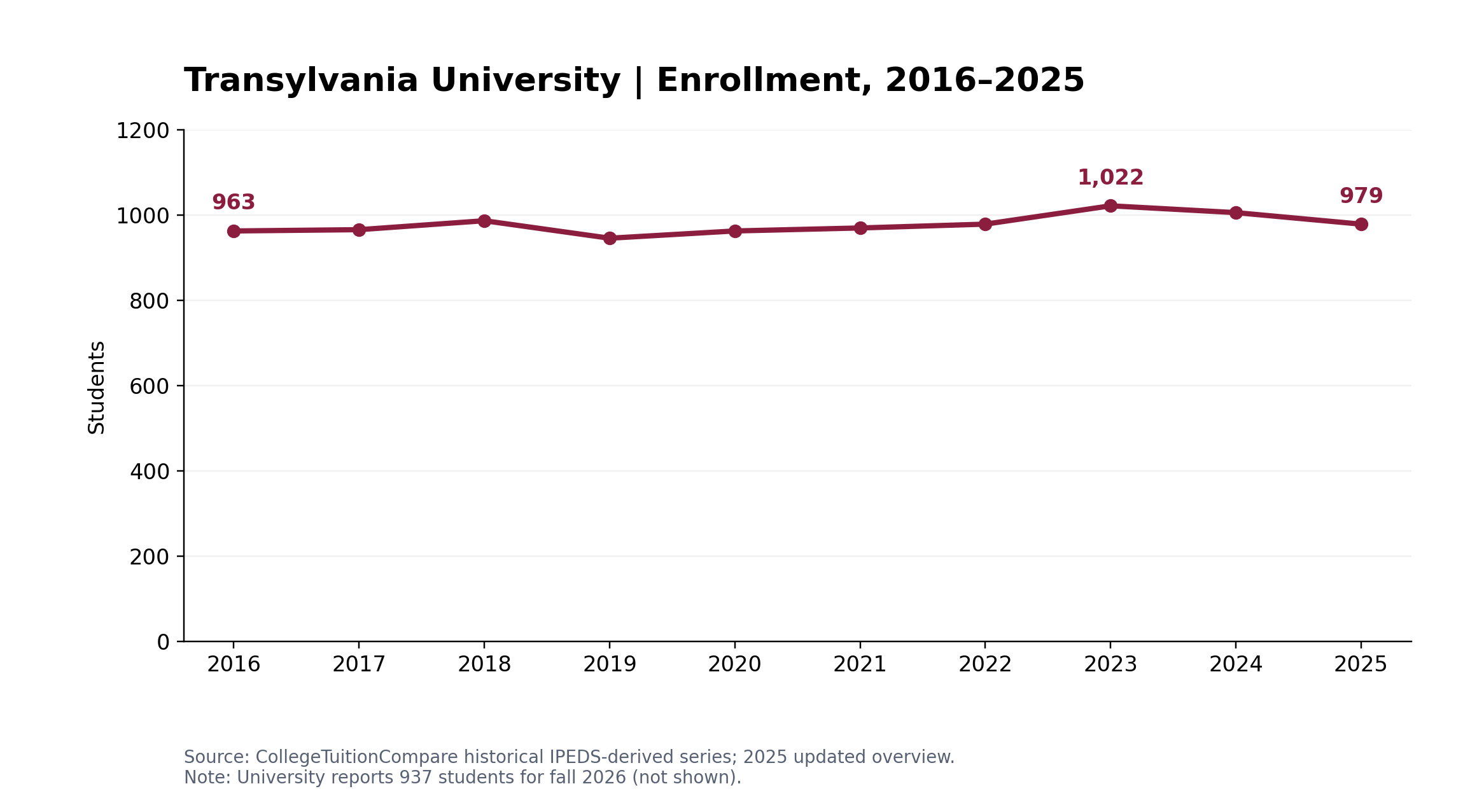
Transylvania’s enrollment tells a story of persistence rather than dramatic growth. In 1983, when Charles Shearer became president, the university enrolled approximately 655 students. Enrollment rose past 1,000 during the 1980s and reached roughly 1,150 in 2008. During the past decade, however, its student population has generally stayed close to 1,000. The historical series below shows 963 students in 2016, 1,022 in 2023, and 979 in 2025. Transylvania reports 937 students for fall 2026, a decline from the recent high.
The geography of recruitment is as revealing as the numbers. About 78 percent of students come from Kentucky; 22 percent are from other states, and international students make up less than one percent. Transylvania is a historic national institution whose contemporary student market is predominantly regional. For many Kentucky families, its appeal is precisely that it offers a small, residential private education within reach of home. But the limited geographic reach also narrows the recruiting pool at a time when competition for students is intense.
Transylvania’s strategic ambitions are larger than its current enrollment. An earlier plan envisioned 1,500 students. The Transylvania 2030 plan aims for at least 1,200 full-time students, including possible graduate enrollment. Today, the university remains principally an undergraduate institution. Its challenge is not to recover an imagined era of continuous growth, but to determine what combination of undergraduate recruitment and carefully chosen new offerings can sustain the education it wants to provide.
William T. Young: Rebuilding a University Through Scholarships
No modern benefactor shaped Transylvania more decisively than William T. Young. A Lexington entrepreneur and University of Kentucky graduate, Young built the Big Top peanut butter business that later became associated with Jif. He was also a prominent horse breeder and philanthropist. Although he never attended Transylvania, he served as a trustee beginning in the 1960s and eventually chaired its board for more than two decades.
Young believed a small college could compete for exceptional students if it offered an exceptional opportunity. In 1982—before Shearer became president—the first ten W. T. Young Scholars arrived with scholarships covering tuition, room, board, and a stipend. The program subsequently became central to the university’s recruitment strategy under Shearer. More than 800 students have benefited from it over four decades. The idea was straightforward: recruit outstanding students to a small university by removing the financial barrier for those selected on merit.
The Young legacy gained fresh importance in May 2026, when Transylvania announced the largest gift commitment in its history: $10 million from an anonymous donor. Of that amount, $9 million was committed to the Young Scholars endowment, with another $1 million available as a match dependent on gifts from former Young Scholars. The announcement tied an initiative born during the enrollment difficulties of the early 1980s directly to Transylvania’s ambitions for its next generation.
Young’s approach was not limited to scholarships. He believed attracting capable students required equally capable teachers. That conviction led to an investment that may be Transylvania’s clearest contemporary academic distinction.
The Bingham Fund: Making Undergraduate Teaching a Priority
In 1987, William T. Young joined Mary and Barry Bingham Sr. to establish a $5 million fund devoted to teaching excellence. That original commitment has become one of Transylvania’s defining academic resources. The separately governed Bingham Fund reports investing more than $30 million in teaching and faculty development since its founding. Its Form 990 reporting identifies $130.6 million in net assets as of June 2024. The fund’s central purpose is to sustain exceptional undergraduate teaching across generations.
The program is more than an annual teaching prize. It supports faculty growth, recognizes excellent instruction, and subjects teaching to review by educators from outside Transylvania. A $25 million commitment over fifteen years supports up to twelve Bingham Endowed Chairs for Teaching Excellence. Eight had been named by 2026. Each receives an additional $25,000 annually during a five-year appointment.
The range of disciplines is important. Among the chairs are biologist James Wagner, philosopher Peter Fosl, artist Kurt Gohde, historian Frank Russell, Chinese-language scholar Qian Gao, biologist Paul Duffin, political scientist Michael Cairo and psychologist Bethany Jurs. The program treats excellence in biology, the humanities, the arts and social sciences as equally central to the university’s mission. Cairo, for example, uses Socratic dialogue to challenge students to analyze international affairs rather than memorize simple answers. The selection committee’s external review gives that teaching philosophy practical institutional weight.
This is where Transylvania differs from colleges whose main academic selling point is simply small classes. Its 11-to-1 student–faculty ratio and average class size of fifteen are attractive, but not rare among selective liberal arts institutions. A dedicated teaching endowment, built over nearly forty years and used to reward and develop faculty across disciplines, is a more specific statement about institutional priorities. It does not guarantee that every class is exceptional. It does explain what Transylvania has chosen to invest in—and why.
Academics: Learning in Lexington and Beyond
Transylvania offers a broad undergraduate liberal arts curriculum, including biology, business, psychology, the humanities, and preprofessional preparation for medicine, law, and other fields. Its proximity to the University of Kentucky creates opportunities for academic pathways and professional connections without requiring Transylvania to operate a large graduate school of its own. For students considering health professions, the combination of close faculty advising and access to a major university and medical community can be valuable.
One of its most recognizable curricular features is May Term. After two conventional fourteen-week terms, students focus intensively on a single course, often taking learning into the city or farther afield. It is not Colorado College’s year-round Block Plan, but it offers a concentrated period for work that would be harder to arrange within a conventional semester.
In May 2026, accounting students visited Lexington’s local-government chambers to understand how public budgets are assembled. Students studying Kentucky history worked with archival records and helped preserve gravestones while exploring how communities remember their past. A sports facilities course took students behind the scenes of Lexington Legends Stadium and Cincinnati’s Great American Ball Park. Those experiences show the value of a university situated within a working city: government, public history, commerce and professional sports can become extensions of the classroom.
The university’s record also offers outcomes beyond anecdotes. Transylvania reports that 48.7 percent of its 2022 graduates entered graduate study within two years, following 48.3 percent for the 2021 class and 42.0 percent for the 2020 class. Its education graduates achieved a reported 100 percent Praxis pass rate in 2022, 2023, and 2024. Those results suggest meaningful preparation for further study and professional qualification, although outcomes differ by major and career path. The university also reports that 95 percent of graduates are employed or enrolled in graduate school within six months, a figure best read alongside its defined reporting methodology.
Transylvania’s downtown Lexington location broadens those opportunities. In a metropolitan area of approximately 344,000 people, hospitals, businesses, government offices, and nonprofit organizations offer settings for internships, service, and applied learning. What emerges is not a single signature major comparable to Spelman’s nationally visible STEM pipeline, but a teaching-centered model that connects a small undergraduate community to experiences beyond the classroom.
Student Success
Graduation rates offer a useful check on the promise of personal attention. Transylvania reports six-year graduation rates of 69.0 percent for the 2016 entering cohort, 70.4 percent for 2017 and 71.5 percent for 2018. It is nearing Transylvania’s own 75 percent goal. Among Pell-eligible students, six-year completion increased from 58.7 percent for the 2016 cohort to 64.2 percent for 2017 and 64.7 percent for 2018.
Four-year completion has been more challenging. The 2018, 2019, and 2020 entering cohorts posted rates of 56.6, 48.3, and 55.0 percent, all below Transylvania’s institutionally adopted 65 percent threshold. Transylvania attributes some delayed graduations to its Pioneer Plus pandemic-era program, which allowed affected students to return for a fifth year. The institution has responded with academic support initiatives, including Jumpstart, additional course-based learning support and a Pell Guarantee covering tuition and fees for eligible Kentucky students. The question now is whether those interventions produce sustained improvement.
Affordability and Access: Beyond the Published Price
For 2026–27, Transylvania lists tuition and fees of $50,640 and food and housing of $15,010, bringing direct charges to $65,650. Its estimated full cost of attendance, including books, transportation, and other expenses, approaches $70,000. That price places the university in direct competition with private colleges nationwide, even though its principal recruiting market is Kentucky.
Yet published tuition is only part of the picture. Transylvania reports that 99 percent of students receive financial aid. Merit awards such as the Young Scholars scholarships can transform the economics for selected students, while the Pell Guarantee targets eligible lower-income Kentuckians. These programs serve different purposes: one rewards exceptional achievement, while the other seeks to remove financial barriers for students with demonstrated need.
Net price, student borrowing, and graduation outcomes provide a clearer measure of access than the published price alone.
Athletics: An Important Enrollment Driver
Athletics plays a prominent role at Transylvania. The university sponsors 26 NCAA Division III intercollegiate teams, and student-athletes have represented nearly half its enrollment. At a university with fewer than 1,000 students, athletics influences recruitment, campus life, and institutional identity. The women’s basketball team brought national attention to Transylvania in 2023, completing a perfect 33–0 season with the NCAA Division III national championship, the first in university history. Athletics also attracts students who want to combine competitive sports with a liberal arts education.
Alumni: An Extraordinary Historical Reach
For an institution of its current size, Transylvania has an extraordinary alumni history. Its former students include two U.S. vice presidents, Richard Mentor Johnson and John C. Breckinridge, and two Supreme Court justices, Samuel Freeman Miller and John Marshall Harlan. Harlan’s dissent in Plessy v. Ferguson became an enduring argument against the constitutional acceptance of racial segregation. Stephen F. Austin played a central role in Anglo-American settlement in Texas; Cassius Marcellus Clay became an abolitionist and diplomat.
Those names also expose the contradictions of American history. Breckinridge later joined the Confederacy, while Harlan’s dissent challenged a legal order built on segregation. Jefferson Davis attended Transylvania before transferring to West Point and later becoming president of the Confederacy. He was not a Transylvania graduate. Henry Clay was associated with the university as a law teacher and trustee, not as an alumnus. The university’s influence extended into competing visions of the nation, not a single political or moral tradition.
More recent graduates have made their marks in business, media, and community life. Lance Tucker, class of 1991, became chief executive of Jack in the Box in 2025. Matt Jones, class of 2000, founded Kentucky Sports Radio and built a substantial audience around Kentucky athletics and public affairs. Actor and performer Ned Beatty attended Transylvania, although he did not complete a degree there. These figures illustrate a modern alumni network whose reach is different from that of nineteenth-century political leaders but remains visible in Kentucky and beyond.
The 100 Doors to Success mentoring program adds a practical, present-day dimension to the alumni story by connecting graduates with students seeking advice, professional exposure, and opportunities. For a small college, the personal accessibility of alumni may matter as much to students as the fame of a handful of names.
Financial Resources and the Question of Sustainable Scale
Transylvania has invested significantly in its campus over the past decade. Dalton-Voigt residence hall opened in 2015; Bassett and Pioneer halls followed in 2017. The William T. Young Campus Center, completed in 2021, added contemporary spaces for dining, wellness, and student activity. Those investments improve the residential experience, but they also reinforce the need to fill residence halls and support fixed operating costs with a relatively small enrollment base.
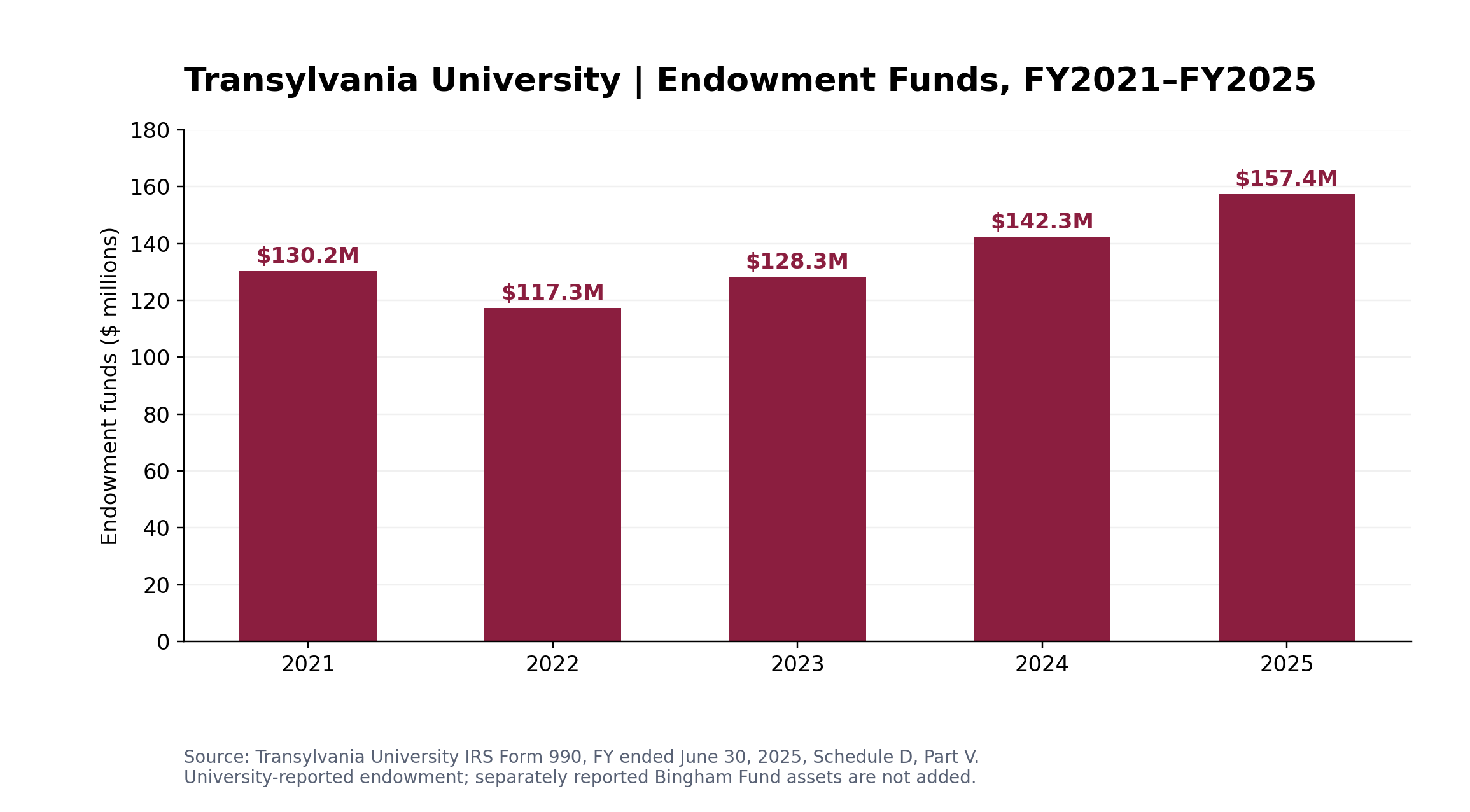
Philanthropy has helped Transylvania sustain an educational model that would be difficult to support from tuition alone. The university’s Form 990 for the year ended June 30, 2025 reports $157.4 million in endowment funds, up from $130.2 million four years earlier, despite a decline in fiscal 2022. The filing describes approximately 550 individual endowment funds supporting scholarships, academic programs, and enrichment. It also reports that just 4.4 percent of the endowment was board-designated or quasi-endowment, with the balance classified as permanent or term endowment. These resources provide long-term support but are not interchangeable with cash available for day-to-day expenses.
The Bingham Fund illustrates both Transylvania’s strength and the need to distinguish its resources carefully. It files a separate federal tax return, yet the university’s Schedule D reconciles consolidated audited financial statements by removing Bingham Fund activity from the university-only Form 990. Its assets should therefore not be added mechanically to university endowment figures. The university reported $216.8 million in net assets and $57.8 million in liabilities at June 30, 2025; these figures, like its endowment balance, describe financial position rather than an operating surplus.
Transylvania’s strategic plan calls for greater enrollment and investment resources as the university approaches its 250th anniversary. For its next president, the question is how to translate a substantial but largely purpose-restricted capital base into reliable scholarship support, strong teaching and a sustainable operating model. The university’s financial history gives it advantages many similarly sized colleges lack; enrollment and recurring tuition revenue will determine how effectively it can use them.
Transylvania 2030: The Next Leadership Test
President Brien Lewis took office in July 2020, just as the pandemic unsettled higher education. He has announced plans to depart in summer 2027, placing the university on the threshold of another leadership transition before its 250th anniversary. Board leadership includes Christopher Young, continuing a family association that has influenced Transylvania for generations.
The Transylvania 2030 strategy raises consequential questions. Can a university with 937 students reach a target of 1,200 full-time students, including potential graduate students, without weakening the personal academic experience it prizes? Can it broaden recruitment beyond Kentucky while remaining accessible to Kentucky families? And can it translate its unusually well-funded teaching commitment into student outcomes that distinguish it from other liberal arts colleges?
Those decisions will shape the next reinvention of a university that has already survived more than two centuries of change.
Beyond the Brochure: Pumpkins, a Naturalist and a Curse
Each autumn, hundreds of carved pumpkins glow on the steps of Old Morrison during PumpkinMania, a tradition launched in 2011. Families from Lexington join students and alumni in a setting where nineteenth-century architecture becomes a stage for a distinctly contemporary celebration. It is hard to imagine a more photogenic reminder that Transylvania belongs to its city.
The campus has an even stranger story. Constantine Samuel Rafinesque, a brilliant and famously quarrelsome naturalist, taught at Transylvania in the early nineteenth century. After an unhappy departure, stories circulated that he had cursed the institution. People believed his remains were brought back to Old Morrison in 1924, and questions about the bones only added to the mystery. Today the university embraces the eccentricity: its mascot, Raf, is a bat. Between a supposed curse, a naturalist’s tomb and a sea of Halloween pumpkins, Transylvania has more than enough material for an unforgettable campus tour.
Why Is Transylvania University Important?
Transylvania challenges the familiar geography of American higher education. A college emerged west of the Alleghenies before Kentucky became a state and before the United States adopted its Constitution. It educated physicians, lawyers, and political figures whose influence extended across a growing and divided nation. That history alone makes it worthy of attention.
But the more important question for small-college leaders is what Transylvania represents today. William T. Young and the Bingham family helped make undergraduate teaching an enduring philanthropic priority. The Bingham Fund, faculty chairs, and hands-on learning opportunities show how an institution can invest deliberately in the educational experience it wants to be known for. The university also illustrates the limitations of relying on reputation alone: respectable graduation rates coexist with gaps in completion, and generous philanthropic resources coexist with enrollment ambitions not yet realized.
The lesson is not that every small college needs a fund as large as Bingham’s, or a history stretching back to the Revolution. It is that an institution’s distinctive promise must be more than a slogan. It must be visible in faculty work, student opportunities, measurable results, and decisions about the future. Nearly 250 years after its founders imagined a college beyond the mountains, Transylvania faces another frontier: demonstrating why its intimate version of higher education remains compelling for the next generation.
Dean Hoke is Executive Producer and co-host of Small College America and Managing Partner of Edu Alliance Group, a higher education consulting firm based in Bloomington, Indiana, and Abu Dhabi, United Arab Emirates. He formerly served as President/CEO of the American Association of University Administrators (AAUA) and has worked with colleges and universities in the United States and internationally throughout his career.
Dean is also a Senior Fellow at the Sagamore Institute in Indianapolis, where his research focuses on the economic and social impact of small colleges in rural communities. He is a co-author, with Chet Haskell and Barry Ryan, of the forthcoming book Small Colleges at the Crossroads: Strategic Paths to Growth, Partnership, Merger, or Responsible Closure, scheduled for publication in Fall 2026.