
November 15, 2026, by Dean Hoke – In 1833, Michigan was still four years away from statehood. According to Kalamazoo College’s official history, Thomas Merrill, a young Baptist minister, had arrived in Michigan in 1829 with just seven dollars and a plan to establish a college. With the assistance of Judge Caleb Eldred, that ambition led to the founding of the Michigan and Huron Institute in 1833.
The institution adopted the name Kalamazoo College in 1855. Originally affiliated with the Baptist Church, it later became an independent, nonsectarian liberal arts college.
Women attended Kalamazoo during its early years, although initially in a separate department. By 1870, they were earning the same degrees as men. Lucinda Hinsdale Stone, who arrived in 1843 with her husband, James A. B. Stone, became a leading advocate for women’s education. Ella Osborn Adams, Class of 1871, successfully challenged the college’s practice of holding separate commencement ceremonies for men and women.
Today, Kalamazoo College, commonly known as “K,” is a private liberal arts college in southwestern Michigan. Students pursue a traditional liberal arts education while also studying abroad, gaining practical experience, and conducting independent research.
The K-Plan: A New Approach to Liberal Arts Education
In 1962, during Weimer Hicks’s presidency, Kalamazoo College introduced the K-Plan. It combined traditional liberal arts study with opportunities to study abroad, gain practical experience, and conduct independent research. The program drew national attention. According to the Kalamazoo Public Library, students returning from overseas study appeared on Walter Cronkite’s CBS television program Calendar to discuss their experiences.
The K-Plan has helped distinguish Kalamazoo from other liberal arts colleges for more than six decades. It also requires a substantial institutional commitment to international programs, faculty involvement, and individualized student experiences. With enrollment below its level of a decade ago, maintaining that commitment while keeping the college affordable is an important consideration for its future.
The K-Plan has changed over the years, but its basic elements remain. Kalamazoo offers more than 50 study-abroad programs in over 25 countries, with a majority of students participating. Depending on the program, students may attend overseas universities, live with host families, complete internships, or conduct field research. Many spend a term or longer abroad.
Kalamazoo applies institutional financial aid to approved study-abroad programs and provides additional assistance for certain expenses. This helps make international study possible for students who might otherwise find it financially difficult, although travel and other costs vary by program.
Another part of the K-Plan is the Senior Integrated Project (SIP). Students may undertake laboratory research, investigate a historical subject, develop an artistic performance, or work with an outside organization. Faculty members supervise the projects, giving students an opportunity to explore a subject in greater depth than they might in a regular course.
Campus Traditions and the Chapel Bells
Kalamazoo has several longstanding campus traditions. The Day of Gracious Living, established in 1974, arrives without advance notice on a spring day. Classes are canceled, chapel bells ring, and students can travel by bus to South Haven on Lake Michigan. Student representatives select the date and share it with only a few administrators. In 1980, after a tornado struck Kalamazoo, students spent the day helping clean up damaged neighborhoods.
Monte Carlo Night, first held in 1975, is another tradition. Students dress up for an evening of casino-style games in the Hicks Student Center, with faculty members, staff, and sometimes the president serving as dealers. The event began after the college discontinued its former men’s and women’s societies in 1971.
One of Kalamazoo’s more unusual traditions began with mathematics professor T. Jefferson Smith. He became interested in English change ringing, in which groups of bell ringers follow mathematical sequences rather than play conventional melodies. Smith incorporated the practice into his teaching, founded the Kalamazoo College Guild of Change Ringers in 1977, and helped arrange for bells to be installed in Stetson Chapel.
Eight bells, cast at the Whitechapel Bell Foundry in London, were installed in 1984. Smith and his students learned to ring them, and over time the group expanded to include alumni and members of the Kalamazoo community. Each bell carries the college motto, Lux Esto, meaning “be light.” Stetson Chapel has the only English change-ringing tower in Michigan and is one of relatively few in North America.
The tradition continues today. Students can learn change ringing through a physical education course that involves timing, coordination, and an understanding of mathematical patterns. The bells mark college occasions and can also be heard throughout the surrounding neighborhood. It is a lasting contribution from a professor whose interests extended well beyond mathematics.
What Students Study
Kalamazoo offers approximately 30 majors across the humanities, sciences, social sciences, and interdisciplinary fields. In 2024, psychology was the most frequently completed major, with 51 bachelor’s degrees, followed by business (45), biology (40), Spanish (31), and English (29). Other popular majors included biochemistry, computer science, history, chemistry, and economics.
The college reports a student-faculty ratio of approximately 10 to 1. Undergraduates have opportunities to participate in faculty-guided research and creative work, including through the SIP. The small scale of the institution allows students to work directly with professors rather than primarily with graduate assistants.
Faculty research is another part of the undergraduate experience. During summer 2025, five chemistry and biochemistry faculty members worked with approximately 25 students in their laboratories. Many students received stipends for full-time research, and some projects contributed to Senior Integrated Projects or resulted in conference presentations.
Dani Arias-Rotondo, Associate Professor of Chemistry, studies molecules that can convert light into electricity and has received support from the American Chemical Society Petroleum Research Fund. Dwight Williams, Associate Professor of Chemistry, specializes in medicinal and synthetic organic chemistry. Both work with undergraduate researchers.
A 2022 National Science Foundation analysis covering 2010 through 2020 ranked Kalamazoo College 34th nationally for the proportion of graduates who subsequently earned research doctorates in science and engineering. The ranking measures alumni who completed doctorates during that period, rather than the percentage of each graduating class immediately entering graduate school.
Kalamazoo College has earned recognition in several national college rankings. In the 2027 U.S. News & World Report rankings, it placed 74th among National Liberal Arts Colleges, second among Michigan institutions in that category, and third nationally for study abroad. Forbes ranked Kalamazoo as Michigan’s highest-ranked private college and 48th nationally among small colleges.
Theater and the Arts
Kalamazoo’s theater program dates back several decades. Nelda K. Balch arrived in 1954 and helped develop the program. In 1964, she founded Festival Playhouse, bringing students and professional theater artists together in productions.
Steven Yeun, Class of 2005, majored in psychology and participated in campus improvisational theater before appearing in The Walking Dead, Minari, and Beef. Jordan Klepper, Class of 2001, also participated in student improvisation before establishing his career as a comedian and political satirist on The Daily Show. Both were involved with the student improv group Monkapult.
Other graduates in the arts include playwright Lisa Kron, actor Quincy Isaiah, visual artist Julie Mehretu, and writer Teju Cole. Kalamazoo’s theater productions and improvisational groups have also attracted students majoring in fields outside the arts.
Alumni in Other Fields
Kalamazoo has more than 20,000 alumni. Diane Seuss, Class of 1978, received the 2022 Pulitzer Prize for Poetry. Larry Bell, Class of 1980, founded Bell’s Brewery and became an important figure in American craft brewing. Myra Selby, Class of 1977, became the first woman and first African American to serve on the Indiana Supreme Court.
Bell has maintained ties with the college. The Larry J. Bell ’80 Environmental Stewardship Center, established in 2019, supports environmental research, student projects, and community activities. It includes the Lillian Anderson Arboretum, a 140-acre natural area west of campus. Anderson, a 1926 graduate, donated land from her family farm in 1982. The arboretum now offers trails, fieldwork opportunities, and public access.
What Happens After Graduation?
Kalamazoo’s first-destination report for the Class of 2025 identified outcomes for 294 of 339 graduates, an 87 percent knowledge rate. Of those whose destinations were known, approximately 67 percent were employed, and 29 percent were continuing their education within six months. The college reported positive outcomes for 96 percent of this group.
In a separate career mobility study conducted with Lightcast and reported in 2026, more than 2,170 alumni responded to a survey. Among respondents from the classes of 2014 through 2019, 86 percent described their work as meaningful, 85 percent reported career satisfaction, and 84 percent said they used skills developed at Kalamazoo. These findings represent survey respondents rather than the entire alumni population.
Athletics and a Tennis Record
Approximately one-third of Kalamazoo students participate in intercollegiate athletics. The college competes in NCAA Division III as a member of the Michigan Intercollegiate Athletic Association (MIAA), founded in 1888 and recognized as the nation’s oldest collegiate athletic conference. Kalamazoo sponsors 22 varsity sports.
Men’s tennis has an extraordinary history at Kalamazoo. Between 1936 and 2012, the Hornets won or shared 74 consecutive MIAA championships, a streak the college describes as the longest known conference-title streak in any sport at any level. Kalamazoo also captured seven NCAA Division III national championships, including three consecutive titles from 1991 through 1993.
George Acker coached the Hornets from 1959 through 1993 and oversaw all seven national championships. Stowe Stadium has hosted major collegiate tennis competitions for decades.
Enrollment and the Student Body
Kalamazoo’s undergraduate enrollment has declined over the past decade. According to federal IPEDS figures, the college enrolled 1,166 students in fall 2024, compared with 1,443 in fall 2015, a decrease of approximately 19 percent. Enrollment fluctuated during those years, including an increase in 2020, but the overall trend has been downward.
Kalamazoo is not alone in experiencing enrollment declines, but its reduction has been greater than that of most institutions it identifies as peers. Among the 11 colleges in its 2024–25 IPEDS comparison group, eight experienced enrollment declines between 2015 and 2024. Allegheny and Earlham recorded larger percentage losses than Kalamazoo, while institutions such as Denison and Hope maintained or increased enrollment. The comparison suggests that although enrollment pressures are widespread, Kalamazoo’s decline has been more pronounced than that of most of its selected peers.
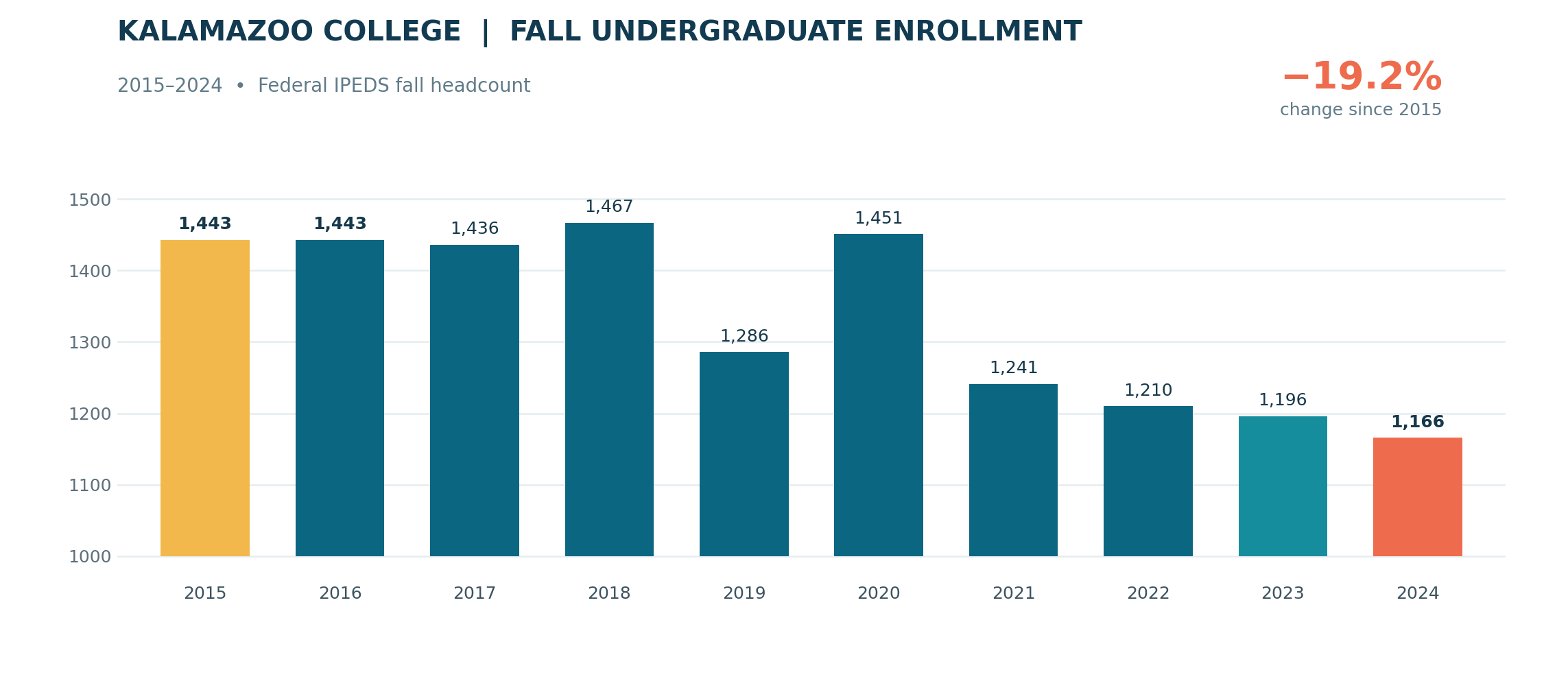
Figure 1. Fall undergraduate enrollment, 2015–2024 (IPEDS fall undergraduate headcount; annual series cross-checked with published enrollment data).
Kalamazoo is predominantly residential, with 64 percent of students living on campus. Federal enrollment data for fall 2024 indicate that approximately 99 percent attended full-time, with women accounting for 55 percent of enrollment and men 45 percent. Approximately 61 percent were White, 17 percent Hispanic or Latino, and 6 percent Black. The college reports that about one-quarter of its students are first-generation college students and 32 percent are eligible for federal Pell Grants.
Approximately two-thirds of students come from Michigan. The international student population is comparatively small, around 4 to 5 percent, even though international study is one of the college’s defining programs. Kalamazoo’s reputation for global education rests chiefly on the opportunities it provides students to study abroad, not on a large international enrollment.
The college has also invested in residential facilities, announcing two new residence halls with a combined 218 beds planned for fall 2027. Student housing, academic programs, and financial aid all influence the experience offered to prospective students.
Retention, Graduation and Student Success
Federal IPEDS data report that about 85 percent of first-time, full-time students returned for their second year in fall 2024. Kalamazoo’s Student Right-to-Know report shows that 74.4 percent of students entering in fall 2019 graduated within six years, compared with 76.2 percent of the 2018 entering class and 80.6 percent of the 2017 class.
Town and Gown
Kalamazoo College has longstanding ties with the surrounding community. The Mary Jane Underwood Stryker Center for Civic Engagement, established in 2001, works with public schools, local government, neighborhood organizations, and nonprofits. According to the college’s academic catalog, about two-thirds of students participate in community-based activities. Approximately 100 students work at community sites each week, and the center maintains relationships with about 45 community partners.
Students tutor children, assist with food access and immigrant services, and participate in local government projects. Some activities are part of academic courses, while others involve paid positions or summer internships. In May 2026, students Carter Haley and Gloria Jackson helped organize a Family Science Night through the Community Advocates for Parents and Students program. Local children visited campus for science activities with student volunteers.
The Arcus Center for Social Justice Leadership is another connection between the college and the community. It hosts programs involving students, faculty, and local residents on civic participation, human rights, and social change. Designed by Studio Gang, the center’s distinctive Y-shaped building has a wood exterior and provides meeting and learning space for campus and community groups.
Finances and Affordability
Kalamazoo’s audited financial statements for the fiscal year ended June 30, 2025, reported operating revenue and support of $76.7 million and operating expenses of $71.5 million, leaving a surplus of about $5.2 million. In FY2024, operating revenue and support totaled $100.3 million against $69.6 million in expenses. The difference largely reflects the much higher level of gifts and grants received that year.
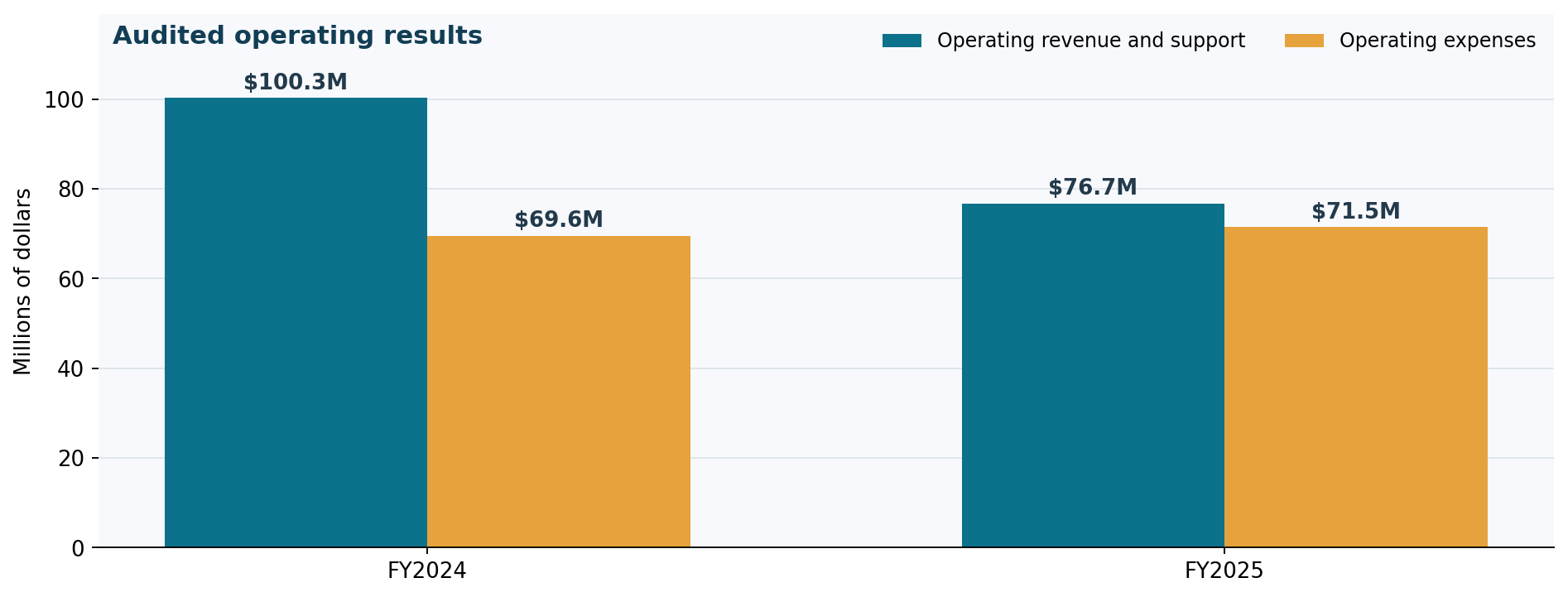
Figure 2. Audited operating revenue and support versus operating expenses, fiscal years ended June 30, 2024 and 2025.
Net tuition and fees generated $21.6 million in FY2025, auxiliary enterprises contributed $9.1 million, and endowment distributions provided $21.9 million. Gifts and grants of financial assets totaled $16.2 million, compared with $39.5 million the previous year. Philanthropy and investment income are important sources of support alongside student tuition.
At June 30, 2025, Kalamazoo reported total assets of $509.5 million and net assets of $407.9 million. Borrowing also increased during the year, including a bond issue for facilities investment. Although the college has substantial investment resources, restrictions and spending policies limit the amount available for annual operations.
For families considering Kalamazoo, the published cost of attendance tells only part of the story. Federal College Scorecard data for 2022–23 show an average net price after grants of approximately $19,100. Students from families earning $30,000 or less paid an average of about $12,000, compared with $28,700 for those from households earning more than $110,000. These figures represent historical averages rather than current costs for individual students.
Affordability also affects participation in the K-Plan. Kalamazoo allows students to apply institutional financial aid to approved study-abroad programs, helping reduce the additional expense of international education. Even with this assistance, the cost of attending remains an important consideration for prospective students and their families.
President Crowley’s Vision
Dr. Karlyn Crowley became Kalamazoo College’s nineteenth president on July 1, 2026, succeeding Jorge Gonzalez. She previously served as provost at Ohio Wesleyan University, where her responsibilities included academic programs, student success, and institutional partnerships.
Speaking to business, civic, and educational leaders in October 2026, Crowley said, “We are a small college, but we can think big.” She has discussed strengthening the college’s relationships with Kalamazoo and the surrounding region, including possible transfer pathways from Kalamazoo Valley Community College.
Crowley has also raised questions about college affordability, preparing students for careers affected by artificial intelligence, and helping graduates find meaningful employment. On the college’s presidential website, she describes her leadership philosophy in four words: “Truth. Hope. Innovation. Joy.”
Kalamazoo’s current strategic plan extends through 2029. As Crowley begins her presidency, she is looking to strengthen partnerships with employers and civic organizations while maintaining the college’s liberal arts mission. How these priorities translate into new programs and partnerships will become clearer over the next several years.
Looking Ahead
Nearly two centuries after its founding, Kalamazoo College remains committed to an educational approach that extends well beyond the traditional classroom. The K-Plan, introduced more than 60 years ago, continues to shape the undergraduate experience through international study, practical experience, and independent research.
Kalamazoo has substantial financial resources, but its enrollment is nearly 20 percent smaller than a decade ago. Crowley begins her presidency with an opportunity to build on the college’s academic reputation while addressing affordability, career preparation, and stronger community partnerships. Kalamazoo faces the question of how to preserve the opportunities that distinguish the K-Plan while making them accessible to future generations of students. How the college addresses that challenge will help define its direction as it approaches its 200th anniversary in 2033.
About This Series
This profile is part of Small College America, an ongoing series of independently researched articles examining the history, distinctive characteristics, academic strengths, financial condition, and future prospects of private nonprofit colleges across the United States. The series is intended to inform college leaders, trustees, alumni, and others interested in the challenges and opportunities facing small colleges.
Dean Hoke is co-founder and managing partner of Edu Alliance Group, a senior fellow at the Sagamore Institute, and executive producer and co-host of Small College America. Hoke is also co-author of the upcoming book Small Colleges at the Crossroads: Strategic Paths to Growth, Partnership, Merger, or Responsible Closure.
Selected Sources
Kalamazoo Public Library, “Kalamazoo College” (K-Plan and Walter Cronkite): https://www.kpl.gov/local-history/kalamazoo-history/education/kalamazoo-college/
Kalamazoo College, History and Traditions: https://www.kzoo.edu/about/history/
Kalamazoo Athletics, Men’s Tennis Streak: https://hornets.kzoo.edu/sports/2024/6/20/streak-tennis.aspx
Kalamazoo Athletics, MIAA Tennis Championship History: https://hornets.kzoo.edu/sports/2024/7/29/sports-mten-miaa-team-championship-history.aspx
Kalamazoo College, “Change Ringing Still as Sound as a Chapel Bell”: https://www.kzoo.edu/news/change-ringing-chapel-bells/
Kalamazoo College, Academic Catalog, Experiential Programs: https://www.kzoo.edu/catalog/curriculum/experiential-programs/
Kalamazoo College, Community Engagement: https://www.kzoo.edu/student-life/belonging-at-k/community-engagement-and-activism/
Kalamazoo College, 2025 Summer Research: https://www.kzoo.edu/news/2025-summer-research/
Kalamazoo College, Environmental Stewardship Center: https://envirostewardship.kzoo.edu/
Kalamazoo College, “Science Night”: https://www.kzoo.edu/news/science-night-civic-engagement/
Kalamazoo College FY2025 audited financial statements, supplied for earlier drafts.
U.S. Department of Education, IPEDS Data Feedback Report, 2025: https://nces.ed.gov/ipeds/dfr/2025/ReportHTML.aspx?unitId=170532
Peer enrollment comparison: 2024–25 IPEDS peer-selection group for Kalamazoo College (as presented by The Chronicle of Higher Education); fall 2015 and fall 2024 undergraduate enrollment histories, federal enrollment data compiled by College Tuition Compare. Peer comparison figures are rounded.
Kalamazoo College, Student Right to Know: https://registrar.kzoo.edu/academic-planning/graduation/student-right-to-know/
Federal College Scorecard, net price and outcomes (2022–23): https://www.collegedata.fyi/schools/kalamazoo-college
National Science Foundation, Survey of Earned Doctorates (2022): https://ncses.nsf.gov/pubs/nsf22321/table/6
Kalamazoo College, 2027 national rankings announcements (U.S. News & World Report and Forbes).
Kalamazoo College, Office of the President: https://www.kzoo.edu/president/

