By Dean Hoke July 16, 2019 – I have worked in the field of higher education and non-profit administration for over 45 years. In my various capacities, I have had the privilege to work directly with hundreds of higher education leaders in the United States and the Middle East as well as becoming friends with many. Many people who do not work in the field perceive it’s a cushy prestigious job which is not nearly as challenging as working in a corporation. Many years ago, this may have been true. Being a leader of a university, college or an entire system has always been difficult and comes with real pressure, but during the past few years, I see a new level of urgency and complexity exist that I had not seen before. I wanted to explore the question further.
In 2018 my Edu Alliance partners and I identified a series of operational topics to address and asked experts in the field to write an article and give their views. We titled the series “Things That keep Higher Education Leaders Awake at Night.”
This year the American University of University Administrators Leadership Summit invited us to speak on this topic, and we decided to take an additional step to understand the mindset of higher education leaders. My US partner Tom Davisson (who has worked in higher education for forty plus years) and I directly contacted one hundred higher education leaders across the country of which forty two responded from twenty states. We asked if they would answer in their own words one question; “What Keeps You Awake at Night”? It was made it clear to everyone we contacted they would not be identified, and we wanted their frank opinions.
What follows are the ten areas that we developed for our presentation and I am letting the survey respondents speak for themselves.
Position of the Respondents
- President/CEO/Chancellor 72%
- Provost/Senior Vice President 10%
- Dean/Divisional Leader 18%
Type of Organization
- Public 36%
- Private 62%
- Consortium 2%
Student Enrollment of their Institution
- 0-999 6%
- 1,000-2,499 25%
- 2,500-9,999 41%
- 10,000-24,999 17%
- 25,000 and above 11%
The Results
#1 – Declining image and perceived value of higher education 45%
 “’The impact of identity and social politics in institutional mission: Identity politics, especially sexual identity and racial/cultural identity, are creating a chilling effect on campus and legislatures are now taking up this issue. Eventually, no state money will be awarded to institutions or students who want to attend those institutions if those institutions do not adhere to the prevailing norms.” – President Private University
“The anti-immigration sentiment in the country and the wish, on our government’s part, to reduce the flow of international students to this country is a major problem for all universities as it is leading to significantly lower international enrollments. These STEM students are necessary for the innovation agenda of the country to be successful. Many are graduate students who in only a few years can be part of growing our economy rather than growing another country’s economy.” – President Private University
“Declining in civility, a decreased desire to collaborate, and inequities in our society, which often translate on to our campuses. We need to be the place where all people are welcome, all may be educated and given the opportunity to have a meaningful life. We must advocate for this and for the reinstatement of the social contract for the benefit of our country.” – President Private College
#2 – Competition for students 40%
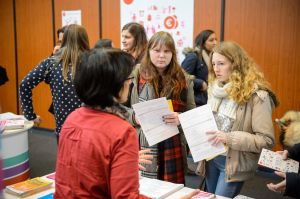 “That is pretty easy. What is happening in higher education and how private independent universities, like mine, are feeling the tremendous competition.” – President Private University
“Enrollment issues and competition with other state and private schools. Enrollment means state funding and we must compete with two Research 1 schools in the state for the same funding dollars.” – President State University
“Battle to maintain & increase enrollment. But the Key issue for me as a first time President has been the unwillingness of some older tenured faculty to adapt to the current world and marketplace we live in.” – President Private University
#3 – Student Welfare and Safety 36%
 “What keeps me up at night is the safety of our students, faculty, staff and visitors on our campuses and over multiple locations. We have had 5 instances over the last 12 months where shootings and/or other gun-related crimes took place adjacent to…one in our parking lot…our campuses.” “We want to be highly accessible and located close to our students, yet safe to all who come within. This creates a bit of a paradox regarding safety.” – President Public Community College
“I lose some sleep over student behaviors that are risky for themselves, for others, and for the college. Many such concerns stem from irresponsible use of alcohol, especially by members of Greek organizations.” – President Private University
“A student harming themselves or someone else coming onto the campus and assaulting a student or an employee.” – President Public University
#4 – Funding and Student Affordability 36%
 “What is happening in higher education and how private independent universities, like mine, are feeling the tremendous competition and how to make sure we are financially sustainable.” – President Private University
“Concerns about the state budget, of course. I’m sleeping better this year than I did during the years of the budget impasse when public universities were entirely deprived of regular funding. But even this year, as we recover from the budget nightmare and gain momentum, state appropriations are a big worry.” – President State University
“Declining tuition revenue from the federal government and states that is putting a burden on student debt. College should not be free, but it should not be so expensive. The Pell Program works great and should be increased so that it covers tuition at average state university but is given to the student so they can take it with them. If we doubled the Pell Grant, we would go a long way in helping the neediest students achieve a college education with less debt.” President Private College
#5 – The Pressure of the Job 36%
 “My institution has been in financial difficulty for the past few years and about 6 -12 months ago declared this publicly. We attempted to find a path to survive as an independent unit but determine that was not feasible. We are about to announce a merger/acquisition.” – Anonymous
“Being a college president SUCKS!” – Vice President Private University
“What keeps me up at night: Creeping complacency about compliance. Low expectations from our business community. Shifting performance standards as a function of state higher education politics. What can be done to get a good night’s sleep: I have tried everything. Given up on that goal.” – President State University
#6 – Accreditation and Regulatory Agencies 29%
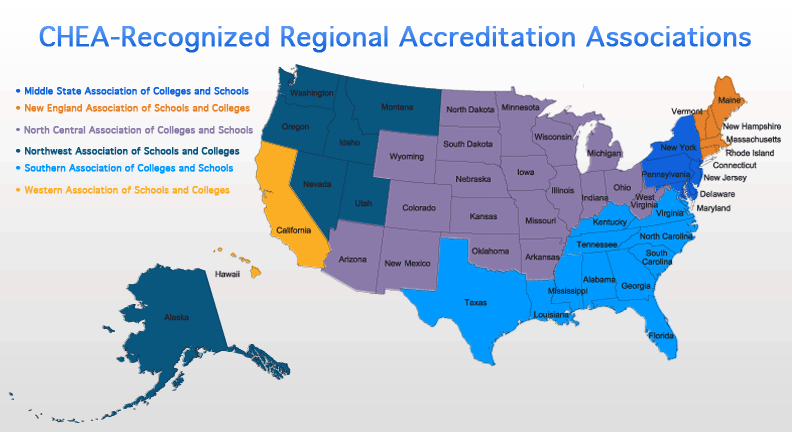
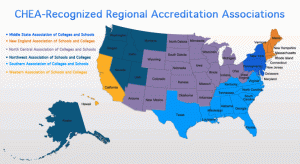 “SACSCOC – very old school, very rigid, very slow. I have an entrepreneurial model for dramatically expanding and SACSCOC is not supportive and indeed appears to be working at cross purposes . . . and I have worked with other regional accreditation agencies where this was not the case.” – President Private University
“The inability to react quickly and get permission from regional accreditors to implement new degrees and programs industry wants.” – President Public University
“I worry about the “broken business model” of higher education and the legal provisions that prevent us from collectively fixing it.” President Private University
#7 – Retention 24%
 ” We have good tuition and fee scholarship programs here, but many of our students really struggle with meeting other day to day needs.” Provost State University
“Over the years that I have been an administrator the issues that have kept me awake have generally focused on the issue of resources. So we have what we need in personnel, technology, supportive resources for students to deliver a balanced education that makes them both marketable as well as knowledgeable and engaged citizens. More recently, how do we convince many of our families and students that this is the most viable approach to education.” – Dean – Retired State University
“I recently asked the community in University Senate which represents everyone to recommend to me improvements in communications that they would see as useful. I am also doing my own small group focus groups to get to know people better. Things are better but it can’t improve quickly enough.” – President Private University
#8 – Communications and Social Media 14%
 “For me, the fitful nights come when I’m not sure I have all the facts. Are my people telling me what I need to know or what they think I want to hear?” – President Public University
“Social Media Stupidity…something goes viral and nothing I can do about it.” – Dean State University
“One that I hear expressed quite a bit is the increasing use of social media as a “public court” that pronounces judgment before the evidence is in, thereby creating the concern of mob rule (or, in other contexts, the tyranny of the majority). The speed to conclusion creates challenges for presidents who have a responsibility for actually caring about the facts.” – President University Consortium Organization
#9 – Lack of National Leadership 14%
 “What keeps me up at night is wondering what the future of higher education should look like and thinking that it doesn’t look like what we are currently offering. There is a disconnect, a misalignment, a misunderstanding of what is wanted and needed out into the world and how we – a very general “we” in higher ed – are not listening, have not heard, or perhaps are unwilling to think more deeply about change.” – President Private College
“We are soon to face a huge vacuum of leadership, which is going to set higher education and higher education reform back a generation and one-half. We desperately need visionary, creative, bold leadership–and those are not the terms that come to mind for higher ed leadership.” – Vice President Private University
“Does not seem such a voice exist and its hurting us all. We need a Father Ted Hesburgh of Notre Dame.” – President State University
#10 – Changing Needs of Employers 12%
 “Respond quickly to the needs of industry. There are opportunities to develop specialized programs for industries but they are capital intensive and there is no guarantee a corporation will stay in the partnership during economic downturns. – President Public College
“My major heartburn is that colleges seem ill equipped to anticipate a rapidly changing job market and the possible dramatic increase in credentialing of skills in a way that could make traditional degrees largely obsolete. If employers start routinely accepting credentials short of a degree, and delivered through non-traditional post-secondary education routes, traditional higher education could be severely disrupted.” – President State University
“Most professional fields are being transformed by advances in information technology. In addition, automation, machine learning and robotics often replace low wage/low skill physical and mental tasks, and require higher levels of employee knowledge and abilities. This phenomenon has the potential to increase the wage gap by educational levels.” – Executive Vice President Private University
Being a leader in higher education has become one of the most stressful executive positions but few if any would leave the profession.
We asked the follow up question is why to stay in the profession?
 “How do I Get a Good Night’s Sleep—What is it the song says? “I count my blessings instead of sheep.” It’s important to remember that we work every day in settings that transform students’ lives. We can and do overcome worries and obstacles to make a difference and to serve the public good.” – President Public University
“I’m starting year 15 as president which will be my final one. In the early years, I was up most nights. Low enrollment, financial crises left and right. I sleep well now. Enrollment has doubled, we’ve raised big money, operating surpluses every year. We are fortunate to be in Atlanta and not the rural Midwest. What’s saved us on top of growing revenue is that we have managed to operate with a low-cost model.” – President Private University
“Losing a couple hours of sleep here and there is worth it if it means working through a crisis that has yet to happen, but still may. We are often judged more on our reaction to an issue than on the issue itself, and our reaction must be at the ready and meticulously thought through, in advance. This phenomenon reminds us of one of my favorite managerial mantras: to thank and congratulate colleagues not just for what they did, positively, but also how they protected us from the many things that might have gone south in a university’s life. Ultimately, how I end up getting a good night’s sleep is by reflection—reflecting on the day and expressing my gratitude for all the things that went right and to all those who had our back, sheltering us from the infinitude of less advantageous possibilities.” – President Private University
If you are in higher education leadership we encourage you to write your thoughts on our blog or social media sites or contact Dean Hoke privately and let us know “What Keeps You Up at Night”.
Author – Dean Hoke is Co-Founder and Managing Partner of Edu Alliance Group a international higher education consultancy firm with offices in Bloomington, Indiana and Abu Dhabi, United Arab Emirates. If you would like to discuss how we can be of service to your institution please feel free to contact me.

 By Tom Davisson February 10, 2020 – Who and how a person becomes a university president has always been something of an enigma, and what are their day-to-day activities? The answer is generally as varied as the number of presidents. Here are some profile facts from the 2017 American College President Study from the American Council of Education.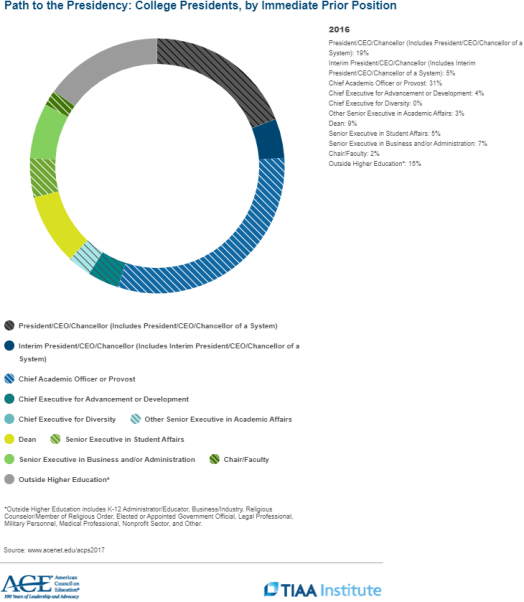







 Edu Alliance Journal