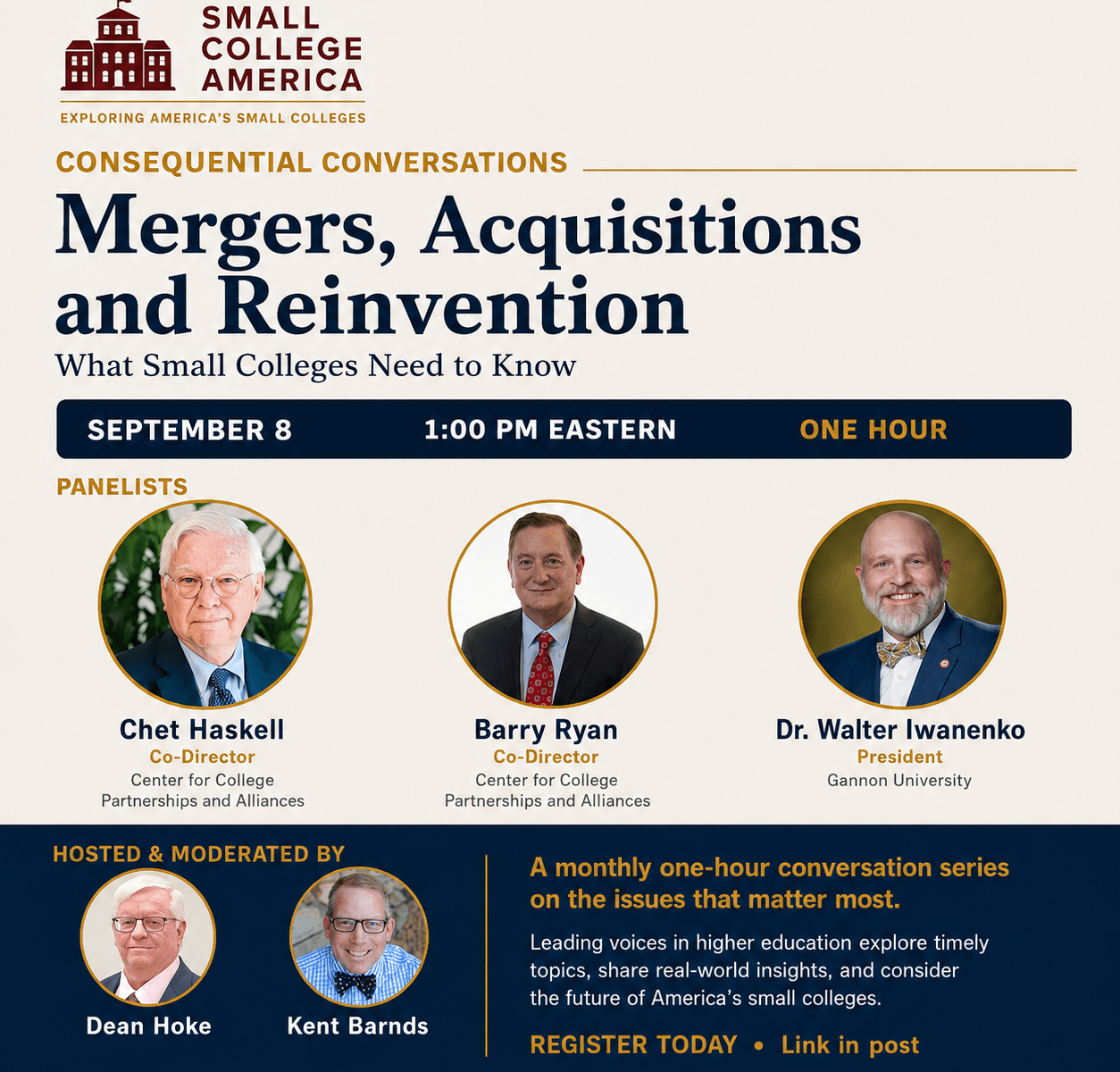
What legal (and other) help do you actually need in Mergers, Acquisitions, and Partnerships?

May 17, 2026, by Dr. Barry Ryan – To accomplish almost anything of importance these days seems to require the engagement of lawyers. This is absolutely true for institutions of higher education in so many aspects of their lives, but never more so than in the matter of potential mergers, acquisitions and partnerships. Full disclosure: my observations herein are a result of my decades as a professor, an administrator (including several presidencies), and as someone actively involved in accreditation from every perspective (including a six-year stint as an accreditation commission member). And for good measure, as an attorney for the last 30 plus years. Tempus fugit.

I often encounter persons who are quick to quote a misunderstood saying about lawyers. The origin is Shakespeare’s Henry VI, Part 2 (Act IV, Scene 2): “The first thing we do, let’s kill all the lawyers.” In context, however, it’s clear that the Bard is not advocating murder. Rather, the words uttered by “Dick the Butcher” are an indication that lawyers and their functions are supposed to stand as a bulwark against tyranny and chaos.

Likewise, the skillful and ethical lawyer can, in the crafting of merger and partnership agreements, help prevent either party from taking advantage over the other (tyranny) and also preclude mutually harmful descent into institutional chaos.

So, on the one hand, as we shall see below, lawyers can play an essential and positive role in such higher education transactions. On the other hand, they should not drive the process or defeat the legitimate purposes of the parties they represent. What’s the balance and how do you find it? And how do you find the help you actually need?

Many institutions considering such transactions turn immediately to their inside counsel or usual external attorney or firm. While it may be prudent to consult a known lawyer to begin the task of finding the specialized legal counsel that is required, it can be a mistake to assume that relying on a current lawyer will be sufficient. Here’s why.

Small to medium-sized colleges may not have the luxury of inside counsel, or even a relationship with a firm that knows well their inner workings. Most such attorneys are retained primarily for employment-related matters: employment agreements, equipment leasing contracts, personnel disputes, terminations, employee manuals and so on. It’s obvious that those types of legal services, while essential for day-to-day operations, have little to do with the considerations of significant partnership or merger transactions. In fact, most attorneys who practice with smaller colleges have no experience at all with higher ed mergers and acquisitions (as is also true of most presidents, provosts, board members, etc.). These are rare events in the life of an institution, thus there are seldom any experts already on board the institution with the requisite real-world knowledge.

So how, and when, should such colleges retain experienced and capable counsel?

Let’s consider the when, first. An institution does need at least some preliminary conversations with and direction from counsel at the outset of any consideration of a partnership or merger. Once it becomes a serious topic of conversation among institutional leadership, checking in with counsel is a good idea. A competent higher ed lawyer can help establish the lay of the land from the outset, saving the college significant time, money and energy pursuing things (rabbit holes) that may not be legally possible or advisable.

These can include implications of the legal structure of the institution (currently and after the proposed transaction), state laws pertaining to non-profit entities (or corporate law if for-profit), laws related to boards and their duties, ownership types, implications for real estate (including zoning and local ordinances) and so on.

All this is in addition to addressing completely the requirements of accreditors (institutional as well as programmatic), state education authorities and the federal Department of Education (which monitors and approves or denies a CIO – Change in Ownership/Control). As you can see, this endeavor is neither for the faint of heart, nor for the amateur!

You will absolutely require highly competent and experienced guides (lawyers and non-lawyers) to make your way through this process. Some you may want to hire from outside and bring on board, others you may want to engage as consultants. Such experienced and talented people are available. Coordinating them and your administrative team for the duration of the undertaking, though, is a job in and of itself.

An internal point person should be designated at your institution, usually as the head of a committee. Critically important is that such a person be impeccably trustworthy. In addition, that point person must be able to relate well and closely with your internal and external teams, most particularly the president, provost, CFO, board chair and a few others on whose expertise and dependability you will come to rely.

As the process moves forward, it will be important to consider adding more internal team members. Faculty leadership, Human Resources, communications, alumni, external relations, student affairs, essentially all areas should ultimately play a part. The timeline needs to be flexible for carefully adding people to the internal committee.

Where to turn for external help, though? Let’s start with the legal area, not forgetting the financial and operational as well. 

There are a number of well-known higher education law firms in the US, mostly concentrated in bigger cities. Because there are many different types of legal implications inherent in such transactions, it is often best to work with an education practice group that is within a larger, more comprehensive law firm. Solo practitioners are harder to find and evaluate, which means that the typically more expensive firms, often including 100 or more attorneys, may be the best option. An adviser (inside counsel or someone similar) who knows your own situation well may be the best way to help you and your senior team sort through this part of the selection process.

Initial meetings with prospective firms can establish the rough outlines of an engagement, including the key question of whether billing should be on an hourly versus a project basis. If hourly, you’ll probably encounter a sliding scale, depending on the level of the attorney being engaged for a particular aspect. So, for example, a very experienced senior partner may bill at $750 an hour or more. Junior partners might be somewhat lower, associates below that, possibly at something in the $200 to $450 range. Remember, these numbers are hypothetical only. Ranges vary greatly, depending in part on your region as well as the experience (and success history) of the firm in such matters. The actual number is dependent on the hours billed, which relates both to the complexity of the matter within the larger proposed transaction, as well as the effectiveness of the attorneys engaged. What’s the total number? It’s almost impossible to hazard a guess, but there are better and worse (i.e. more expensive) ways to manage this part of the process.

There are a number of tools for tracking, projecting and managing legal expenses. But your inside counsel may be your best management tool. There are other options, too, if you don’t have  a current lawyer to whom you can entrust these management and connection point duties.

There are many tips to avoid wastage in this process. If you have good external advisors, they should be able to help you with learning and applying these techniques. These can involve adjusting the number of partners/associates, managing meeting participants and length of those meetings, keeping the points of contact within the institution in check, even just asking for any non-profit discount if applicable, and more.

It is important to remember that most lawyers have little idea about how higher education institutions function. Even fewer know how a merger or similar process works in higher ed. You don’t want to spend massive amounts of money just educating your legal advisors about such things, which is why is it more advisable to hire firms with such experience and expertise right out of the gate. Again, your current counsel and the external advisors you engage should be very helpful in this important aspect.

Know that the pace and scale of legal counsel during a transaction will change as it goes along. The initial discussions, the due diligence phase, the construction of the letter of intent, progress towards a definitive agreement, all mark increasing tempo and complexity. Of course, after an agreement is reached there are still a number of key milestones which will require counsel through the statutory, accreditation and related processes that lead to completion.

How long can this process take, from inception to conclusion? In my experience, Part 1 takes at least nine months to a year if done well. During this period, starting from when an institution makes the decision to move forward on an acquisition or merger, then achieving internal approvals and putting together a team (external and internal), and then organizing for due diligence is a complicated process. Throughout this time frame you’ll be using various approaches to assess potential good matches for the partnership.

The due diligence process is never quick, and shouldn’t be rushed. But the more you know about your own institution (and the prospective partner) makes a huge difference in the length of the due diligence period. It can take anything from a few months to longer than a year. Again, preparation and a sharp team really help.

Critically important in the due diligence portion is the role of your financial advisor. Yes, it’s important to have a very good CFO who really understands your institution. But few higher ed CFOs have been involved in merger and related processes, so even the best will have a steep learning curve.

To augment your internal finance and accounting expertise will most likely involve the addition of one or more external experts. They need to work well and closely with your leadership team, as well as with your legal counsel. The due diligence work that they will need to help manage is vital to the success of the whole transaction. There are two parts to this: first, producing everything necessary for due diligence of your own institution, and, second, helping establish what you need about your institutional partner. Missing anything important in this effort can create difficulties that can linger far into the future.

Let’s say you’ve done the introductory work, found and approached the right partner, completed mutual due diligence, received accreditation and other non-federal approvals and signed a definitive agreement. Are we done yet? Of course not, even though it may start to feel like you’ve already gone through a merger.

Much of what happens next is in the hands of the Department of Education, following “completion” of the merger – the Change in Ownership/Control (Part 1 in the 2 part process). After all those approvals have taken place involving various authorities, the Department can allow progress to Part 2, which essentially is an approval of the structural merger. The timeline is uncertain given the changes in policy, staffing, etc. that have involved the Department in recent years, but what is not uncertain is the continuing need for legal counsel and external advisors.

Doing all of this right takes time, money, dedication, patience and many other virtues as well! Getting it wrong, however, is painful and can be disastrous for all involved – including most importantly the students!

But what if you get it right? You’ll have pulled off something you can be proud of and will be part of a successful legacy of your institution. Students, faculty, staff and their loved ones will, if all goes right, be much better off than they would have been – especially if the only alternative would have been a closure.


Dr. Barry Ryan is a seasoned higher education executive, legal scholar, and former president of Woodbury University. He is the Co-Director, Edu Alliance’s Center for College Partnerships and Alliances, and a legal scholar. With more than 25 years of leadership experience, Dr. Ryan has served in numerous roles, including faculty member, department chair, dean, vice president, provost, and chief of staff at state, non-profit, and for-profit universities and law schools. His extensive accreditation experience includes two terms on the WASC Senior College and University Commission (WSCUC), serving a maximum of six years. He is widely recognized for his expertise in governance, accreditation, crisis management, and institutional renewal.

In addition to his academic career, Dr. Ryan ​ served as the Supreme Court Fellow in the chambers of Chief Justice William H. Rehnquist and is a​ member of numerous federal and state bars. He has contributed extensively to charitable organizations and is experienced in board leadership and large-scale fundraising. He remains a trusted advisor to universities and boards seeking strategic alignment and transformation.

He earned his Ph.D. from the University of California, Santa Barbara, his J.D. from the University of​ California, Berkeley, and his Dipl. GB in international business from the University of Oxford.

From Silent Stakeholders to Strategic Partners: Donor Engagement in College Mergers

November 2, 2025, By Dean Hoke — When Sweet Briar College’s trustees voted to close in 2015, they framed the decision as a financial necessity. Alumnae mounted an extraordinary campaign—raising $28.5 million in 110 days—and, through a state-brokered settlement, the college reopened under new governance. By 2023, donors had contributed well over $133 million since the crisis. What looked like an inevitable failure became one of higher education’s most remarkable turnarounds.

Sweet Briar is not only a story of crisis response; it exposes a recurring miscalculation in today’s merger conversations: the assumption that boardroom consensus equals donor legitimacy. Trustees speak for donors in a fiduciary sense—they hold legal responsibility for institutional assets—but not in the communal sense that captures sentiment, legacy, and trust. When colleges announce merger talks, headlines dwell on enrollment curves and debt ratios. Yet behind every deal stands a quieter, decisive constituency: major donors, family foundations, and planned-giving benefactors whose confidence (or loss of it) can determine whether the combined institution thrives—or limps forward under the weight of broken relationships.

This article reframes mergers as philanthropic integration projects. The legal mechanics matter, but durable success is won in the design phase: early engagement with philanthropic stakeholders, explicit safeguards for identity and donor intent, transparent transition planning, and a mission-first case that invites continued—and new—investment. When leaders bring donors and alumni into the architecture of the merger rather than the press release, they convert anxiety into commitment and preserve the institutional DNA that constituents care about most.

We’ll see this principle in contrasting cases: mission-advancing acquisitions that attracted significant philanthropic support, integrations that prioritized identity and donor intent from the outset, and lessons from failed or contested processes. The throughline is simple: treat philanthropy as a core workstream—not an afterthought—and the odds of a credible, sustainable merger rise dramatically.

Why Donor Engagement Matters More Than Ever

The stakes have never been higher. Survey data from Ruffalo Noel Levitz’s 2025 National Alumni Survey, which surveyed more than 50,000 alumni, reveals that donor relationships with higher education are already strained. While 81% of alumni report that being philanthropic is important to them personally and 77% make charitable donations, their connection to their alma mater has weakened dramatically. Only 31% of alumni who donate to any charity gave to their alma mater last year, dropping to just 19% among Millennials and 10% among Gen Z graduates.

Even more troubling: 59% of alumni who never donate to their alma mater actively support other causes, as do 83% of lapsed donors. They have not stopped giving—they have simply redirected their philanthropy elsewhere. This suggests that alumni disengagement reflects institutional failure rather than generational selfishness.

Satisfaction drives everything. Alumni who report being ‘very satisfied’ with their student experience are 18 times more likely to donate than neutral respondents and 73 times more likely than dissatisfied graduates. Yet only 42% of Gen Z alumni report feeling ‘very satisfied’ with their experience, compared to 72% of Silent Generation graduates.

Mergers test already-fragile relationships. When institutions announce consolidation, donors who felt lukewarm about their undergraduate experience see confirmation that their alma mater is failing. A merger framed solely as a financial necessity will not inspire them. But a merger presented as advancing mission-driven impact—expanding access, strengthening programs that address social challenges, or preserving an educational model under threat—can mobilize support from the very alumni who have drifted away.

What History Already Taught Us (and We Often Forget)

As Millett (1976) noted, successful integrations often ‘show structure, not just sentiment’—for example, Case Western Reserve kept a distinct Case Institute identity, and Carnegie Mellon created a Carnegie Institute of Engineering and a Mellon Institute of Science to carry legacies forward.

A half-century ago, John D. Millett’s 1976 analysis of U.S. college mergers examined a range of cases—from research institutes to liberal arts colleges—and distilled lessons that remain strikingly current. Four observations deserve renewed attention today:

1. Endowments transfer; relationships do not. In many mergers, endowments and restricted funds move to successor institutions through standard legal pathways. The mechanics are manageable. The harder work is relational: ensuring donors can see how their original intent will be honored in the new configuration, and that the program or ethos they loved will not be erased.

2. Alumni skepticism is predictable—and manageable. Leaders should not assume alumni approval, especially when the smaller institution is absorbed. Visible steps to cultivate and retain legacy alumni—keeping familiar staff contacts for a transitional period, acknowledging a distinct identity, and offering tangible ways to shape the merged future—go a long way.

3. Governance approval is not donor legitimacy. Even when boards vote, state bodies concur, and presidents sign, philanthropic legitimacy remains a separate test. Communities expect to be consulted; they often oppose mergers if they learn about them too late. Participation must be planned early, not added later.

4. Language and structure matter more than sentiment. Labels and explanations—federation versus absorption, mission expansion versus rescue—shape how alumni and donors interpret the outcome. Leaders who explain clear educational benefits and who visibly protect identity through formal structures earn trust faster.

Historical Examples: Structure, Not Just Sentiment

After the Case Institute of Technology and Western Reserve University merger, the successor Case Western Reserve University continued the designation of Case Institute of Technology as an organizational component. At Carnegie Mellon University, leaders created a Carnegie Institute of Engineering and a Mellon Institute of Science—formal structures that carried legacy identities forward within the new entity.

The Bellarmine-Ursuline (Louisville) merger (1968-1971) offers another instructive example. The combined institution briefly used the Bellarmine-Ursuline name before reverting to Bellarmine College in 1971, but Bellarmine has continued to honor Ursuline identity through durable structures—explicitly including Ursuline alumnae in alumni awards and honors and recognizing the Ursuline legacy through commemorations and alumni programming. These are structural signals that preserve identity even when the combined name does not persist.

Millett also notes that successor institutions often made special effort to cultivate and retain alumni of the absorbed college, including keeping an alumni-relations officer from the legacy institution and providing a special alumni designation or status—practical ways to keep traditions and community intact during transition.

Three Models Leaders Use—and Which One Works

Crisis-Reactive: What Not to Do

Planning is done privately, the announcement is abrupt, and donors are asked to accept a fait accompli. Mills College’s merger with Northeastern University proceeded despite alumni resistance, prompting legal challenges over donor intent. The Alumnae Association spent hundreds of thousands in legal fees opposing the merger, and a class action lawsuit resulted in a $1.25 million settlement. The litigation divided alumnae and consumed resources that could have been invested in the merged institution’s success.

Even when the legal mechanics are sound, the community verdict is that identity has been erased. The result: backlash, donor-intent disputes, and years of costly trust repair.

Compliance-Only: Necessary but Insufficient

Teams carefully inventory restricted funds, ensure transfers align with donor intent, and communicate the basics. This prevents disasters but rarely generates enthusiasm or new investment. Survey data reveals that 70% of alumni need to believe their gift amount matters, and 66% rate the ability to see how their gift is used as critical. When a college merges, donors worry their legacy has been erased—regardless of legal assurances that funds will be protected.

The compliance model maintains existing donors but does not mobilize new support for the merged institution’s expanded mission. The message is ‘We will comply,’ not ‘Here is a better future you can help build.’

Strategic Partnership: The Target State

Donors and foundations are treated as co-creators from Day 0. Leaders conduct quiet briefings with major benefactors pre-announcement, frame the merger as mission expansion, and embed structural commitments to legacy preservation. This model doesn’t eliminate hard feelings, but it channels energy toward shared outcomes.

Delaware State University–Wesley College (2020–21). DSU—an HBCU—acquired Wesley and framed the move as mission advancement, launching the Wesley College of Health & Behavioral Sciences to expand pathways in nursing and allied health for underserved students. Financing combined philanthropy and prudence: a $20M unrestricted gift from MacKenzie Scott (with a portion—reported as roughly one-third of the $15M total—applied to transition costs) and a $1M Longwood Foundation grant for the acquisition. The case shows how a mission-first narrative can catalyze major-donor and foundation support.

By tying dollars to a new health‑workforce pipeline—rather than balance‑sheet triage—leaders converted donor anxiety into visible, restricted impact.

Ursuline College–Gannon University (ongoing). From the outset, both institutions engaged stakeholders publicly and affirmed philanthropy principles: “Honoring donor intent is important to Gannon University,” and donors will be able to designate gifts to the Pepper Pike campus. Ursuline will retain its identity as the Ursuline College Campus of Gannon University after the transition, and the Ursuline Sisters of Cleveland have voiced support for the merger—signals aimed at preserving community trust and legacy while the integration proceeds through 2026. These commitments, paired with the HLC’s Change-of-Control approval, frame the merger as continuity-minded rather than absorptive.

University of Tennessee Southern (formerly Martin Methodist College).

University of Tennessee Southern (formerly Martin Methodist College)
When Martin Methodist joined the University of Tennessee System in 2021, leaders prioritized transparent, compassionate communication—“a liminal space” requiring a strong plan, as President Mark La Branche put it. They also set aside portions of the legacy endowment (via the Martin Methodist College Foundation) to protect signature programs, showing that integration need not erase institutional identity.

Public commitments to donor intent and the campus naming convention did early legitimacy work that legal filings can’t.

Engaging the Acquiring Institution’s Donors

When a stronger institution absorbs a struggling one, leaders often assume donor concerns belong primarily to the acquired institution. This is a strategic error. The acquiring institution’s donors also have a stake in the outcome—and their continued support is essential to merger success.

Major donors to the acquiring institution may question why resources should be directed toward absorbing another college. They may worry that the acquired institution’s struggles will tarnish their alma mater’s reputation, or that merger costs will compete with planned campus improvements. These concerns are legitimate and require proactive engagement.

Frame the Merger as a Strategic Opportunity

The narrative for acquiring institution donors must emphasize strategic opportunity rather than charitable rescue. Several frames can be effective:

Geographic expansion: The merger creates a presence in a new market, expanding the institution’s reach and visibility.

Program complementarity: The acquired institution brings academic strengths that fill gaps in the acquiring institution’s portfolio.

Mission advancement: The merger expands capacity to serve students and fulfill the educational mission on a greater scale.

Competitive positioning: In an era of consolidation, the merger strengthens the institution’s competitive position and long-term sustainability.

Rather than waiting for resistance to emerge, acquiring institution leaders should brief major donors before public announcement. These confidential conversations acknowledge donors’ legitimate interest in institutional strategy, allow leaders to address concerns directly, and create opportunities for donors to become merger advocates.

Legal clarity: When restricted funds cannot be used as originally intended post‑merger, pursue a cy‑près modification early—advancement and counsel should partner on donor communication before any filing to preserve trust.

You can brief a small set of major donors pre‑announcement under strict NDAs without privileging them over faculty governance or regulators. Use a defined rubric for who is briefed (e.g., top 10% of lifetime commitments and active pledgors), disclose no nonpublic counterparties’ terms, and limit to mission rationale, identity safeguards, and timeline. Record each briefing in counsel’s log.

A Practical Playbook for Philanthropic Integration

Before Announcement (Day 0 Work)

Philanthropic due diligence—parallel to financial. Inventory endowed and restricted funds, bequests in the pipeline, and active foundation grants. Identify potential cy-près risks and draft stewardship language now. Treat this as a distinct workstream with advancement, finance, and counsel at the table from the start.

Quiet briefings with top donors and foundations on both sides. Under confidentiality, preview the rationale, surface donor-intent questions, and invite advice. Ask for early champions willing to speak publicly when the time comes.

Identity protections by design, not promise. Prepare a naming plan (e.g., ‘[Legacy] College at [Acquirer]’), preserve scholarship and reporting lines, and keep alumni-relations continuity for 12-24 months. Publish a short ‘Identity & Intent’ brief on day one that shows, in plain language, how donor purposes are carried forward.

At Announcement

Mission-driven case for support. Lead with the educational value only possible together: new academic pathways, access expansions, regional partnerships, research synergies. Avoid rescue framing. Make the case specific and concrete, tied to programs and outcomes donors care about.

Dedicated ‘Legacy to Impact’ funds with challenge matches. Create visible vehicles that convert anxiety into investment—restricted funds for scholarships, program launches, and student success tied to the integrated entity.

Community-benefit specificity. Spell out local benefits and stakeholder wins (clinics, teacher pipelines, innovation hubs). When people can ‘see’ the upside, they are likelier to invest in it.

First 12-24 Months

Quarterly transparency. Report enrollment in merged programs, first scholarship cohorts, renewed or new foundation grants, and capital milestones. Transparency reduces rumors and builds credibility.

Recognition symmetry. Offer parity for legacy and acquirer donors—naming walls, digital honor rolls, endowed-fund dashboards, and joint stewardship events.

Two-sided cultivation. Brief the acquirer’s major donors so they see strategic growth rather than a charitable drain. Ask two or three to seed a matching pool restricted to merger priorities; matches signal confidence and reduce perceived risk.

Measuring Success Beyond the Closing Date

Because reliable analytics on donor behavior in mergers are sparse, leaders should build their own lightweight evidence base. For each merger, track three years pre- and post-integration for: total private support; alumni participation (where available); number of $1M+ gifts; and the mix of restricted versus unrestricted giving.

Pair quantitative metrics with a qualitative log: Was identity preserved in naming? Did a Legacy Alumni structure exist? Were there donor-intent disputes? Did the acquirer launch dedicated legacy funds? How soon were KPIs reported?

Even a simple dashboard, updated quarterly, changes the conversation with trustees and donors. It shows momentum (or lack thereof), prompts targeted stewardship, and gives leaders permission to make mid-course corrections. It also validates the core claim of this article: philanthropy works best when it is built into planning, not bolted on after the fact.

Conclusion: From Stakeholders to Strategic Partners

The most fundamental error in merger planning is treating donors as communications targets rather than strategic partners. Donors are not merely sources of revenue to be managed; they are partners whose investments reflect belief in institutional mission and values.

Mergers that succeed treat donors, foundations, and alumni as planning inputs, not a downstream audience for PR. Millett’s 1976 study reminds us that while the legal mechanics of endowment transfers are straightforward, the human mechanics are not. Alumni skepticism is predictable; identity needs visible protection through formal structures, not just promises; language and framing carry unusual weight.

When leaders internalize those lessons—and create structures that honor donor intent, invite co-creation, and make the mission upside measurable—legacy becomes leverage rather than liability. Higher education’s financial pressures are real, but so is the reservoir of goodwill that donors and alumni hold for institutions that respect them.

The Sweet Briar alumnae who raised $133 million did not do so because they were told the college would comply with donor intent. They did so because they were invited to co-create a future worth investing in. That is the lesson for every merger: bring philanthropic stakeholders into the room early, build identity protections into the design, launch vehicles that convert anxiety into investment, and report steadily and transparently on what their support makes possible.

That is how two proud legacies become one stronger future—and how the ‘silent stakeholders’ find their voice in shaping it.

Sources (selected): institutional FAQs and press releases (Ursuline–Gannon; DSU–Wesley; UT Southern), RNL Alumni Giving Data 2025 (for participation/attitudes), and Millett, J.D. (1976) ED134105 on college mergers.

Dean Hoke is Managing Partner of Edu Alliance Group, a higher education consultancy. He formerly served as President/CEO of the American Association of University Administrators (AAUA). Dean has worked with higher education institutions worldwide. With decades of experience in higher education leadership, consulting, and institutional strategy, he brings a wealth of knowledge on colleges’ challenges and opportunities. Dean is the Executive Producer and co-host for the podcast series Small College America.