

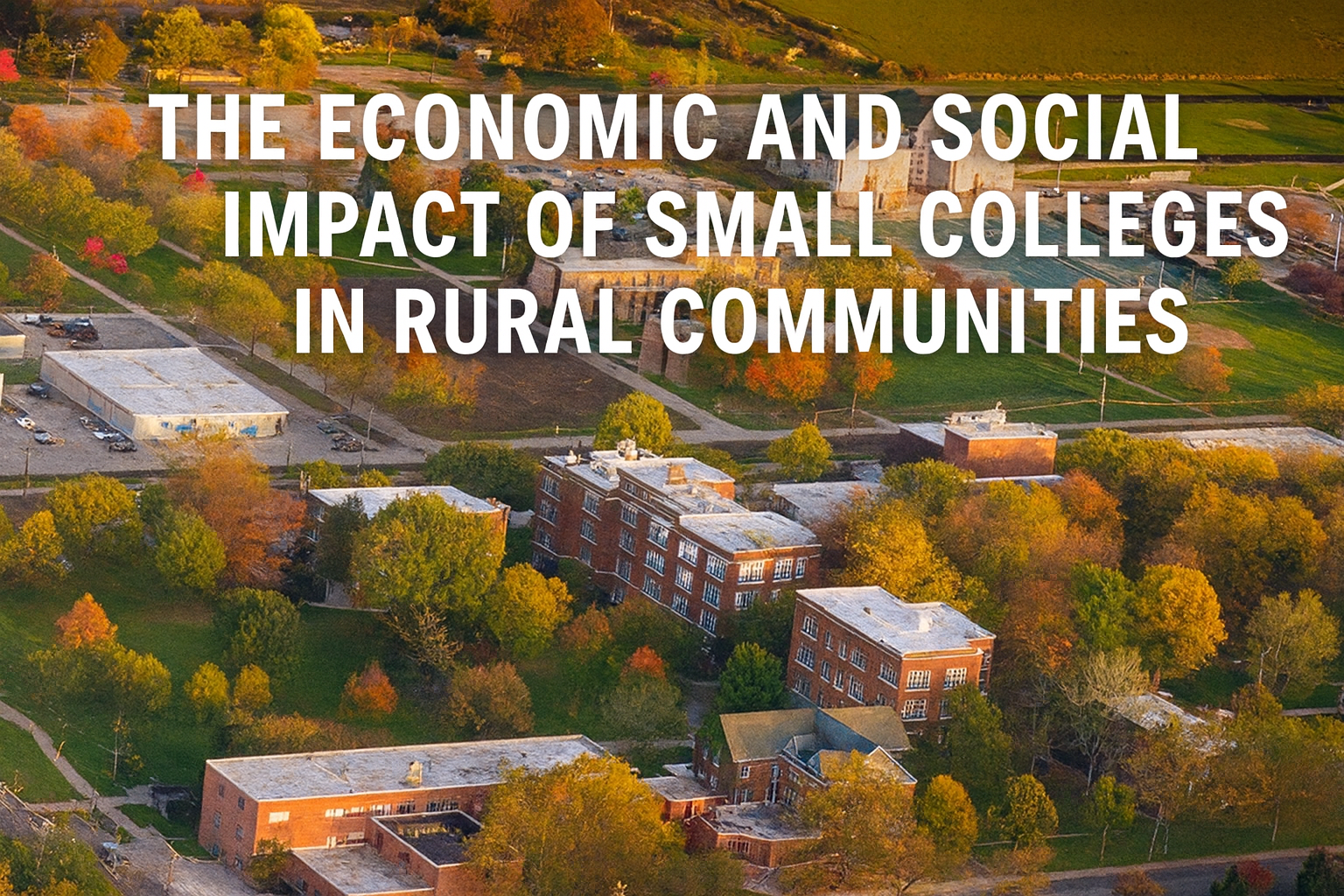
By Dean Hoke, October 13, 2025 – In the small towns of America, where factories have closed and downtowns often stand half-empty, a small college can be the heartbeat that keeps a community alive. These institutions—sometimes enrolling only a few hundred students—serve as economic anchors, cultural centers, and symbols of hope for regions that might otherwise face decline.
From the farmlands of Indiana to the mountain towns of Appalachia, small colleges generate economic energy far beyond their campus gates. They attract students, faculty, and visitors, stimulate local business, and provide the trained workforce that rural economies desperately need. They also embody something deeper: a sense of identity and connection that sustains civic life.
Economic Impact: Anchors in Fragile Economies
Small colleges are powerful, if often overlooked, economic engines. Their presence is felt in every paycheck, every restaurant filled with students and parents, and every local business that relies on their purchasing power.
Across the United States, nearly half of all public four-year colleges, over half of all public two-year colleges, and a third of private four-year colleges make up the 1,100 rural-serving institutions as identified by the Alliance for Research on Regional Colleges (ARRC). These colleges educate 1.6 million students, accounting for more than a quarter of total U.S. enrollments. Yet their role extends far beyond classrooms and degrees.

Rural-serving institutions are frequently among the largest employers in their counties, especially where other industries have faded. In areas where 35% or more of working-age adults are unemployed, 83% of local colleges are rural-serving, making them pillars of economic stability. Unlike large universities in metropolitan areas, their spending is highly localized—on utilities, food service, maintenance, and partnerships with small vendors.
Economic models underscore their importance. The Brookings Institution found that high-performing four-year colleges contribute roughly $265,000 more per student to local economies than lower-performing institutions, while two-year colleges add about $184,000. In many rural towns, every institutional dollar recirculates multiple times, magnifying its effect.
Beyond direct payroll and procurement, small colleges attract outside dollars. Students and visitors rent housing, dine locally, and shop downtown. Athletic events, alumni weekends, and summer programs bring tourists who fill hotels and restaurants. The IMPLAN consulting group estimated that when a college closes, the average regional loss equals 265 jobs, $14 million in labor income, and $32 million in total economic output—a devastating hit in thin rural economies.
Human Capital and Workforce Development
If small colleges are the economic engines of rural communities, they are also the primary producers of human capital. They educate the teachers, nurses, business owners, and civic leaders who sustain local life.
The Federal Reserve Bank of Richmond describes community colleges as “anchor institutions” that shape regional labor markets. Many partner with local employers to design training programs that meet specific workforce needs—often at minimal cost to businesses. In one case study, a rural college collaborated with an advanced manufacturing firm to tailor instruction for machine technicians, ensuring a steady local labor supply and convincing the company to expand rather than relocate.
Rural-serving colleges are also critical in addressing educational disparities. Only 22% of rural adults hold a bachelor’s degree, compared with 37% of non-rural Americans. This gap translates directly into income inequality: according to the U.S. Department of Agriculture’s Economic Research Service, nonmetro workers with a bachelor’s degree earned a median of $52,837 in 2023, compared with substantially higher earnings for their urban counterparts. In states such as Indiana, Ohio, and Pennsylvania, rural degree attainment lags 10 to 15 percentage points behind state averages.
Beyond Economics: RSIs as Equity Infrastructure
Rural-serving institutions are more than economic engines—they are critical equity infrastructure, often providing the only realistic pathway to higher education for students the system has historically marginalized.
RSIs enroll far higher proportions of high-need students than their urban counterparts. Nearly 50% of undergraduates at RSIs receive Pell Grants, compared to 34% nationally. These institutions also serve disproportionate numbers of first-generation students, working adults, and students from underrepresented communities who lack access to flagship universities.
For many rural students, the local college isn’t a choice—it’s the only option. Geographic isolation, family obligations, and financial constraints make residential college attendance impossible. Research shows that every ten miles from the nearest college reduces enrollment probability by several percentage points. For students without transportation, without broadband for online learning, or without family support to relocate, the local institution is existential.
When rural colleges close, equity suffers most. Displaced students, if they re-enroll at all, face higher debt burdens and lower completion rates. Wealthier students can transfer to distant institutions; low-income students stop out. Communities of color, already underserved, lose ground.
Policymakers often evaluate colleges through narrow metrics: completion rates and graduate earnings. But this ignores mission differentiation. RSIs serve students that flagship universities would never admit, in places that for-profit colleges would never enter, at prices that private colleges could never match. Investing in rural-serving institutions isn’t charity—it’s infrastructure investment in equity, ensuring every region has pathways to economic mobility. If America is serious about educational equity, it must recognize RSIs as essential public infrastructure, not discretionary spending.
Despite these barriers, rural institutions remain lifelines for upward mobility. They offer affordable tuition, flexible programs for working adults, and pathways for first-generation students who might otherwise forgo higher education.
However, the pressures are real. Rural students face tighter finances, higher borrowing costs, and fewer grant opportunities. Nearly half of rural undergraduates receive Pell Grants, but average aid remains lower than that at urban institutions. Many graduates leave rural areas to find higher-paying jobs, a “brain drain” that weakens local economies. Yet for those who stay—or return later—their impact is outsized, driving new business formation, civic leadership, and generational stability.
Example: Goshen College and Elkhart County, Indiana — A Model of Mutual Benefit
The following example illustrates the positive interdependence of a small college and its surrounding community—how shared growth, service, and opportunity can strengthen both the institution and the region it calls home.
Few examples better demonstrate this relationship than Goshen College in northern Indiana. Founded in 1894 by the Mennonite Church, Goshen sits in Elkhart County, a region best known for its manufacturing and recreational vehicle industries. While the area has long been an economic hub, its continued success depends heavily on education and workforce development—both areas where Goshen College has quietly excelled for more than a century.
Goshen employs more than 300 full-time and part-time faculty and staff, making it one of the city’s largest private employers. Its local purchasing—from food services to maintenance and printing—injects millions of dollars annually into the county’s economy. The student body, drawn from across the Midwest and around the world, supports rental housing, restaurants, and small businesses throughout the region.
According to the 2024 Independent Colleges of Indiana Economic Impact Study, Goshen College contributes roughly $33 million each year to the regional economy through employment, operations, and visitor spending. Beyond the numbers, the college enriches community life. The Goshen College Music Center and Merry Lea Environmental Learning Center are regional treasures, hosting performances, lectures, and research programs that attract thousands of visitors annually. During the COVID-19 pandemic, the college partnered with local health officials to serve as a testing and vaccination site—further demonstrating its civic commitment. Its nursing, environmental studies, and teacher preparation programs continue to meet critical workforce needs across Elkhart County and beyond.
Goshen College stands as a model of how a small private college and its community can thrive together. Its example underscores a broader truth: when rural colleges remain strong, the benefits extend far beyond campus—bolstering jobs, sustaining income, and enriching the civic and cultural life that define their regions.
Social and Cultural Role: The Heart of Civic Life
Beyond numbers, the social and cultural influence of rural colleges may be their most irreplaceable contribution. In many counties, the college auditorium doubles as the performing arts center, the gym as the public gathering space, and the library as a community hub.
Rural colleges host art shows, festivals, lectures, and athletics that bring people together across generations. They sponsor service projects, tutoring programs, and food drives that connect students with their neighbors. For residents who might otherwise feel isolated or overlooked, the local college provides a sense of belonging and civic pride.
Research from the National Endowment for the Arts underscores that local arts participation strengthens community bonds and well-being. Rural colleges amplify that effect by providing both venues and expertise. Their faculty often lead community theater, music ensembles, or public workshops—bringing culture to places that might otherwise lack access.
The COVID-19 pandemic vividly demonstrated this social bond. While large universities shifted to remote learning with relative ease, small rural colleges had to improvise with limited broadband access and fewer resources. Yet many became essential service providers—hosting testing centers, distributing food, and maintaining human contact in otherwise isolated communities.
In these moments, small colleges revealed what they have always been: not just educators, but neighbors and caretakers.
Challenges: Fragility and the Risk of Decline
Despite their immense value, small rural colleges operate under fragile conditions. Their scale limits efficiency, their funding sources are volatile, and demographic shifts threaten their enrollment base.
Enrollment Declines and Demographic Pressures.
A steep decline in traditional-age students is projected to start by 2026, with the number of new high school graduates expected to fall by about 13 percent by 2041, according to The Chronicle of Higher Education, March 3, 2025, article “What is the Demographic Cliff”. For rural colleges already competing for a shrinking pool of students, this decline threatens their enrollment base and financial viability. Many have already experienced double-digit enrollment drops since the Great Recession. Rural public bachelor’s/master’s institutions enroll 5% fewer students today than in 2005, while community colleges struggle to recover from pandemic-era losses.
Financial Constraints.
Small colleges rely heavily on tuition revenue and relatively modest endowments. According to the Urban Institute, the median private nonprofit four-year college holds about $33,000 in endowment assets per student, compared with hundreds of thousands of dollars per student at elite universities such as Amherst or Princeton. For many rural private colleges, endowment resources are often well below this national median. Their financial models depend heavily on tuition and auxiliary income, leaving them vulnerable when enrollment softens. Fundraising capacity is also limited: alumni bases are smaller and often less affluent than those of major research universities, making sustained growth in endowment and annual giving more difficult to achieve.
Operational Challenges.
Compliance, accreditation, and technology costs weigh disproportionately on small staffs. Many rural colleges lack the personnel to pursue major grants or expand programs quickly. Geographic isolation compounds difficulties in recruiting faculty and attracting external partnerships.
Brain Drain and Opportunity Gaps.
Even when colleges succeed in educating local students, retaining them can be difficult. Many leave for urban areas with higher wages and broader opportunities. The irony is painful: the better a rural college fulfills its mission of empowerment, the more likely it may lose its graduates.
Closures and Community Fallout.
When a small college shuts its doors, the ripple effects are severe. Studies estimate average regional losses of over $20 million in GDP and hundreds of jobs per closure. Local businesses—cafés, landlords, bookstores—suffer immediately. Housing markets soften, municipal tax revenues drop, and cultural life diminishes. It can take a decade or more for a community to recover, if it ever does.
Reversing the Talent Flow: Retention Strategies That Work
The brain drain challenge is not insurmountable. Several states and institutions have pioneered retention strategies that show measurable results.
Loan forgiveness programs specifically targeting rural retention have gained traction. Kansas’s Rural Opportunity Zones offer up to $15,000 in student loan repayment for graduates who relocate to designated counties. Maine provides annual tax credits up to $2,500 for graduates who live and work in-state. Early data suggests these programs can shift settlement patterns, particularly in high-demand fields like nursing and teaching.
The most effective models involve tri-party partnerships: colleges provide education and career counseling, employers offer competitive wages and loan assistance, and municipalities contribute housing support or tax relief. In one Ohio example, a regional hospital, community college, and county government created a “stay local” nursing pathway that reduced turnover by 40% over five years.
Place-based scholarships are also emerging as retention tools. “Hometown Scholarships” provide enhanced aid for students from surrounding counties who commit to working regionally after graduation. When paired with community-engaged learning and local internships throughout the curriculum, these programs cultivate regional identity—shifting the narrative from “I have to leave to succeed” to “I can build a meaningful career here.”
Federal policy could amplify these efforts. A Rural Talent Corps modeled on the National Health Service Corps could leverage student loan forgiveness to address workforce shortages while stabilizing rural economies. The brain drain will never disappear entirely, but intentional investment can shift the calculus from inevitable loss to manageable flow.
Policy Pathways and Strategies for Resilience
Sustaining small colleges—and the communities they support—requires creativity, collaboration, and policy attention.
1. Deepen Local Partnerships.
Rural colleges thrive when they align closely with regional needs. Employer partnerships, dual-enrollment programs, and apprenticeships can connect education directly to local labor markets. In Indiana and Ohio, several colleges now co-design health care and manufacturing programs with regional employers, ensuring steady pipelines of skilled workers.
2. Form Regional Alliances.
Small institutions can collaborate rather than compete. Shared academic programs, cross-registration, and joint purchasing agreements can reduce costs and expand offerings. Examples such as the New England Small College Innovation Consortium show how collective action can extend capacity and visibility.
3. Diversify Revenue and Mission.
Rural colleges can strengthen financial resilience by expanding adult education, microcredentials, and workforce training. Many are converting underused buildings into community hubs, co-working spaces, or conference centers. Others are developing online and hybrid programs to reach place-bound learners in neighboring counties.
4. Increase State and Federal Support.
Federal recognition of Rural-Serving Institutions within the Higher Education Act could unlock targeted funding similar to programs for Minority-Serving Institutions. States should adapt funding formulas to reflect mission-based outcomes—rewarding colleges that serve low-income, first-generation, and local students rather than penalizing them for small scale.
5. Encourage Philanthropic Investment.
Foundations and donors have historically overlooked rural institutions in favor of urban flagships. Increasing awareness of their impact could mobilize new giving streams, particularly from community foundations and regional philanthropists.
6. Invest in Infrastructure.
Broadband access, housing, and transportation are essential to sustaining rural higher education. Expanding digital infrastructure allows colleges to deliver online learning, attract remote faculty, and connect to global markets.
Looking Ahead: The Role of Small Colleges in Rural Renewal
As rural America seeks to reinvent itself in the 21st century, small colleges are uniquely positioned to lead that renewal. They combine local trust with national expertise, and they possess the physical, intellectual, and moral infrastructure to drive change from within.
Their future will depend on adaptability. Colleges that align programs with regional industries, embrace digital learning, and form strategic alliances can thrive despite demographic headwinds. Institutions that cling to older models may struggle.
Yet the measure of success should not be enrollment size alone. A rural college’s value lies in its multiplier effect—on jobs, community life, and civic identity. For many counties, it is the last remaining institution still rooted in the public good.
Conclusion: Investing in Irreplaceable Infrastructure
Small colleges in rural America are far more than schools. They are community builders, employers, cultural anchors, and symbols of local resilience. Their closure can hollow out a county; their success can revive one.
The rural-serving institutions identified by ARRC represent a quarter of U.S. enrollments but touch nearly half the nation’s geography. They serve regions facing population loss, persistent poverty, and limited opportunity—yet they continue to educate, employ, and inspire.
The choice facing policymakers, philanthropists, and citizens is simple: either we invest in these engines of opportunity, or we risk watching the lights go out in hundreds of rural towns.
The question is no longer whether we can afford to support small rural colleges but whether America can afford not to.
Sources and References
- Alliance for Research on Regional Colleges (ARRC). Identifying Rural-Serving Institutions in the United States (2022).
- Brookings Institution. The Value of Higher Education to Local Economies (2021).
- Federal Reserve Bank of Richmond. Community Colleges as Anchor Institutions: A Regional Development Perspective (2020).
- National Student Clearinghouse Research Center. High School Benchmarks 2022: National College Progression Rates.
- National Endowment for the Arts. Rural Arts, Design, and Innovation in America (2017).
- Lumina Foundation. Stronger Nation: Learning Beyond High School Builds American Talent (2024).
- National Skills Coalition. Building a Skilled Workforce for Rural America (2021).
- IMPLAN Group, LLC. Measuring the Economic Impact of Higher Education Institutions (2023).
- U.S. Census Bureau. Educational Attainment in the United States: 2023 (American Community Survey Tables).
- Bureau of Labor Statistics. Employment and Earnings by Educational Attainment, 2023.
- Goshen College. Economic Impact Report 2022 and institutional data from the Office of Institutional Research.

Dean Hoke is Managing Partner of Edu Alliance Group, a higher education consultancy, and a Senior Fellow for the Sagamore Institute located in Indianapolis, Indiana. He formerly served as President/CEO of the American Association of University Administrators (AAUA). Dean is a champion for small colleges in the US. and is committed to celebrating their successes, highlighting their distinctions and reinforcing how important they are to the higher education ecosystem in the US. Dean is the creator and co-host for the podcast series Small College America.
 By
By  Edu Alliance Journal