International Recruitment Post Covid-19

Alfredo AveroBy Alfredo Varela Associate Vice President Global Affairs The College of St. Rose Albany New York June 15, 2020.

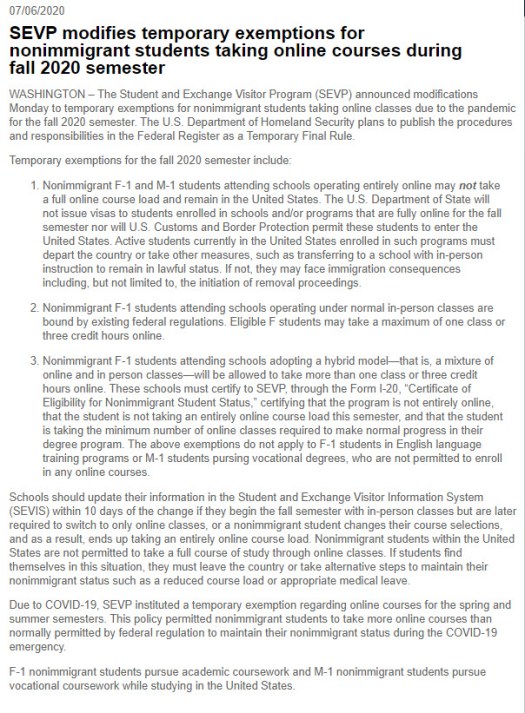
Inside Higher Education just published another a series of articles outlining the expected severe downturn in international student enrollment. Citing mostly large state institutions, this latest article predicts declines of 10% to 30% in new and returning students. During a recent CNN interview, Scott Galloway, Professor of Marketing at NYU Sterns School of Business 20 to 40% of schools, will start a “death march.” Here, rather than focus on the dire outcomes of such predictions, we must shift attention to the work required if institutions are to eventually turn the tide on this crisis.

Yes, this is an existential crisis. Especially for smaller private institutions, this is a moment of great reflection on their mission and history. Can institutions remain true to their core values and continue? Such questions are for those at a different level of decision-making. For those of us “in the trenches,” we must work, roll-up our collective sleeves, re-focus, regroup, and move forward.

Here are some very frank and concrete suggestions directed mainly at smaller private institutions. What comes next for us as individuals and collectively will rely on the work we do now.

Looking Forward

 While domestic recruitment has been affected by the current crisis, there are additional factors that have resulted in a long-term downward trend. International recruitment has been for many institutions a market to make up for losses due to demographic shifts in the US. As a result, the disruption felt by COVID19 in regards to new and returning international students has become a significant concern. In order to approach recovering, there are numerous barriers each institution must address. For example, the general anxiety of parents and students, financial issues created as the result of the crisis, travel restrictions, and the fact that most consular offices remain closed or are offering limited access. These are only the most visible challenges facing international students and are largely out of our reach to change.

With these issues likely to continue for the next few months, any institution hoping to see some recovery in their overall enrollment and retain diversity among their student population must make a long- term commitment. It will take 2-5 years before a full recovery takes place.

Here are four areas of consideration for maintaining and eventually increasing international student enrollment.

 1. Focus on direct contact and specific markets.

“Fortune always favors the brave” – PT Barnum

 Keeping health and safety primary, institutions that will recover most quickly are those that return to the markets in-person the soonest. Rightly so, the world has become concerned about issues of health and safety. However, now more than ever, students (and more importantly, their parents) must be assured that institutions are committed to providing the support needed to do everything possible to keep their children safe. Often large networks of familial ties support international graduate students, so this applies to them as well.

There will be no demonstration of this commitment more potent than being “there” in-person.

While international travel may continue to be difficult, there will be opportunities that are more safe and available. Supporting a local representative in-market could be an alternative, if they are chosen and managed carefully. Temporarily relocating a current employee overseas could also be an option. In either case, this could avoid issues related to travel between targeted destinations and the US. Where regional travel is possible, a well-placed employee could cover several markets and build true brand recognition.

Virtual fairs and meetings will be saturated in the coming months. Distinguishing an institution apart from the many others will be difficult, if not impossible. An immense concern is the “Brand Effect.” At live events, one ‘brand name top-50 school’ will attract a large number of students, but only to that one table or a few others in the room. Having attended such events, it is not impossible to turn such potential disasters into a positive, either through proximity to that school or some alternative attraction. A public announcement about a give-away or special scholarship could attract some “overflow” from such as school. Such actions will be much more difficult in a virtual arena where all students see is a series of logos or banners on a website.

Virtual events can still be productive, but they will have to be very well thought-out and executed. Separation from the herd is essential. Every piece of social media and each online event must literally burn the memory of your institution into the psyche of those who experience it.

Remember, every other institution will be attempting to do the same.

Domestic international students (international students currently in the US attending high school or a community college) represent a market already the focus of many institutions. For the coming fall, many universities are relying exclusively on these students to save them from a total disaster in international enrollment. However, moving forward, institutions must recognize that the same challenges and concerns that will limit international students at the college level might doubly affect high school students. Online classes, concerns about housing, or lack of homestays, travel restrictions, and of course, health concerns are likely to have a greater impact on this pipeline, and likely for a longer period. One only needs to ask themselves, “If I have concerns about sending my young adult away to college this fall, then how much more would I be concerned sending a child 1000’s of miles away from home?” Institutions should anticipate that this market will narrow for the coming recruitment cycle if not longer.

In the end, choosing regions and the entry for each market is key. Those staff and partners most closely aligned with international students must be trusted for their experience and on-the-ground intelligence to identify opportunities. It will be a highly fluid situation; responsiveness and focused action are required.

2. Know where you can strategically pullback resources or where to invest.

Have the courage to follow your heart and intuition.” – Steve Jobs

 This will likely be the most controversial of these suggestions. However, in the short-term recognizing resources will be limited; the best opportunity for future growth may be in maintaining budget lines dedicated to marketing, travel, student-centered events, and anything that will increase brand recognition. If it saves budget-lines and permits some or all of the regular recruitment activities to continue, institutions should look to strategic staffing options.

This will be less complicated if a comprehensive international office is already in place. Alternatively, this may be an opportunity to consolidate some offices and bring them under the direction of Enrollment Management. As a comprehensive office for all things Global, an institution can reassign some responsibilities, rely on Graduate Assistants for some administrative tasks, and focus efforts on the recruitment and retention of international students.  It is important that a senior international official remain responsible for the strategic implementation of the international recruitment strategy in addition to essential duties such issuing and maintaining SEVIS records.

Of course, this is recognizing that while there may be some reduced demand in the short term for services a Global office would traditionally provide and that the university will look to replace staffing as international student enrollment and study abroad participation is rebuilt. This will result in a temporary reduction of some services and a time lag in addressing requests. Again, the focus for the coming year should be on recruitment and retention.

3. Re-imagine “the international campus.”

“You cannot swim for new horizons until you have courage to lose sight of the shore.” – William Faulkner

 While the presence of international students enhances the atmosphere of a campus and provides opportunities for domestic students to interact with other languages and cultures, looking forward, we must be open to other models to ensure the sustainability of the institution. Innovative partnerships and new models of delivery must grow out of this crisis. As has been said recently, “we cannot simply rebuild, but we must build better.”

Looking at alternative modes to deliver programs and degrees is essential. Offering degree programs overseas with limited or no on-campus presence is something to be considered. A set of completely online programs would put an institution in competition with a large number of other providers. This mode of delivery can be challenging to manage across time zones and is often viewed as having a very low value in many overseas markets, even though the degree may be the same. Some combination of in-person and online instruction, potentially partnered with a local institution, is likely going to be more successful. The option of students being able to come to campus for a summer or semester will further increase interest, though not all students may take advantage of this option. The University of Arizona has already launched what they call the “Global Campus,” but this does not mean the market is not still open to others.

Institutions must think creatively and without fear, nor permit the past to dictate the future.

4. Commit to the long-term or decide to shift direction.

“The best way out is always through.” – Robert Frost

 As has been stated at the onset, this crisis is an existential threat to many institutions. As a result, it is not a time to be timid or reserved. Institutions either commit to a vision of what the university will be in 100 years or face the inevitable now. Some institutions may decide no or limited international exposure is best for them.  While many will feel is the wrong decision, even this choice will require some continued work to wind-down processes and obligations. If the commitment is to an institution with a clear set of international connections and perspectives, then, as best as possible, strategic investments must be made and acted upon now.

Unfortunately, now is not a time for half-measures. We must move forward, whatever that may look like. Standing in place will only result in being swept over by the current wave of events.


cropped-edu-alliance-logo-square.jpgEdu Alliance Group, Inc. (EAG) is an education consulting firm located in Abu Dhabi, United Arab Emirates and Bloomington, Indiana USA. We assist higher education institutions worldwide on a variety of mission critical projects. Our consultants are accomplished university / college leaders who share the benefit of their experience to diagnose and solve challenges.

EAG has provided consulting and successful solutions for higher education institutions in Australia, Egypt, Georgia, India, Kazakhstan, Morocco, Nigeria, Uganda,  United Arab Emirates, and the United States.

Edu Alliance offers higher education institutions a wide range of consulting services. If you are an organization that wants to know more how Edu-Alliance can best serve you, please contact us at info@edualliancegroup.com 

Small rural Colleges and Universities are they viable?

Allen MeadorsBy Allen C. Meadors, Chancellor and Professor Emeritus The University of North Carolina-Pembroke May 4, 2020. The United States has over 5,000 Colleges and Universities ranging from less than a hundred students to over 50,000 students. All institutions of higher education have been re-evaluating their mission and viability, but none more than the 500 or so smaller institutions spread throughout rural America. These institutions are often the lifeblood of their community (and often their region). They often represent one of the most substantial ties to the community/region’s history and culture. They are often the economic engine (jobs, purchases, etc.) that keeps the community and the region alive.

In the last 40 years, many have seen their enrollment decrease, often to the extent that they have had to merge with other higher education entities or close their doors. Like many businesses in America, they cannot continue to be successful in doing things as they always have. So, are small rural Colleges and Universities viable?

There was a comic strip in the 1940-1970’s by Walt Kelly, Jr called Pogo. One of Pogo’s famous quotes was, “We have met the enemy, and he is us.” Rural institutions often underrate themselves. One University with about 2,000 students, said we can’t grow because the large State University is only 45 miles away and that is where everyone wants to go. As we worked with them, we convinced them that they offered something that the much larger campus couldn’t.  They offer a more personal touch campus where you obtain an excellent education and “only” 45 miles from a university of over 40,000. Once they accepted this vision and market it to potential students, they were able to double their enrollment in four years.

Many rural campuses (especially public institutions) often see themselves as commuter campuses. It is a limiting vision to have. Winston

Churchill once said, “A pessimist sees the difficulty in every opportunity; an optimist sees the opportunity in every difficulty.” Bringing residence students to your campus not only provides growth opportunities but adds diversity that will enrich the commuter student’s educational experience. It will also be good for the local community. Institutions in metropolitan areas often complain that their students do not engage in on-campus opportunities because the local area offers so much distraction (professional sports, major entertaining events, major events brought to the community by industry). The rural institution has the opportunity to be the “destination” not only for their students but for the local community as well.

We always encourage rural campuses to form an active “Town/Gown” committee and support it vigorously. One complaint we often hear is that our community isn’t supportive of our students. At one institution, we had identified several rural institutions that had very positive “Town/Gown” images. We put together bus tours to these communities and had the College’s town businesspeople visit with the town and College individuals in those communities. They came back excited about the business opportunities that a small “College” town could provide that worked for both the academic institution and the town. Over just five years, remarkable changes occurred in the community. Everyone was better off.

We often hear, we are too far away from a major city or we’re not located in a desirable resort area. Again, those are just mental blocks. Your first job is to re­ educate your faculty and staff to the positive that your institution has to offer. One campus with only under 3,000 students (they had lost enrollment over the past ten years) felt exactly that way. We had a forum to discuss the things we did have to offer and why they were a great fit for some students. The campus started to focus on campus life and the fact that it was only 2-3 hours away from two large metro areas, the ocean and beautiful beaches and mountains. Today, students have grown up to not see 2-3 hours as that big of issues. Often it takes nearly that long to drive from one side of a metro area to the other.

Once the focus moved from what they weren’t to what they had to offer, they were able to grow to nearly 8,000 students. The community now has numerous student apartments, restaurants, and a developing classy downtown area. It is moving to be a true “College” town.

Another opportunity that is often overlooked is International students. Small institutions often think that international students wouldn’t want to attend a small rural institution. I am sure that is true for some international students, but many want a campus that will offer them a safe haven during their academic years away from home. One institution located in the lower mid-west was able to increase its international enrollment from less than 250 to nearly 1,000 in three years. The international students were introduced to a University in a small community where they got a lot of individual attention, and the US students got an introduction to students from all over the world. A significant enhancement to their classroom experience.

Another key  factor that is especially critical for small rural institutions relates to a quote from one of Jim Collins’s books, “Good to Great.” It is essential that you “Get the right people on the bus and get the right people in the right seats and get the wrong people off the bus.” It is a positive for all institutions, but small institutions do not have the luxury of often having multiple individuals in various departments/units. Institution leadership often worry about the “get the wrong people off the bus,” and the negative push back from the local community, if these are local individuals. Yes, this will be necessary sometime, but the focus needs to be on “get the right people in the right seats”! Most people want to do a good job, but if we have them in a position that does not fit their skill set, then we have a lose-lose situation. We need to take the time to evaluate an individual’s skill set. If some aren’t good with people, don’t put them or keep them in a position that requires that above other skills. They might do well in a purchasing position that is more research-oriented than handling students’ complaints in the business office.

Another approach recommended by Jim Collins is when addressing a problem “shift the decision from a “what” question (‘what should we do”) into a “who” decision(‘who would be the right person to take responsibility for this”). You will be amazed at how often weak employees in one position shine once they are in an environment where their skill set is a plus.

The Coronavirus (COVID 19) have brought new challenges and opportunities to higher education.  Financially weak institutions may not be able to sustain their financial viability before full recovery occurs.  However, small rural institutions may be able to market their remoteness and small enrollment as safer and more responsive than their larger sister institutions.

So, are small rural Colleges and Universities viable? Absolutely, but each has its history, culture, and opportunities. It is so important to know that no one approach fits all institutions. With small rural institutions, its history and its regional culture play a critical role in not only what you do but how you do it.


Dr. Allen Meadors is an American higher education professor and administrator. He has worked in international higher education as President/CEO of St. John International University in Torino, Italy and served as Executive Director for Higher Education for the Ministry of Higher Education in the United Arab Emirates. He is currently serving as an Associate Editor for the journals “Frontiers in Public Health” and “Frontiers in Education”.

His previous US career included serving as President/Chancellor of three US state universities including Penn State Altoona (February 1994 to June 1999); University of North Carolina-Pembroke (July 1999 to June 2009); and University of Central Arkansas (July 2009 to September 2011).  Prior positions held include Dean of Health, Social and Public Services, Eastern Washington University; Dean of Public Health, University of Oklahoma, Executive Director of the Northwest Arkansas Radiation Therapy Institute; and an executive at Blue Cross/Blue Shield of Kansas.

Allen currently serves on the Edu Alliance Advisory Council and is Associate Editor of Frontiers in Public Health