
July 12, 2020 – Edu Alliance asked Ken Salomon, co-chair of the Thompson Coburn LLP Lobbying & Policy Group and a member of the Edu Alliance Advisory Council and Katie Wendel, counsel in Thompson Coburn’s higher education practice group to give our readers their insight on the recent actions by U.S. Immigration and Customs Enforcement.
U.S. Immigration and Customs Enforcement (ICE) published Broadcast Message 2007-01 – COVID-19 and Fall 2020, related to the Student and Exchange Visitor Program (“SEVP”). F-1 and M-1 Visas allow international students to study full-time in the United States, and typically only allow non-immigrant students to count one online class per term toward their course of study. Due to COVID-19, SEVP instituted a temporary exemption regarding the online study policy for the spring and summer semesters. This policy permitted F- and M-Visa students to take more online courses than normally allowed for purposes of maintaining their F-1 and M-1 non immigrant status during the COVID-19 emergency (including fully online programs during that time).
The following is the news release issued by ICE:
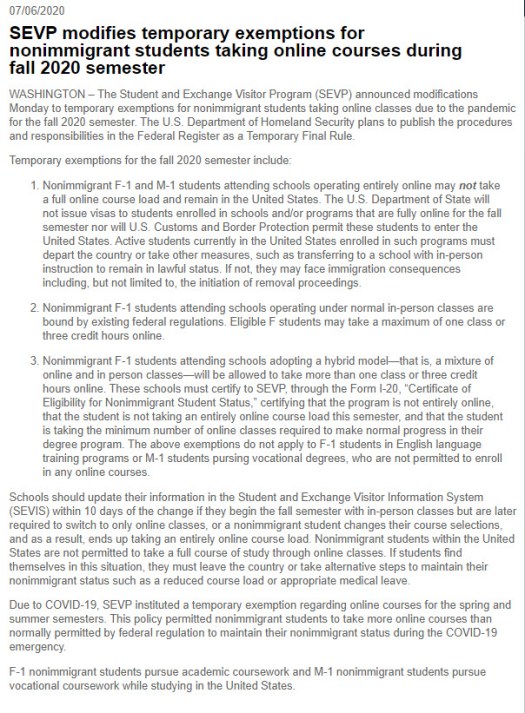
With the Broadcast Message, SEVP has indicated that non-immigrant students studying in the U.S. using an F-1 or M-1 Visa will not be permitted to remain in the United States if their program is held entirely online for the fall semester. SEVP stated that some flexibility will continue for schools that adopt an in-person or hybrid model for Fall 2020, but will not continue for students in the United States studying at schools operating entirely online. At present, there is no clear guidance regarding how much of a course must be on-ground to be “hybrid.”
New students beginning programs this fall will not receive visas if their school plans to operate online-only. Students who are already enrolled are required to transfer to a school offering at least some in-person classes or leave the country (where they are permitted to continue their courses online).
Schools that will be entirely online or will not reopen for Fall 2020 must notify SEVP no later than Wednesday, July 15, 2020. Schools that will offer an in-person or hybrid program for Fall 2020 must notify SEVP of their plans by August 1, 2020. These deadlines put intense pressure on schools to decide how they will move forward under these changes. Many schools are contemplating hybrid methods, but are reluctant at this point in time to commit to requiring students, faculty and staff to return to campus amid the COVID-19 pandemic. This decision is especially hard when schools found success operating online over the last four months and have no other reason to require attendance in person until local, state and national health officials say it is safe to do so.
F-1 and M-1 non-immigrant visas allow international students to study in the U.S. within specific parameters. As part of these programs, higher education institutions track sponsored students, ensuring their presence in the U.S. complies with relevant law and regulation. The prohibition on F-1 and M-1 students participating in online-only educational programs is intended to further compliance, as well as national security. This week, with most schools between terms, SEVP has revived its prohibition on F-1 and M-1 students enrolling in online-only curriculum’s.
Many argue that the exemption SEVP put in place in the spring should remain in place as the country continues to grapple with COVID-19. In fact, Harvard, M.I.T and the University of California have all filed lawsuits against the federal government to try to block this policy shift for fall of 2020. Harvard and M.I.T. claim that this has put higher education institutions in “the untenable situation of either moving forward with their carefully calibrated, thoughtful, and difficult decisions to proceed with their curricula fully or largely online in the fall of 2020 … or to attempt, with just weeks before classes resume, to provide in-person education despite the grave risk to public health and safety that such a change would entail.”
In addition to the logistical problems schools face with this change, many schools could face a substantial revenue loss from their large international student population. Analysis from the National Association of Foreign Student Advisers finds that international students studying at U.S. colleges and universities contributed $41 billion and supported 458,290 jobs in the U.S. economy during the 2018-2019 academic year.
For further information from SEVP on this announcement, please see the FAQ issued by the agency on July 7, 2020. For further information or questions regarding the announcements or steps towards compliance by U.S. Immigration and Customs Enforcement (ICE) concerning the Student and Exchange Visitor Program (SEVP), contact Katie Wendel at Thompson Coburn.
Update July 14, 2020. Multiple News outlets have reported The Trump administration rescinded a policy that would have stripped visas from international students whose courses move exclusively online amid the coronavirus pandemic. https://thehill.com/homenews/administration/507293-trump-administration-rescinds-policy-to-strip-visas-from-foreign
 Katie Wendel is counsel in Thompson Coburn’s higher education practice group. She handles a wide variety of regulatory and transactional work for the nonprofit and for-profit higher education sector, including online education programs, and has extensive knowledge of the laws and policies affecting colleges and universities. In addition to her comprehensive regulatory work, Katie represents higher education institutions and investors in the postsecondary sector. She works with state, federal, and accrediting agencies on behalf of colleges and universities and helps her clients maintain compliance with complex agency rules and standards.
 Ken Salomon is a co-chair of the Thompson Coburn LLP Lobbying & Policy Group and serves on the Edu Alliance Group Advisory Council. He has spent his entire legal career in the public and private sectors in Washington, DC and has a thorough understanding and appreciation of how lobbying can advance client needs and interests. He has helped clients develop and implement winning lobbying strategies by crafting and implementing innovative approaches to affect the formation of public policy in the U.S. Congress and the administration. Ken is an elected member of the Ethics Committee of the United States Olympic and Paralympic Committee.
Edu Alliance also thanks from Thompson Coburn, Kelly Simon, lead immigration partner, and Aaron Lacey, head of higher ed legal and regulatory practice for contributing to the article.
 Edu Alliance Group, Inc. (EAG) is an education consulting firm located in Abu Dhabi, United Arab Emirates and Bloomington, Indiana USA. We assist higher education institutions worldwide on a variety of mission critical projects. Our consultants are accomplished university / college leaders who share the benefit of their experience to diagnose and solve challenges.
EAG has provided consulting and successful solutions for higher education institutions in Australia, Egypt, Georgia, India, Kazakhstan, Morocco, Nigeria, Uganda, United Arab Emirates, and the United States.
Edu Alliance offers higher education institutions consulting services worldwide. Our US office specializes in assisting universities on international projects and partnerships. If you like to know more how Edu Alliance can best serve you, please contact Dean Hoke at dean.hoke@edualliancegroup.com
 By Alfredo Varela Associate Vice President Global Affairs The College of St. Rose Albany New York June 15, 2020.
 Edu Alliance Group, Inc. (EAG) is an education consulting firm located in Abu Dhabi, United Arab Emirates and Bloomington, Indiana USA. We assist higher education institutions worldwide on a variety of mission critical projects. Our consultants are accomplished university / college leaders who share the benefit of their experience to diagnose and solve challenges.
 Edu Alliance Journal