

Small Rural Colleges Are Knowledge Infrastructure

February 15, 2026, By Dean Hoke – Through my ongoing work with Small College America and Edu Alliance Group, I’ve researched dozens of rural and small-town campuses and interviewed presidents, faculty, and community leaders across the country. I keep encountering a pattern that rarely makes the national conversation about higher education’s future.

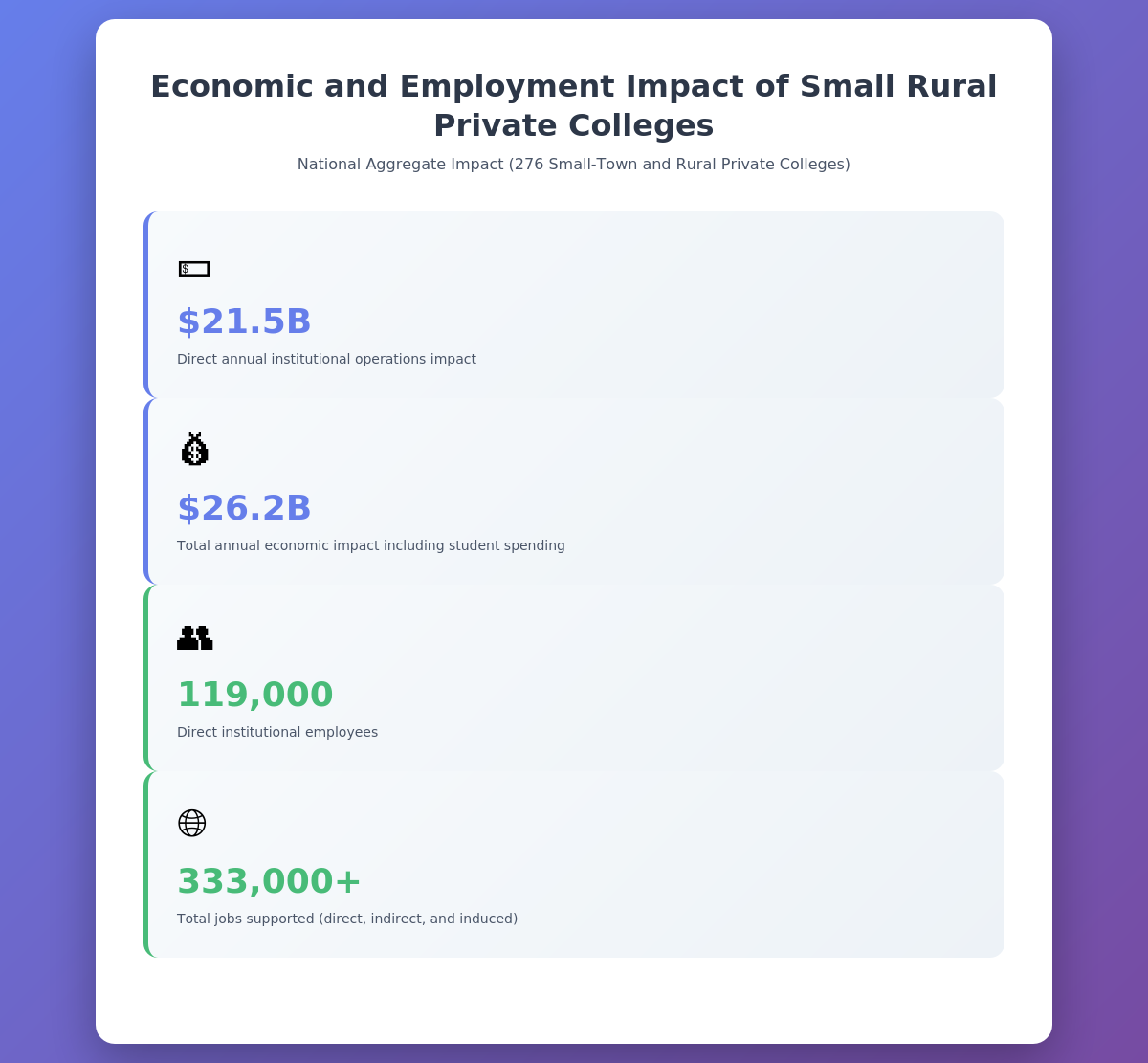
The economic case for small rural colleges is straightforward and substantial. Across 276 small-town and rural private colleges in America, institutional operations generate an estimated $21.5 billion in annual economic impact. Add student spending, and the total reaches roughly $26.2 billion. These institutions directly employ nearly 119,000 people, with total employment impact exceeding 333,000 jobs when accounting for indirect and induced effects. These institutions serve the 66.3 million Americans—roughly 20 percent of the U.S. population—who live in Census-defined rural areas.
Those numbers matter. But the multiplier, as compelling as it is, tells only part of the story.

In communities where local journalism has collapsed, where city governments lack planners or grant writers, and where technical expertise is scarce, small colleges increasingly function as something more fundamental than economic anchors.

They serve as a distributed knowledge infrastructure.

In many rural regions, they are the only institutions capable of conducting research, convening stakeholders, analyzing complex problems, and producing evidence-based recommendations. When difficult questions arise, who can evaluate this policy? Who has access to data? Who can design a solution? Rural communities often turn to their local college. Not because it is the best option among many. But because it is the only option.

“When Hendrix thrives, Conway thrives, and when Conway thrives, Hendrix thrives,” Dr. Karen K. Petersen, President of Hendrix College in Conway, Arkansas, told me. “There’s just no way for one of us separately to thrive and the other not.” Beyond shared prosperity, she sees an ecosystem at risk. If these colleges hollow out across the middle of the country, she warns, it is not simply a loss for higher education; it is a loss for the republic.

The question facing rural and small-town America is not just what happens when a college closes. It is who fills the knowledge vacuum left behind.

The Capacity Gap in Rural Communities

At the Education Writers Association’s 2025 Higher Education Seminar on rural education, panelists emphasized a critical distinction that deserves broader attention. Rural communities do not lack ambition; they lack capacity.

Many counties simply do not employ research analysts, planners, or grant writers capable of navigating federal infrastructure funding or complex policy design. Colleges frequently step into that space—convening stakeholders, hosting workshops, applying for grants, coordinating broadband expansion, and facilitating healthcare initiatives.

This capacity gap extends beyond federal funding. According to a 2024 Trust for Civic Life survey of over 500 rural residents, rural Americans trust local institutions, such as schools, churches, and community businesses, far more than national organizations. When complex problems arise, rural communities turn to the institutions they know. Increasingly, that means turning to their local colleges, even if those institutions weren’t originally designed for such roles.

In many counties, the college is the only entity with:

  • Research infrastructure
  • Analytical capacity
  • Convening power
  • Multi-disciplinary expertise

Remove the college and you do not simply lose tuition revenue or student housing demand. You lose the region’s primary source of knowledge production.
Four Domains of Knowledge Work

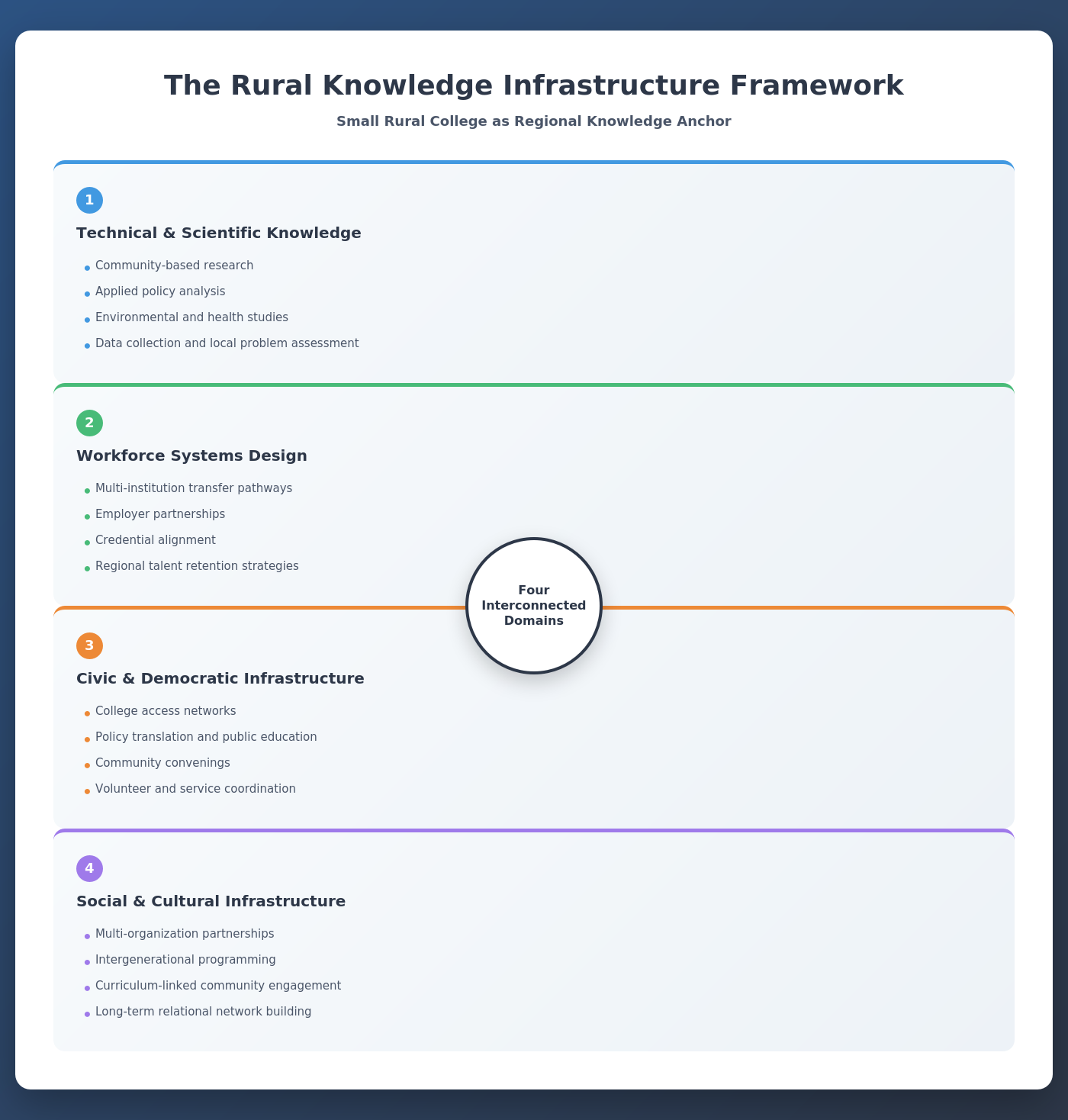
What does this knowledge infrastructure look like in practice? Across the country, small rural colleges operate in four distinct but overlapping domains.

1. Technical and Scientific Knowledge

In 2023, students at Hendrix College conducted a telephone survey of 901 older Arkansans as part of an Advanced Policy Analysis course. The project, developed in partnership with the University of Arkansas for Medical Sciences and AARP Arkansas, aimed to evaluate how communities could better serve aging populations.

The findings were striking: Conway—despite relative prosperity—ranked lowest among surveyed communities as a place to retire. Students analyzed transportation barriers, housing access, and social isolation, then presented policy recommendations at a public symposium attended by civic leaders and national AARP representatives.

Here is the question worth asking: Who would have conducted that survey if Hendrix did not exist?

Conway, a city of 59,000, does not employ research analysts. Contracting a private consulting firm would cost tens of thousands of dollars. The study likely would not have happened.

Across the country, similar patterns emerge. Environmental science students test regional water quality. Computer science students build nonprofit websites. Engineering students troubleshoot manufacturing systems. These projects may not always produce journal publications. But they produce something equally valuable to rural communities: locally actionable knowledge that would otherwise go uncreated.

2. Workforce Development Knowledge

When Arkansas officials documented a shortage of approximately 9,000 nurses, Lyon College in Batesville did more than launch a nursing major. It orchestrated a regional pipeline.

Lyon developed formal partnerships with White River Health, Arkansas State University-Newport, Ozarka College, and the University of Arkansas Community College at Batesville. Students begin liberal arts coursework at Lyon, transfer for RN licensure, then return to complete a BSN. Working nurses can finish degrees online at deliberately affordable tuition rates, with significant transfer credits applied.

This was not simply program development. It was system design.

The college identified a regional workforce shortage, convened institutions that historically operated independently, negotiated articulation agreements, aligned curricula, and built an infrastructure that retains healthcare workers locally.

In many rural communities, no other institution has the legitimacy, convening authority, and organizational stability to accomplish this kind of coordination. The college becomes a knowledge broker—connecting employers, students, technical programs, and policymakers.

3. Civic and Democratic Knowledge

In rural Kentucky, Berea College operates Partners for Education, serving the Appalachian counties through a network of full-time specialists providing academic intervention, college counseling, and wraparound services.

The program places staff directly in rural schools, offers Advanced Placement preparation, assists with college applications, and runs volunteer income tax preparation programs serving low-income families. It employs over 100 AmeriCorps volunteers annually and coordinates services across multiple counties.

This is not incidental service. It is institutionalized civic infrastructure.

When a student in Clay County aspires to attend college, Berea’s specialists navigate financial aid, admissions testing, and bureaucratic systems that under-resourced schools cannot manage alone. When families need help accessing earned income tax credits, Berea-trained volunteers assist. Remove the college, and the network dissolves.

The knowledge infrastructure here is not abstract research—it is the expertise required to translate policy into opportunity.

4. Social and Cultural Knowledge

In Swannanoa, North Carolina, Warren Wilson College coordinates the Verner Experiential Gardens—a multi-organization partnership with early childhood educators and nonprofit partners.

College students work alongside young children, developing food systems education, outdoor curriculum, and intergenerational learning environments. The partnership requires sustained coordination, curriculum integration, infrastructure management, and evaluation.

Individual volunteers can serve a meal, and Institutions build systems.

This quieter work—relationship-building, curriculum alignment, multi-year coordination—rarely appears in rankings or federal datasets. But it shapes long-term community resilience.

The Counterfactual: What Happens When Colleges Close?

Economic impact studies estimate that a small college closure can eliminate roughly $32 million in annual output and hundreds of jobs. Property values decline. Businesses shutter. Young professionals leave.

But the knowledge loss is harder to quantify—and more damaging over time.
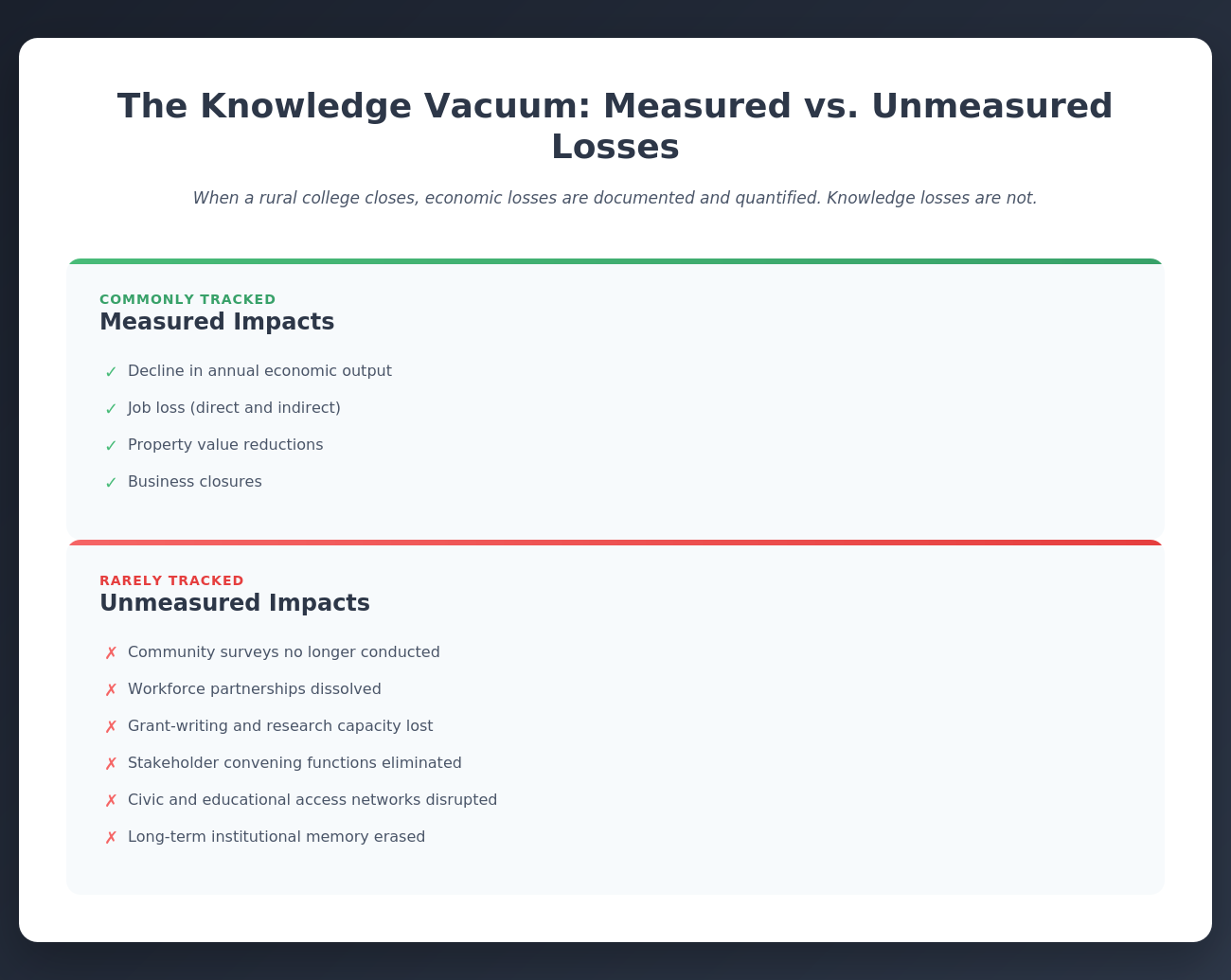
Who conducts the next community survey? Who negotiates the next workforce pipeline? Who coordinates regional college access initiatives? Who convenes hospitals, schools, and nonprofits around emerging challenges?

In major metropolitan areas, other universities, think tanks, and consulting firms can step in. In rural regions, there often is no alternative provider. When a college closes, the community loses:

  • Research capacity
  • Stakeholder convening power
  • Multi-disciplinary expertise
  • Alumni networks and institutional memory
  • Grant relationships with state and federal agencies

Infrastructure like this takes decades to build. It can vanish in months.

The Measurement Problem

Part of the challenge lies in how we measure higher education value.

Federal data systems such as IPEDS focus heavily on first-time, full-time, degree-seeking students. Adult learners, part-time enrollees, noncredit workforce trainees, and transfer preparation work are often undercounted or invisible.

The four domains described above—community surveys, workforce pipelines, civic partnerships, regional coordination—generate almost no federal metrics. We reward enrollment and graduation numbers. We ignore regional knowledge production.

The result is a mismatch between what rural colleges do for their communities and what public policy measures. When you measure the wrong outputs, you misjudge what is worth preserving.

Policy Implications: Recognizing Knowledge Infrastructure

If small rural colleges function as distributed knowledge infrastructure, policy must reflect that reality.

First, states should create Rural Knowledge Partnership Grants—competitive funding streams that reward documented college-community problem-solving initiatives.

Second, federal agencies should expand community-engaged research funding targeted specifically at small and mid-sized institutions serving rural regions.

Third, state economic development strategies should formally integrate colleges as implementation partners in broadband, healthcare, workforce, and infrastructure initiatives.

Fourth, foundations concerned about rural resilience should treat colleges not merely as grantees, but as anchor intermediaries capable of coordinating multi-sector coalitions.

These changes do not require new institutions. They require recognizing what already exists.

What We Stand to Lose

President Petersen describes Hendrix as ‘scrappy,’ an institution that ‘punches above its weight.’ But she worries about the broader ecosystem of small colleges across the middle of the country.

The demographic headwinds are real. The financial pressures are mounting. Elite institutions attract disproportionate philanthropic attention. Meanwhile, rural-serving colleges operate in relative obscurity. Yet as rural America faces aging populations, workforce shortages, infrastructure deficits, and civic fragmentation, the institutions most capable of addressing these challenges are themselves under strain.

We often talk about colleges as if they are simply educational providers. In rural America, they are something more. They are the institutional capacity to ask complex questions. They are the convening power that aligns fragmented stakeholders. They are the research engines capable of producing evidence-based solutions.

When a rural college closes, we count the lost jobs and shuttered dormitories. We rarely measure the knowledge vacuum. We do not count the surveys never conducted, the partnerships never negotiated, the civic programs dissolved, the problem-solving capacity eroded.

Infrastructure is not only roads, water systems, and broadband. It is the ability to solve problems. In many rural counties, that capacity resides primarily inside one institution: the local college. The question is not whether America can afford to sustain these institutions. The question is whether rural communities can function without them.

If we are honest about existing capacity gaps—if we recognize that knowledge infrastructure takes decades to build and weeks to dismantle—the answer becomes clear. Small rural colleges are not luxuries we can no longer afford. They are necessities we cannot afford to lose. Not because they are historic or charming. But because they perform work that no one else is doing, in places that desperately need it done.


Dean Hoke is Managing Partner of Edu Alliance Group, a higher education consultancy, and a Senior Fellow for The Sagamore Institute. He formerly served as President/CEO of the American Association of University Administrators (AAUA).

Dean has worked with higher education institutions worldwide. With decades of experience in higher education leadership, consulting, and institutional strategy, he brings a wealth of knowledge on small colleges’ challenges and opportunities. Dean is the Executive Producer and co-host for the podcast series Small College America.
The Inevitable Question: How Can Small Colleges Survive in an Era of Consolidation?

January 5, 2026Editor’s Note: Last week we published a synthesis of insights from Small College America’s 2025 webinar series, featuring voices from seven leaders navigating change, partnerships, and strategic decisions. Here, two expert panelists from the December webinar on mergers and partnerships provide a deeper analytical examination of the economic forces and partnership models reshaping small colleges.

By Dr. Chet Haskell and Dr. Barry Ryan. During a recent national webinar titled Navigating Higher Education’s Existential Challenges: From Partnerships and Mergers to Reinvention, in which we served as panelists, we were struck by both the familiarity and the seriousness of the questions raised by senior higher education leaders—particularly those concerning the growing consideration of mergers and partnerships. Most were no longer asking whether change is coming, but which options remain realistically available.

This article builds on conversations from that webinar and complements the recent synthesis of insights shared by our fellow panelists and the college presidents who participated in Small College America’s fall webinar series. Here we examine more systematically the economic forces and partnership models small colleges must now navigate. This article represents our attempt to step back from that conversation and examine more deliberately the forces now reshaping higher education.

Anyone involved with higher education is both aware and concerned about the struggles of small, independent colleges and the challenges to their viability. Defined as having 3000 or fewer students, more than 90% of these institutions lack substantial endowments and other financial assets and thus are at risk.

For many of these institutions, the risk is truly existential. Many simply are too small, too under-financed, too strapped to have any reasonable path to continuity. The result is the almost weekly announcement of a closure with all the pain and loss that accompanies such events.

Why is all this happening? Most of the problems are well known and openly discussed. Since almost all of these institutions are tuition revenue dependent, the biggest threat is declining enrollments. Demographic changes leading to fewer high school graduates are central, a situation exacerbated in many cases by Federal policy changes that discourage international students. But there are many others: excessive tuition discounting leading to reduced net tuition revenue, rising operating costs for everything from facilities to insurance to employee salaries, changes in state and Federal policies, especially student aid policies and restrictions on international students are just some examples.

The reality is that higher education is in a period of consolidation. After decades of growth beginning after the Second World War, the basic economic drivers of the private, non-profit residential undergraduate institutions are slowing down or even reversing. There simply are not enough traditional students to make all institutions viable. The basic financial model no longer works. If it did work, one could expect to see new institutions springing up. This has not happened except in the for-profit sphere, a totally different model known mostly for its excesses and failures. While there is a place for the for-profit approach, it is not in the small liberal arts college world. This is true for the same reason that the small institutions are under stress: the economics do not work.

One crucial challenge is simple scale or, rather, lack thereof. Small institutions have fewer opportunities for achieving economies of scale. Unlike larger public institutions (that have different challenges of their own) these colleges cannot have large classes as a significant characteristic of their modes of delivery. Their basic model assumes a relatively comprehensive curriculum provided through small classes, giving a wide variety of choices and pathways to a degree for undergraduates. But the broader the curriculum, the fewer students per program, almost always without commensurate faculty reductions. The economic inefficiency of the current model is clear.

And there are certain base personnel costs beyond the faculty. Every institution needs a range of administrative personnel (often required by accreditors) regardless of size. Attracting experienced personnel to such institutions is neither easy nor inexpensive.

The undergraduate residential model is both a key element in the American higher education ecosystem and a beloved concept for those fortunate enough to have experienced it. These schools are often cornerstones of small communities. They have produced an inordinate number of future professors and scholars. For example, a 2022 NCSES study provided evidence of doctoral degree attainment being at higher ratios for graduates of baccalaureate arts and science institutions than for baccalaureate graduates of R1 research universities.* The basic matter of scale is central to the liberal arts institutions’ attractiveness for students who may go on to doctoral study: small classes with high levels of faculty interaction; a focus on teaching instead of research; the sense of intimacy and a clear mission.

With proper planning and courage, some of these colleges may yet find ways to survive through some form of merger with – or acquisition by – a larger and stronger institution. Further, with sufficient foresight, many other seemingly more solid colleges may find ways to assure survival through other forms of partnerships.

However, the fact is that only the wealthiest 10% of institutions are not at immediate risk, even though prudence would suggest even they should be considering possible changes in their paths.

What can be done?

There have been multiple efforts to reimagine higher education. Some have been based on technology and have led to the growth of various distance or remote models, some quite successful, other less so. MOOCs were going to take over education generally, but have faded. For-profit models have all too often led to abuses, especially of poorer students. Artificial intelligence is at the forefront of current change concepts, but it is too early to assess outcomes. But small residential colleges have resisted such innovations, in part because they are clear about their education model and in part because they often lack the expertise or the resources to take advantage of change.

Some institutions have sought to mitigate the impacts of their scale limitations through consortia arrangements with other institutions. While significant savings may be achieved through the sharing of administrative costs, such as information technology systems or certain other “back office” functions, these savings are unlikely to be more than marginal in impact.

Other impacts for a consortium may come from cost sharing on the academic side. Small academic departments (foreign languages, for example) may permit modest faculty reductions while providing a wider range of choices for students. Athletic facilities and even teams may be shared, as well as some academic services such as international offices or career services operations. In the case of two of the most successful consortia, the Claremont Colleges and the Atlanta University Center, the schools share a central library. Access to electronic databases certainly creates an easier and less expensive pathway to increased economically efficient use of critical resources.

While the savings in expenses may be considered marginal, the true potential in such arrangements is the chance to grow collective student enrollments by offering more options and amenities than would be possible for a single institution.

However, there are other challenges to the consortium model. A primary one relates to location. Institutions near each other likely can find more ways to take advantage of the contiguity than those widely separated. Examples might be the Five Colleges in Western Massachusetts, the previously noted Claremont Colleges or the Atlanta University Center that links four HBCU institutions in the same city. New examples of cooperation include the recently announce CaliBaja Higher Education Consortium, a joint effort of both private and public institutions reaching across the border in the San Diego/Baja California region.

A different kind of sharing arrangement is represented by initiatives to share academic programs though arrangements where one institution provides courses and programs to others through licensing agreements and the like. An example would be Rize Education, an initiative that seeks to enable undergraduate institutions to expand and enhance academic offerings through courses designed elsewhere that can be readily integrated into existing curricula, thus avoiding the costs of time and money needed to build new programs.

At the other end of the spectrum are straightforward mergers and acquisitions. One institution takes over another. Sometimes this is accomplished in ways that preserve at least parts of the acquired school, even if only for political reasons related to alumni, but the reality is that one institution swallows another.

Another version is a true merger of rough equals. There are numerous examples, one of the best known being Case Western Reserve University in Ohio. In this situation, two separate institutions decided they could both be better together and, over time, they have built an integrated university of quality. A recent example may be the announced merger of Willamette University and Pacific University in Oregon. Such arrangements are quite complex, but may provide a model for certain institutions.

A third model might be the new Coalition for the Common Good. Initially a partnership of two independent universities, Antioch and Otterbein Universities, the Coalition is built on three principles: symbiosis, multilateralism and mission. The symbiosis involves Antioch taking on and expanding Otterbein’s graduate programs for the shared benefit of both institutions. Multilateralism refers to the Coalition basic concept of being more than two institutions as the goal: a collection of similar institutions. Mission is central to the Coalition. The initial partners share long histories of institutional culture and mission, as reflected in the name of the Coalition itself.

Other partnership models are possible and should be encouraged. While it is rare to see a partnership of true equals, as one partner is usually dominant, this middle ground between a complete merger or acquisition and consortia should be fertile ground for innovation for forward thinking institutions not in dire straits. Since there is no single approach to such structures, the benefits to participating partners should be at the core of the approach. These partnerships may be able to address the challenge of scale and provide opportunities for shared costs. Properly presented, they should be attractive to potential students and provide a competitive edge in a highly competitive environment.

The importance of mission and culture

While the root cause of most college declines and failures is economic in nature, it is all too easy to forget the role of an institution’s mission and culture. Many colleges look alike in terms of academic offerings, yet institutions usually have a carefully defined and defended mission or purpose. These missions are important because they help define the college as more than just a collection of courses. Education can serve many different missions and thus mission clarity is crucial to institutional identify. And identity is one way for institutions to differentiate themselves from competition, while also helping to attract students.

Mission is also tied to institutional culture. Colleges have different subjective cultures that serve to attract certain students, as well as faculty and staff members. Spending four years of one’s life ought not to be spent in an impersonal organizational setting. There are multiple individual personal reasons for attending one institution instead of another. Most of these reasons are not entirely objective, but instead depend on an individual’s sense of ‘fit’ in the college setting.

What should institutions be doing?

The stark reality is that for many smaller institutions the alternative to some sort of partnership is likely to be closure. But closure is not to be taken lightly. The impact of these institutions is far-reaching and the human, educational and community costs are very real.

All institutions, regardless of financial assets, should be openly discussing their futures in a changing world. As noted, a few may be able to simply proceed with what they have been doing for years. But this luxury (or blindness) is not a viable or attractive option for most.

Every institution should be looking into the future at its basic model. Is there a realistic path to assuring enrollment and revenue growth in excess of expenses over time? Is there a budget model that provides regular surpluses that can provide a cushion against unanticipated challenges or can enable investment in new initiatives? Are there alternative paths to revenues that can augment tuition, such as fundraising, auxiliary enterprises or the like? And in looking at such questions, an institution should be asking how it can be better off over time with a partner or partners.

Even institutions that examine such matters and conclude it would be advantageous to engage a partner are faced with daunting challenges. First is determining what is desired in a partner and then identifying one. Some colleges feel bound by geography, so can only think about like institutions nearby. Others are more creative, looking to use technology to enable a more widely dispersed partnership.

Once a partner is identified, the path to an agreement is arduous, complex, lengthy and costly. Accreditors, the Department of Education, state boards of higher education, alumni, and all manner of other interested parties must be addressed. This requires external legal and financial expertise. This process is excessively demanding of an institution’s leaders, especially presidents, provosts and chief financial officers. Boards must be deeply involved and internal constituencies of faculty and staff must be brought along.

And once a final agreement is reached, signed and approved, the work has only begun. The implementation of any partnership is also arduous, complex, lengthy and costly. Furthermore, implementation involves deep human factors, as institutional cultures must be aligned and new personal professional partnerships must be developed.

The fact is that many institutions will either enter into some form of partnerships in the coming years, as the alternative will be closure. Unfortunately, the clock is ticking, and unnecessary delays create limitations on available options and increase risks. Every institution’s path into partnerships will vary, as will the particulars of each arrangement. It is incumbent upon boards of trustees and institutional leaders to face such facts realistically and to devise practical plans to move forward. Not doing so would be a dereliction of duty.


Dr. Chet Haskell is an experienced higher education consultant focusing on existential challenges to smaller nonprofit institutions. and opportunities for collaboration. Dr. Haskell is a former two-time president and, most recently, a provost directly involved in three significant merger acquisitions or partnership agreements. including the coalition. for the common good, the partnership of Antioch and Otterbein University.

Barry Ryan is an experienced leader and attorney. has served as a president and provost for multiple universities. He helped guide several institutions through mergers, acquisitions, and accreditation. Most recently, he led Woodbury University through its merger. with the University of Redlands. He also serves on university boards and is a commissioner for WASC.

Haskell and Ryan are the Co-Directors of the Center for College Partnerships and Alliances, launched by Edu Alliance Group in late 2025. It is dedicated to helping higher education institutions explore and implement college partnerships, mergers, and strategic alliances designed to strengthen sustainability and mission alignment.