

May 19, 2025, by Dean Hoke: In my recent blog series and podcast, Small College America, I’ve highlighted the essential role small colleges play in the fabric of U.S. higher education. These institutions serve as academic homes to students who often desire alternatives to larger universities, and as cultural and economic anchors, especially in rural and small-town America, where, according to IPEDS, 324 private nonprofit colleges operate. Many are deeply embedded in the towns they serve, providing jobs, educational access, cultural life, and long-term economic opportunity.
Unfortunately, a wave of proposed federal budget cuts may further severely compromise these institutions’ ability to function—and in some cases, survive. Without intervention, the ripple effects could devastate entire communities.
Understanding the DOE and USDA Budget Cuts
The proposed reductions to the U.S. Department of Education (DOE) and U.S. Department of Agriculture (USDA) budgets present a two-pronged threat to small colleges, particularly those in rural areas or serving low-income student populations.
Department of Education (DOE)
The most significant concerns center on proposed changes to Pell Grants, a vital financial resource for low-income students. One House proposal would redefine full-time enrollment from 12 to 15 credit hours per semester. If enacted, this change would reduce the average Pell Grant by approximately $1,479 for students taking 12 credits. Students enrolled less than half-time could become ineligible entirely.
Additionally, the Federal Work-Study (FWS) and Supplemental Educational Opportunity Grants (SEOG) programs face serious threats. The House Appropriations Subcommittee has proposed eliminating both programs, which together provide over $2 billion annually in aid to low-income students.
Programs like TRIO and GEAR UP, which support first-generation, low-income, and underrepresented students, have been targeted in previous proposals; however, current budget drafts maintain level funding. Nonetheless, their future remains uncertain as negotiations continue.
The Title III Strengthening Institutions Program, which funds academic support services, infrastructure, and student retention efforts at under-resourced colleges, received a proposed funding increase in the FY 2024 President’s Budget, though congressional appropriations may differ.
Department of Agriculture (USDA)
The USDA’s impact on small colleges, while less direct, is nonetheless critical. Discretionary funding was reduced by more than $380 million in FY 2024, reflecting a general pullback in rural investment.
Programs like the Community Facilities Direct Loan & Grant Program, which supports broadband access, healthcare facilities, and community infrastructure, were level-funded at $2.8 billion. These investments often benefit rural colleges directly or indirectly by enhancing the communities in which they operate.
While some funding has been maintained, the broader trend suggests tighter resources for rural development in the years ahead. For small colleges embedded in these communities, the consequences could be substantial: delayed infrastructure upgrades, reduced student access to services, and weakened town-gown partnerships.
Why Small Colleges Are Particularly Vulnerable
Small private nonprofit colleges—typically enrolling fewer than 3,000 students—operate on thin margins. Many are tuition-dependent, with over 80% of their operating revenue derived from tuition and fees. They lack the substantial endowments or large alumni donor bases that buoy more prominent institutions during hard times.
What exacerbates their vulnerability is the student profile they serve. Small colleges disproportionately enroll Pell-eligible, first-generation, and minority students. Reductions in federal financial aid and student support programs have a direct impact on student enrollment and retention. If students can’t afford to enroll—or stay enrolled—colleges see revenue declines, leading to cuts in academic offerings, faculty, and student services.
Additionally, small colleges are often located in areas experiencing population decline. The so-called “demographic cliff”—a projected 13% drop in the number of high school graduates from 2025 to 2041 will affect 38 states and is expected to hit rural and non-urban regions the hardest. This compounds the enrollment challenges many small colleges are already facing.
Economic and Social Impact on Rural Towns
The closure of a small college doesn’t just mean the loss of a school; it signifies a seismic shift in a community’s economic and social structure. Colleges often rank among the top employers in their towns. When a college closes, hundreds of jobs disappear—faculty, staff, groundskeepers, maintenance, food services, IT professionals, and more.
Consider Mount Pleasant, Iowa, where the closure of Iowa Wesleyan University in 2023 cost the local economy an estimated $55 million annually. Businesses that relied on student and faculty patronage—restaurants, barbershops, bookstores, and even landlords—felt the immediate impact. Community organizations lost vital volunteers. Town officials were left scrambling to figure out what to do with a sprawling, empty campus in the heart of their city.
Colleges also provide cultural enrichment that is often otherwise absent in small towns. Lectures, concerts, art exhibitions, and sporting events bring together diverse groups and add vibrancy to the local culture. Many offer healthcare clinics, counseling centers, or continuing education for adults—services that disappear with a campus closure.
USDA investments in these communities are often tied to colleges, whether in the form of shared infrastructure, grant-funded development projects, or broadband expansions to support online learning. As these federal investments diminish, so too does a town’s ability to attract and retain both residents and employers.
Real-Life Implications and Stories
The headlines tell one story, but the real impact is felt in the lives of students, faculty, and the surrounding communities.
Presentation College in Aberdeen, South Dakota, ceased operations on October 31, 2023, after citing unsustainable financial and enrollment challenges. Hundreds of students, many drawn to its affordability, rural location, and nursing programs, were forced to reconsider their futures. The college quickly arranged teach-out agreements with over 30 institutions, including Northern State University and St. Ambrose University, which offered pathways for students to complete their degrees. The Presentation Sisters, the founding order, are now seeking a buyer for the campus aligned with their values, while local officials explore transforming the site into a technical education hub to continue serving the community.
Birmingham-Southern College in Alabama, a 168-year-old institution, closed its doors on May 31, 2024, after a $30 million state-backed loan request was ultimately rejected despite initial legislative support. The college had a $128 million annual economic impact on Birmingham and maintained partnerships with K–12 schools, correctional institutions, and nonprofits. The closure triggered the transfer of over 150 students to nearby colleges like Samford University, but left faculty, staff, and the broader community facing economic and cultural losses. A proposed sale of the campus to Miles College fell through, leaving the site’s future in limbo.
Even college leaders who have weathered the past decade worry they’re nearing a breaking point. Rachel Burns of the State Higher Education Executive Officers Association (SHEEO) has tracked dozens of recent closures and warns that many institutions remain at serious risk, despite their best efforts. “They just can’t rebound enrollment,” she says, noting that pandemic aid only temporarily masked deeper structural vulnerabilities.
Potential Closures and Projections
College closures are accelerating across the United States. According to the State Higher Education Executive Officers Association (SHEEO), 467 institutions closed between 2004 and 2020—over 20% of them private, nonprofit four-year colleges. Since 2020, at least 75 more nonprofit colleges have shut down, and many experts believe this pace is quickening.
A 2023 analysis by EY-Parthenon warned that 1 in 10 four-year institutions—roughly 200 to 230 colleges—are currently in financial jeopardy. These schools are often small, private, rural, and tuition-dependent, serving large numbers of first-generation and Pell-eligible students. Even a modest drop of 5–10% in tuition revenue can be catastrophic for colleges already operating on razor-thin margins.
Compounding the challenge, the Federal Reserve Bank of Philadelphia released a 2024 predictive model forecasting that as many as 80 additional colleges could close by 2034 under sustained enrollment decline driven by demographic shifts. This figure accounts for closures only—not mergers—and spans public, private nonprofit, and for-profit sectors.
Layered onto these economic and demographic vulnerabilities are the potential impacts of proposed federal education funding cuts. The Trump administration’s FY 2026 budget blueprint once again targets student aid programs, proposing the elimination or severe reduction of subsidized student loans, TRIO, GEAR UP, Federal Work-Study, and the Supplemental Educational Opportunity Grant (SEOG). Although similar proposals from Trump’s first term (FY 2018–2021) were rejected by Congress, the renewed push signals ongoing political pressure to curtail support for low-income and first-generation students.
To assess the potential impact of these policy shifts, a policy stress test was applied to both the Philadelphia Fed model and the historical closure trend. The analysis suggests that if these cuts were enacted, an additional 50 to 70 closures could occur by 2034.
- Philadelphia Fed model baseline: 80 projected closures
- With policy cuts: Up to 130 closures
- Historical average trend (2020–2024): ~14 closures/year
- 10-year projection (status quo): ~140 closures
- With policy cuts: Up to 210 closures
In short, depending on the scenario, anywhere from 130 to 210 additional college closures may occur by 2034. Institutions most at risk are those that serve the very populations these federal programs are designed to support. Without intervention—through policy, partnerships, or funding—the number of closures could rise sharply in the years ahead.
These scenario-based projections are summarized in the chart below.

Why Should Congress Care
According to the National Association of Independent Colleges and Universities (NAICU), a private, nonprofit college or university is located in 395 of the 435 congressional districts. These institutions are not only centers of learning but also powerful economic engines that generate:
- $591.5 billion in national economic impact
- $77.6 billion in combined local, state, and federal tax revenue
- 3.4 million jobs supported or sustained
- 1.1 million people are directly employed in private nonprofit higher education
- 1.1 million graduates are entering the workforce each year
As such, the fate of small private colleges is not just a higher education issue—it is a national economic and workforce development issue that should command bipartisan attention.
Strategies for Resilience and Policy Recommendations
There are clear, actionable strategies to reduce the risk of widespread college closures:
- Consortium and shared governance models: Small colleges can boost efficiency and sustainability by sharing administrative functions, faculty, academic programs, technology infrastructure, and enrollment services. This allows institutions to reduce operational costs while maintaining their distinct missions and brands. In some cases, these arrangements evolve into formal mergers. An emerging example is the Coalition for the Common Good, a new model of mission-aligned institutions that maintain individual identities but operate under shared governance. This structure offers long-term financial stability without sacrificing institutional purpose or community impact.
- Strategic partnerships: Collaborations with community colleges, online education providers, regional employers, and nonprofit organizations can expand reach, enhance curricular offerings, and improve student outcomes. These partnerships can support 2+2 transfer pipelines, workforce-aligned certificate programs, and hybrid learning models that meet the needs of adult learners and working professionals, often underserved by traditional residential colleges.
- State action: States should establish stabilization grant programs and offer targeted incentive funding to support mergers, consortium participation, and regional collaboration. Policies that protect institutional access in rural and underserved areas are especially urgent, as closures can leave entire regions without viable higher education options. States can also play a role in convening institutions to plan for shared services and long-term viability.
- Federal investment: Continued and expanded funding for Pell Grants, TRIO, SEOG, Title III and V, and USDA rural development programs is essential to sustaining the institutions that serve low-income, first-generation, and rural students. These investments should be treated as critical infrastructure, not discretionary spending, given their role in expanding educational equity, enhancing workforce readiness, and promoting rural economic development. Consistent federal support can help stabilize small colleges and enable long-term planning.
College leaders, local governments, and community groups must advocate in unison. The conversation should move beyond institutional survival to one of community survival. As the saying goes, when a college dies, the town begins to die with it.
Conclusion
Small colleges are not expendable. They are vital threads in the educational, economic, and cultural fabric of America, especially in rural and underserved communities. The proposed federal budget cuts across the Departments of Education and Agriculture represent a direct threat not only to these institutions but to the communities that depend on them.
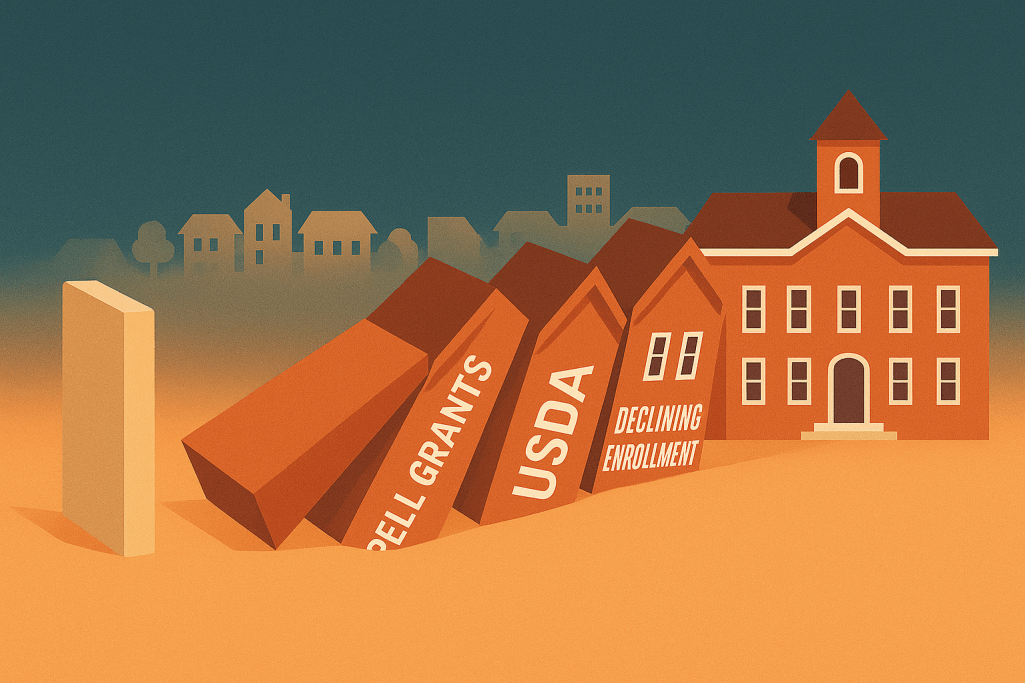
If policymakers fail to act, the consequences will be widespread and enduring. The domino effect is real: reduced funding leads to fewer students, tighter budgets, staff layoffs, program cuts, and eventually, campus closures. And when those campuses close, entire towns are left to absorb the fallout—economically, socially, and spiritually.
We have a choice. We can invest in the future of small colleges and the communities they anchor, or we can stand by as they vanish—along with the promise they hold for millions of students and the towns they call home.
References
- U.S. Department of Education, FY 2025 Budget Summary and Justifications
- National Association of Student Financial Aid Administrators (NASFAA), Analysis of Proposed Pell Grant and Campus-Based Aid Reductions
- State Higher Education Executive Officers Association (SHEEO) and Higher Ed Dive, Data on College Closures and Institutional Viability Trends
- Fitch Ratings, Reports on Financial Pressures in U.S. Higher Education Institutions
- Iowa Public Radio and The Hechinger Report, Case Studies on Rural College Closures and Community Impact
- Council for Opportunity in Education (COE), Statements and Data on TRIO Program Reach and Effectiveness
- Federal Reserve Bank of Philadelphia, Predictive Modeling of U.S. College Closures (2024)
- EY-Parthenon, 2023 Report on Financial Vulnerability Among Four-Year Institutions
- U.S. Department of Agriculture (USDA), Rural Development and Community Facilities Loan & Grant Program Summaries
- Interviews and commentary from institutional leaders, TRIO program directors, and SHEEO policy staff
- Integrated Postsecondary Education Data System (IPEDS), Data on Enrollment, Institution Type, and Geographic Distribution

Dean Hoke is Managing Partner of Edu Alliance Group, a higher education consultancy. He formerly served as President/CEO of the American Association of University Administrators (AAUA). With decades of experience in higher education leadership, consulting, and institutional strategy, he brings a wealth of knowledge on small colleges’ challenges and opportunities. Dean is the Executive Producer and co-host for the podcast series Small College America.


 Edu Alliance Journal