
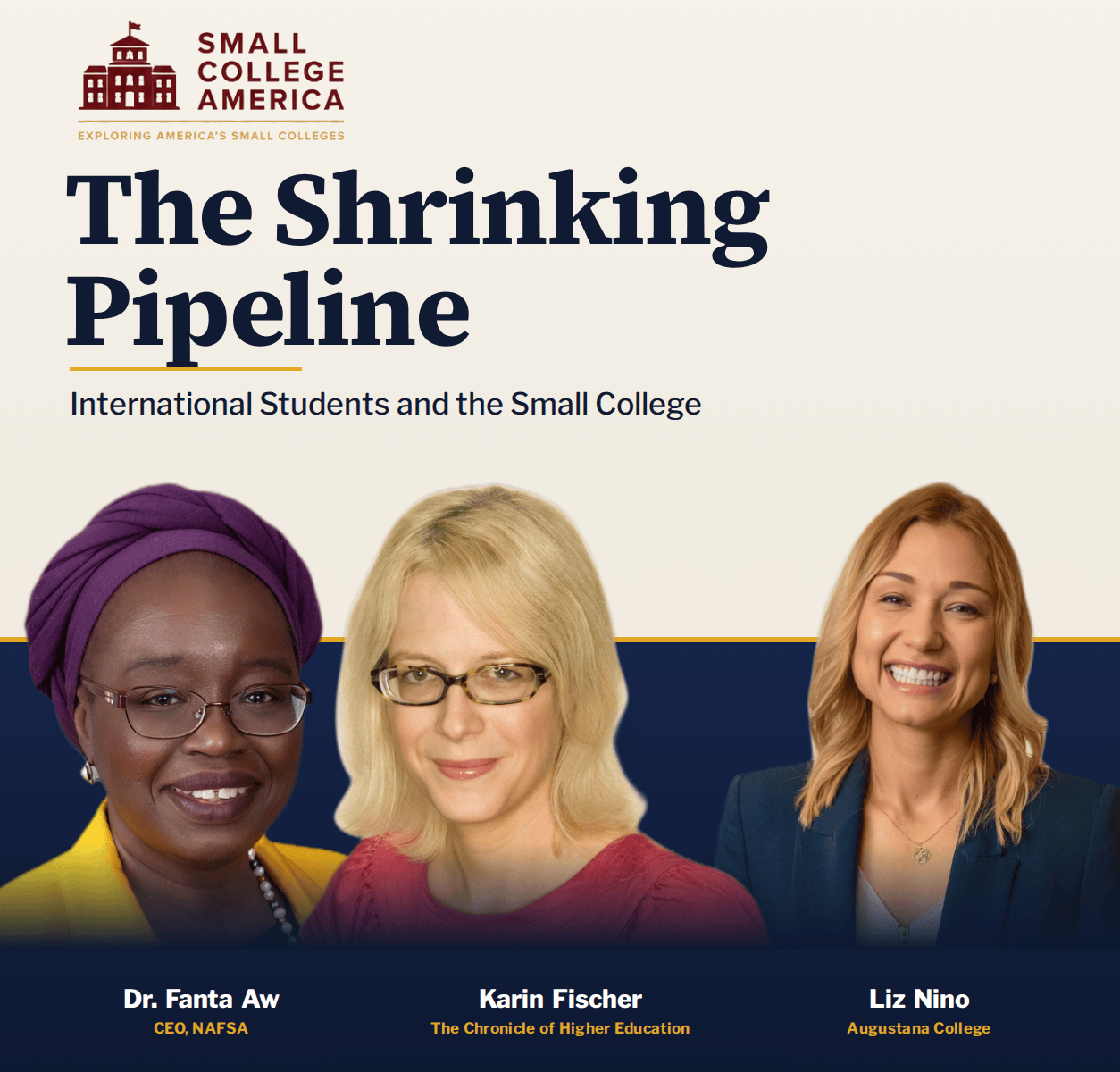
October 12, 2026, by Dean Hoke: Is the international student pipeline to American colleges shrinking, or is the way students choose where to study fundamentally changing? That question was at the center of our October 6 Small College America: Consequential Conversations webinar, which I co-hosted with W. Kent Barnds of Augustana College.
We were joined by three guests who brought national leadership, journalistic insight, and firsthand experience to the discussion. Dr. Fanta Aw, Executive Director and CEO of NAFSA (Association of International Educators), offered a national and global perspective. Karin Fischer, international reporter for The Chronicle of Higher Education, brought more than two decades of reporting on international education. And Liz Nino, Executive Director of International Enrollment at Augustana College, brought the perspective of someone on the front lines—traveling internationally, meeting students and families, and navigating today’s recruitment challenges.
The conversation revealed a complicated picture, but also some reasons for optimism.
Is Student Interest Declining, or Are the Obstacles Growing?
Karin Fischer described today’s international enrollment environment as one of “permanent uncertainty.” Visa difficulties, shifting government policies, and concerns about post-graduation opportunities are complicating decisions for students and families.
Liz Nino highlighted these challenges through Augustana’s recruitment experience. Students who wanted to attend an American college sometimes couldn’t get visas or even schedule interviews in time.
That raises an important question: Are American colleges losing their appeal, or are students simply finding it harder to get here?
The Small College Advantage
Much of the national conversation focuses on large research universities, but smaller institutions face different circumstances. Our panelists explored how personal relationships, residential experiences, and a sense of community can give small colleges competitive advantages. Yet those strengths mean little if international students and their families don’t understand what makes an American small college distinctive.
The discussion also went beyond enrollment numbers and tuition revenue. What happens to the educational experience when international students become a smaller part of campus life?
A Strategic Decision That Could Shape the Next Decade
Perhaps the most consequential advice came from Fanta Aw, who cautioned college leaders against allowing today’s difficulties to dictate tomorrow’s strategy. “Don’t make a long-term strategic decision based solely on a disruption now.”
“Don’t make a long-term strategic decision based solely on a disruption now.”
Her observation raises a difficult question for presidents and trustees: How do you manage immediate financial pressures without sacrificing international relationships and recruitment networks that took years to establish? The panelists also explored opportunities that may be emerging despite today’s challenges, including alternative pathways for international students.
We concluded by asking each panelist to look five years ahead. Their perspectives offered important considerations for college leaders making decisions today.
The future of international enrollment at America’s small colleges may depend less on the size of their recruitment budgets than on the strategic choices they make now.
These highlights only scratch the surface of a wide-ranging conversation. I encourage you to watch or listen to the full program and hear directly from our three panelists.
Watch the full webinar: https://youtu.be/E78DseQwp0I
Listen to the conversation: https://smallcollegeamerica.transistor.fm/51
Small College America: Consequential Conversations is a monthly discussion series hosted by Dean Hoke and W. Kent Barnds that examines the issues shaping the future of America’s small colleges.

