

Why US Schools will see a Decline in Fall 2017 in International Students

By Dean Hoke

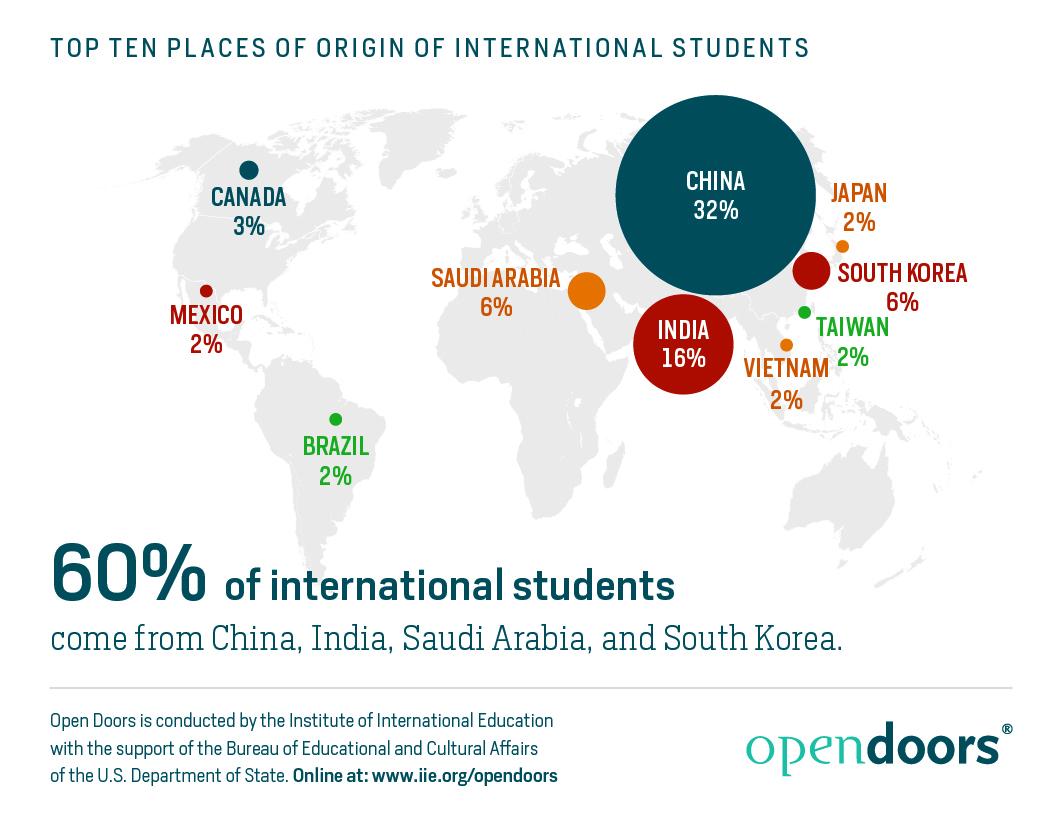
During the past few weeks a number of articles and reports have been published concerning international student enrollment in US higher education institutions. The two studies are: “Shifting Tides: Understanding International Student Yield for fall 2017,” conducted by the Institute of International Education and Data Sources: Admission Yields of Prospective International Graduate Students: A First Look” conducted by the Council of Graduate Schools. Both studies provide important insights into the higher education community. The third item is a story from the Washington Post dated July 10th titled “Overseas students would face close scrutiny under proposal floated at DHS”. also speaks to the importance of the future of international students attending in the United States.

The studies present results which seem to confirm international student enrollment for 2017 is at best flat and more likely predicting a 2-5% decline which reverses a decade trend of increased new international student enrollment in undergraduate and graduate degree programs. The data also states that in particular Texas will have a 5-15% decline in new international students while the other three largest states with international students California, New York, and Massachusetts will hold steady.

Why the likely enrollment decline is widely debated in the higher education community, I believe there are four critical reasons for a decline:

  1. Increased competition for International students

 The United States is finding competition from other countries such as Australia, Canada, and Europe. Regulations for students to enter the country for academic study have been eased and the cost to attend is competitive or in many cases is less expensive. Also many of schools outside the US are now perceived by prospective students and parents as good or nearly as good quality of a United States R2 or R3 institution.

  1. Immigration Ban of 6 Nations

 President Trump has issued an Executive Order banning citizens of 6 nations to enter the United States. It is currently partially in place and waiting for a fall decision of the US Supreme Court. If the ban is put fully in place it will impact about 14,000 students could be affected from Iran, Libya, Somalia, Sudan, Syria and Yemen on international student population. In pure numbers, the loss is not numerically significant. However the immigration ban has sent a signal to Muslim students from the Middle East, Africa and Asia and may well be having a chilling effect on potential students beginning 2017 and the upcoming years. 

  1. Tightening of H-1B visa programs

H-1B visa program allows U.S. employers to temporarily employ up to 65,000 foreign workers in specialty occupations. In addition, another 20,000 foreign nationals holding a master’s or higher degree from U.S. universities may receive the H-1B visa.

Excluded from the ceiling are all H-1B non-immigrants who work at (but not necessarily for) universities, non-profit research facilities associated with universities, and government research facilities.

President Trump signed on April 18th a “Buy American, Hire American” Executive Order which sets broad policy intentions directing federal agencies to propose reforms to the H-1B visa system. This has caused concerns among international students especially in STEMS majors who intended to work in the US usually with multi-national firms for 1-3 years after graduation. The H-1B program has helped attract top-level international students to US universities and to US corporations. This Executive Order may have a smaller effect in the Fall 2017 enrollments but be a major factor beginning Fall 2018.

  1. Student and Parental Concerns

The 2017 IIE survey asked about concerns students have regarding coming to the United States. Responses from the Middle East and Indian population stand out.

  • Middle East: 41% of the potential students expressed concern about being welcomed in the US
  • Middle East: 23% stated their concern for their physical safety.
  • India: 31% of the potential students expressed concern about being welcomed in the US
  • India: 80% stated their concern for their physical safety.

Texas, which in the past has enrolled many Indian and Middle East students, is experiencing the largest drop in applications. Articles in US and international papers, which interview students and parents, express concerns about potential

violence, intimidation, or discrimination. Whether there is an increase in these areas of concern, the data is not clear but clearly the perception is there.

Student Concerns
“Shifting Tides: Understanding International Student Yield for fall 2017,”
Potential New Regulations for Student Visa’s Raises Concerns

In addition to the four reasons above a possible new change in federal regulation would further increase student decline. The Washington Post on July 10th filed a story titled Overseas students would face close scrutiny under proposal floated at DHS in which they report, “Senior officials at the Department of Homeland Security are floating a proposal that would require foreign students to re-apply for permission to stay in the United States every year, a controversial move that would create new costs and paperwork for thousands of visa holders from China, India and other nations, according to two federal officials with direct knowledge of the discussions.” The article further states, “The officials say the proposal seeks to enhance national security by more closely monitoring the students.”

Pedro Ribeiro, a spokesman for the Association of American Universities, a former deputy assistant secretary of homeland security in the Obama administration and a former assistant ICE director was asked his opinion of the proposal. He called the policy “both a policy and logistical nightmare.” The DHS and the State Department “simply don’t have enough counselors and immigration personnel to properly administer a change to the visa program like the one proposed,” Ribeiro said. “It would also have a tremendous chilling effect on students who would have to spend more time doing paperwork than studying.”

This potential change in regulations whether the program is implemented or not, will have a negative effect on those students who are considering coming to United States universities beginning 2018.

Dean Hoke is Co-Founder and North America Managing Partner of Edu Alliance, a higher education consulting firm with offices in Bloomington Indiana and Abu Dhabi United Arab Emirates. 
Should your University enter into a Public/Private Partnership – the Pro’s and Con’s

By Dr. James T. McGill – Retired Senior Vice President for Finance and Administration Johns Hopkins University and member of the Edu Alliance Advisory Council

“P3” (Public/Private Partnership) has become a commonly used acronym in U.S. higher education, as well as in other spheres, notably state and local government. Definition:

  • “Public” is a non-profit institutional or governmental entity that engages a “private” for-profit entity to pay for a particular project.
  • The “private” partner provides funding (and often expertise) to deliver (and often operate) the project used by the “public” entity to meet its purposes.
  • In return for its capital, the “private” entity gets a revenue flow from the asset it has paid for.

A typical example of a higher education P3 project is a private partner paying for and operating a new, revenue-generating facility on the public partner’s property, such as a student residence hall.

The P3 term also can encompass outright purchase by a “private” entity of a physical asset of a “public” entity and subsequent operation of that asset with the cost and revenues emanating therefrom accruing to the “private” partner. The public seller reaps a one-time payment up front. Two recent higher education examples are selling the ownership, and turning over the subsequent operation, of i) campus parking and ii) heating, ventilation, and air conditioning facilities.

This blog focuses on the positives and negatives of the use of P3 arrangements in providing a new facility through a P3, exemplified by a residence hall transaction.

There are a plethora of economically challenged colleges and universities with relatively small operational staff, thereby having only limited financial and personnel resources to manage the delivery of a new building. An institution’s capacity to pay for new student residence hall, say, may be constrained in several dimensions: i) insufficient accumulated cash, ii) reluctance to use endowment resources, and/or iii) limited borrowing capability. Such an institution may consider turning to a private partner with investment capital. Typically, the private partner will have expertise and experience in delivering the facility, knowing efficient construction approaches, how to deal with local zoning and environmental regulations, and managing local permitting processes. Perhaps, too, a partner might be experienced in dealing with the interested publics – neighbors and political interests. Such firms may also be familiar with governmental subsidies available to support such projects; an example is a project located in an economic empowerment zone. Too, not atypically, such a partner is able to deliver a project more quickly than if managed by the institution.

All sounds positive – some else’s money, expertise in building, knowledge of local regulatory restrictions, and fast delivery of a right-priced facility. Are there any drawbacks? Several countervailing factors to consider:

First, the “cost of capital” must be considered. The private partner is paying for the project with its own money (or, often, with that of financial partners it brings to the transaction); thus, it expects a return of perhaps 8-12% annually, maybe more. That return is generated from the “profits” of the operation of the facility it financed. If the institution is capable of borrowing from i) its own endowment (at a long-term annual cost from foregone investment returns of, say, 6% to 8%) or ii) a bank or the public bond markets (at rates today of perhaps 4% to 5% annual interest costs), there is an incremental carrying cost, ceteris paribus, to the public partner in a P3 arrangement.

Also related to “cost of capital” with the use of the private partner’s money, the bond markets and rating agencies may count part of the project cost as if the public partner had actually borrowed the money, resulting in a decline in the institution’s net worth (“balance sheet degradation” in accounting talk). If a rating agency believes that the institution would be obligated to step in to “rescue” the project if the private partner fails to meet its obligations, its cost will be counted, at least in part, as a credit obligation of the public entity. Any such project located on the campus property is usually so considered, in part at least, as an obligation of the institution. But access to a private partner’s capital nonetheless may be very attractive.

Second, the private partner will manage the facility. While relieving the institution from those day-to-day responsibilities, the public partner must negotiate conditions that ensure proper treatment of occupants in, say, the new residence hall, as if they were in a campus-owned facility. Often, too, the institutional partner is expected to help ensure the profitability of a residence hall by guaranteeing a flow of students to keep its beds filled, maintaining that the cash flow to the private partner. Thus, the institution gives up certain operating autonomies that can be core to its mission. These arrangements have been negotiated satisfactorily at many higher education institutions.

Third, there is the matter of the quality vs. cost of a building to be delivered under a P3 arrangement. The institution needs to specify such requirements and the private partner needs to agree to adhere to an institutional review process to ensure standards will be met. Imposing quality requirements may have pricing implications: the more expensive the project to build, the less value it may have to the private partner. Related is agreement on the responsibility of the private partner to maintain physically the facility throughout the life of the deal. Examples include roof repairs, replacement of heating and related infrastructure, painting and repair of the interior, facade maintenance, etc. Also, it is important to have documented understandings about the “end of the deal” condition of the facility — tear–down condition or fully operational, for instance.

Fourth, P3 arrangements are long-term, perhaps running to 75 years or more. And so, such arrangements will restrict uses of the land on which a project sits well beyond anyone’s capability today to project future institutional needs.

In short, there are positives and negatives to P3 arrangements. A higher education institution considering such must thoughtfully balance them all to arrive at a best decision.

Dr. James T. McGill (Jim) is a life-long higher education finance and administration executive.  He served as the chief business and finance officer at three universities spanning thirty years:  Oregon’s academic health science university, Missouri’s four-campus land grant institution and the Johns Hopkins University. All involved considerable focus on the academic health sciences. He had responsibility for the full range of financial operations; facilities; land development; human resources, and various other administrative functions.

Since retiring from his last full-time position, he has had an active consulting business, serving as a temporary executive at three different institutions and advising on strategic and financial planning at others.  He has supported several non-profit charitable enterprises through board membership and has also recruited and mentored higher education executives.