
One Course at a Time—and the Value of Being Different
September 20, 2026, by Dean Hoke: In my studies and interviews over the years with small private colleges, I have found that the vast majority believe there is something unique or special about their institution. In some cases, that distinction is easier to identify than in others. At Colorado College, it is quite clear. Students take one course at a time.
For more than half a century, Colorado College has organized almost its entire undergraduate experience around what it calls the Block Plan. A block lasts three and a half weeks, with students typically meeting from 9 a.m. to noon each weekday. In effect, a semester’s worth of work is concentrated into 18 class days. Students complete eight blocks during the academic year, with a short break between each one.
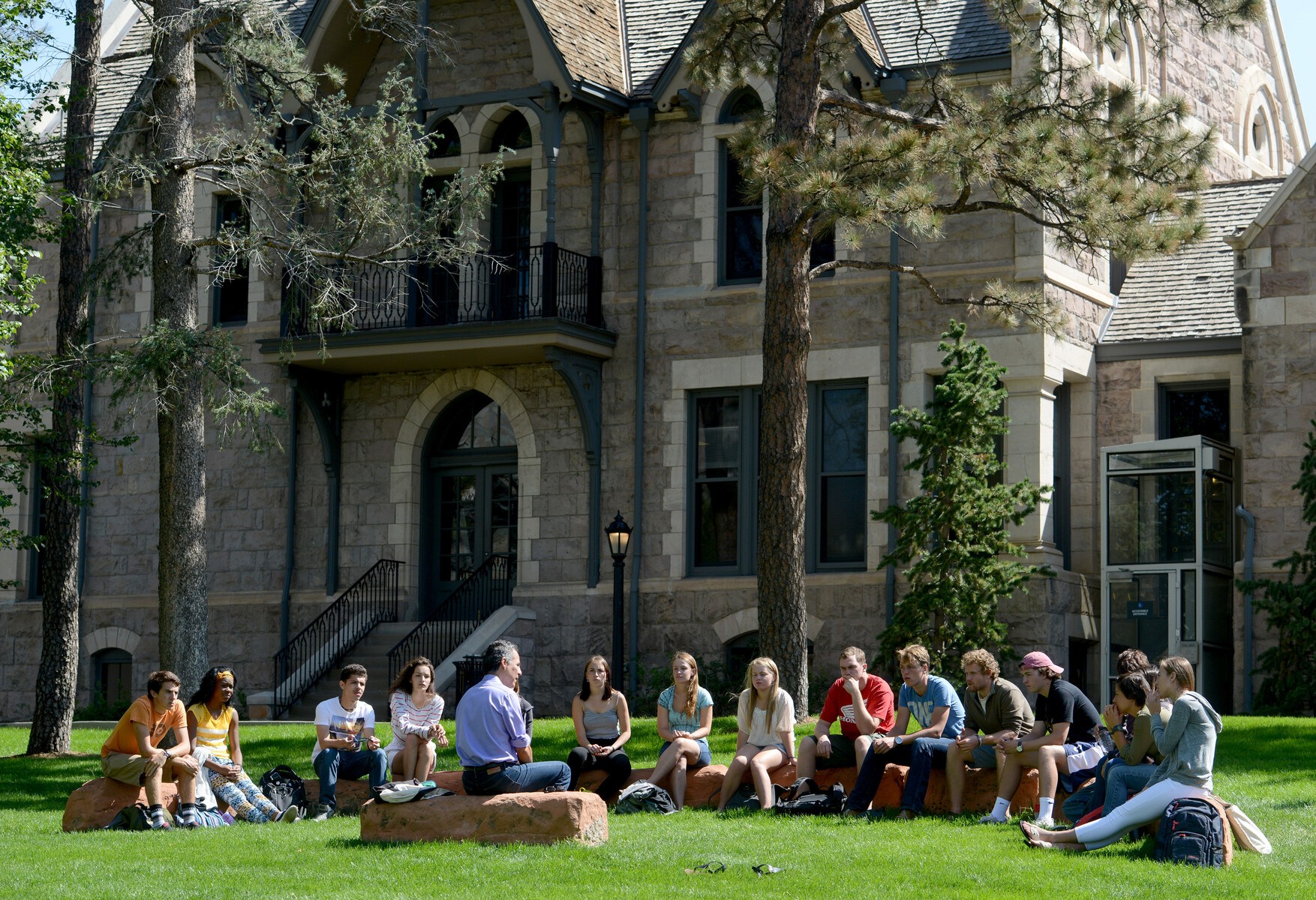
Professors also teach one course at a time. A geology class can spend several days in the Rocky Mountains. A history seminar can devote an entire morning to one discussion rather than stopping after 50 minutes. A laboratory can continue into the afternoon without students rushing to another class.
The Block Plan has become so closely associated with Colorado College that it is difficult to separate the academic model from the institution’s identity.
Background
Colorado College and Colorado Springs essentially grew up together.
General William Jackson Palmer founded Colorado Springs in 1871 along the route of his Denver and Rio Grande Railroad. Palmer envisioned a planned western city built around culture, education, commerce, and the natural environment. Land was set aside for a college while the new community was still taking shape.
Colorado College was founded in 1874, just three years after Colorado Springs and two years before Colorado became a state.
Thomas Nelson Haskell helped establish the college, which held its first classes in May 1874. From its beginning, Colorado College was coeducational, an unusual position for a western college of that era. Those first years were anything but secure. Presidents came and went, money was often tight, and the fledgling college relied heavily on benefactors far beyond Colorado. Yet it endured, gradually finding its footing as Colorado Springs grew around it.
Today, Colorado College is a private nonprofit liberal arts college. Its Fall 2025 Common Data Set reports 1,887 undergraduates and 16 graduate students, for a total enrollment of 1,903. Its campus sits near downtown Colorado Springs, with Pikes Peak and the Rocky Mountains in the background. The location is much more than scenery. Colorado Springs and the surrounding mountains, deserts, public lands, and communities have become part of the educational experience.
The Block Plan: Three Professors Walk Into a Bar
Colorado College’s defining academic innovation has an unusual origin story.
In November 1968, three professors—psychologist Don Shearn and political scientists Tim Fuller and Glenn Brooks—met at Murphy’s, a Colorado Springs dive bar.
The college was approaching its centennial, and President Lloyd Worner had asked Brooks to lead a comprehensive examination of Colorado College. Rather than simply celebrate the institution’s first century, Worner wanted the college to think about what it should become in its second. One problem faculty members identified was familiar to almost anyone who has attended college. Students were trying to manage four or five courses simultaneously, while faculty members were dividing their attention among several classes.
During that conversation at Murphy’s, a different idea began to emerge: What if students took only one course at a time? Brooks developed the proposal, and on October 27, 1969, the faculty approved what became the Block Plan by a vote of 72-53. It was hardly an overwhelming endorsement.
Colorado College implemented the plan in fall 1970. Four years later, when faculty evaluated whether the experiment should continue, the vote was 80-5 in favor. The experiment had become Colorado College.
Colorado College was the first college in the country to adopt this one-course-at-a-time structure. It is no longer entirely alone. Cornell College in Iowa adopted its similar One Course At A Time calendar in 1978 after its dean visited Colorado and studied the model. More than five decades after Colorado College pioneered the approach, however, it remains unusual in American higher education.
Curricula: What Does One Course at a Time Mean?
Colorado College offers a traditional liberal arts curriculum across the humanities, sciences, social sciences, and arts. What distinguishes the curriculum is how those subjects can be taught.
Students normally take one course during each 3½-week block. A typical class meets for three hours each weekday morning, although laboratories, fieldwork, performances, research, and other activities frequently extend beyond those hours.
The advantage is concentration. A student studying organic chemistry is not simultaneously preparing a political science paper, rehearsing for a music performance, and studying for an economics examination. The structure also gives faculty unusual flexibility. A geology class doesn’t have to return to campus because students have another course at 2 p.m. Environmental science students can conduct extended fieldwork. Humanities students can spend an entire morning discussing one text.
Colorado College has approximately nine students per instructional staff FTE, compared with about 13 at the median private nonprofit college. Instructional staffing increased approximately 8% between 2019 and 2024. The model is not for everyone.
Eighteen class days leave little room for illness or falling behind. Some subjects may lend themselves more naturally to immersion than others. Mathematics faculty were among the original skeptics, questioning whether students had enough time to absorb difficult concepts before moving forward.
The Block Plan is not necessarily an easier way to attend college. It is a more concentrated one.
Does the Block Plan Make a Difference?
Colorado College’s student outcomes are strong. Its most recent institutional information reports a retention rate above 90%, and among the Fall 2018 entering cohort, nearly 88% graduated within six years. By comparison, the six-year graduation rate at four-year private nonprofit institutions nationally has been about 68%.
That is a substantial difference. But it would be a mistake to attribute the difference entirely to the Block Plan. Colorado College is highly selective, financially well-resourced, and has a low student-to-faculty ratio. Evidence from Cornell College, which uses a similar one-course-at-a-time calendar, also suggests that the academic calendar by itself does not guarantee unusually high graduation rates.
Perhaps the clearest evidence of the Block Plan’s impact is not in graduation rates but in what students can do while enrolled. With no other classes competing for their time, students can leave campus with a professor for several days—or an entire block—without missing another course. Colorado College reports that 70% to 75% of its graduates have participated in study-away programs over the past decade; more than one-quarter have participated more than once; and more than 1,000 students each year participate in field study.
Study away does not necessarily mean spending a semester in another country. It can include an international experience, a domestic program, an entire semester away, or a faculty-led block in another location. Current Block Away offerings include courses in places ranging from Paris, Florence, Athens, Argentina, Australia, and Costa Rica to Chicago, New York, San Francisco, and Washington, D.C. Colorado College also reports more than 300 courses annually with field-study components.
This may be where the Block Plan’s effect is easiest to see. The academic calendar doesn’t merely change when students attend class; it changes where a classroom can be.
The Students
Colorado College may be closely identified with Colorado Springs and the Rocky Mountain West, but its student body is overwhelmingly national.
Only about 21% of the 2025–26 student body is from Colorado. Put another way, nearly four out of five students come from outside the state.
The Class of 2029 was even more geographically dispersed. Only 18% were from Colorado, and the 517-member class represented 47 states and 19 countries. International students accounted for 6.4% of the entering class.
The Class of 2029 was 50.3% female, 47.6% male, and 2.1% nonbinary or another gender. Eleven percent were first-generation college students, and 23.4% were domestic students of color.
The incoming Class of 2030 continues the college’s broad geographic reach, with students again representing 47 states and 19 countries. Colorado College expects approximately 501 students from a pool of 7,794 applicants.
That national reach is an important part of the Colorado College story. It also provides context for the college’s Four Corners Pledge, which seeks to make Colorado College more affordable for qualifying students from Colorado, Arizona, New Mexico, and Utah.
Colorado College has built a national market while at the same time looking for ways to strengthen its connection to its home state and the surrounding Southwest.
Strengths
A Clear Academic Identity.
Colorado College can explain what makes it different in a sentence. The Block Plan is not an extracurricular program or a branding campaign. It shapes the academic calendar, faculty teaching, student life, and the use of the surrounding region.
Strong Financial Resources. With an endowment exceeding $1 billion, Colorado College has financial resources available to relatively few colleges of its size.
Strong Student Demand. The college remains selective and attracts students from across the country and internationally.
Low Student-to-Faculty Ratio. Approximately nine students per instructional staff FTE supports the intensive teaching required by the Block Plan.
Location. Colorado Springs and the Rocky Mountain West provide opportunities for field research, outdoor education, community engagement, and experiential learning that reinforce the academic model.
Challenges
Enrollment Pressure. Fall undergraduate enrollment declined from 2,241 in 2021 to 1,887 in 2025, a decrease of approximately 15.8%. Over the longer 2015–25 period, undergraduate enrollment declined from 2,118 to 1,887, or about 10.9%.
Tuition Revenue Pressure. Inflation-adjusted net tuition revenue per FTE declined nearly 11% between 2019 and 2024.
International Enrollment. The longer-term data show international enrollment as an area worth watching, although the Class of 2029 was 6.4% international.
The Block Plan Is Not for Everyone. Some students will thrive in an immersive academic environment; others may prefer the pacing and variety of a conventional semester.
Keeping an Innovation Innovative. The Block Plan was radical when introduced in 1970. More than 50 years later, Colorado College must make certain that an innovation created to challenge educational convention does not itself simply become convention.
Enrollment Trends
Colorado College remains in a stronger competitive position than many small private colleges, but its recent enrollment trend deserves attention.
The college’s Common Data Set provides the clearest apples-to-apples measure because it reports enrollment at the institution’s official fall census date. Fall undergraduate enrollment was 2,118 in 2015. It reached 2,241 in 2021, then declined to 2,180 in 2022, 2,145 in 2023, 2,031 in 2024, and 1,887 in 2025. That represents a 15.8% decline from the 2021 peak and a 10.9% decline over the full 2015–25 period.
The decline should not automatically be interpreted as evidence that Colorado College is struggling to attract applicants. The college remains selective and nationally recognized. But four consecutive years of declining fall enrollment are meaningful, particularly when combined with pressure on net tuition revenue.
The distinction between the Common Data Set and the Hechinger Report’s Financial Health Tracker is important. Hechinger uses IPEDS 12-month unduplicated headcount, which counts students enrolled at any point during the reporting year. The Common Data Set is a fall census snapshot. For describing the current size of Colorado College and charting enrollment here, the fall CDS measure is the more intuitive one.
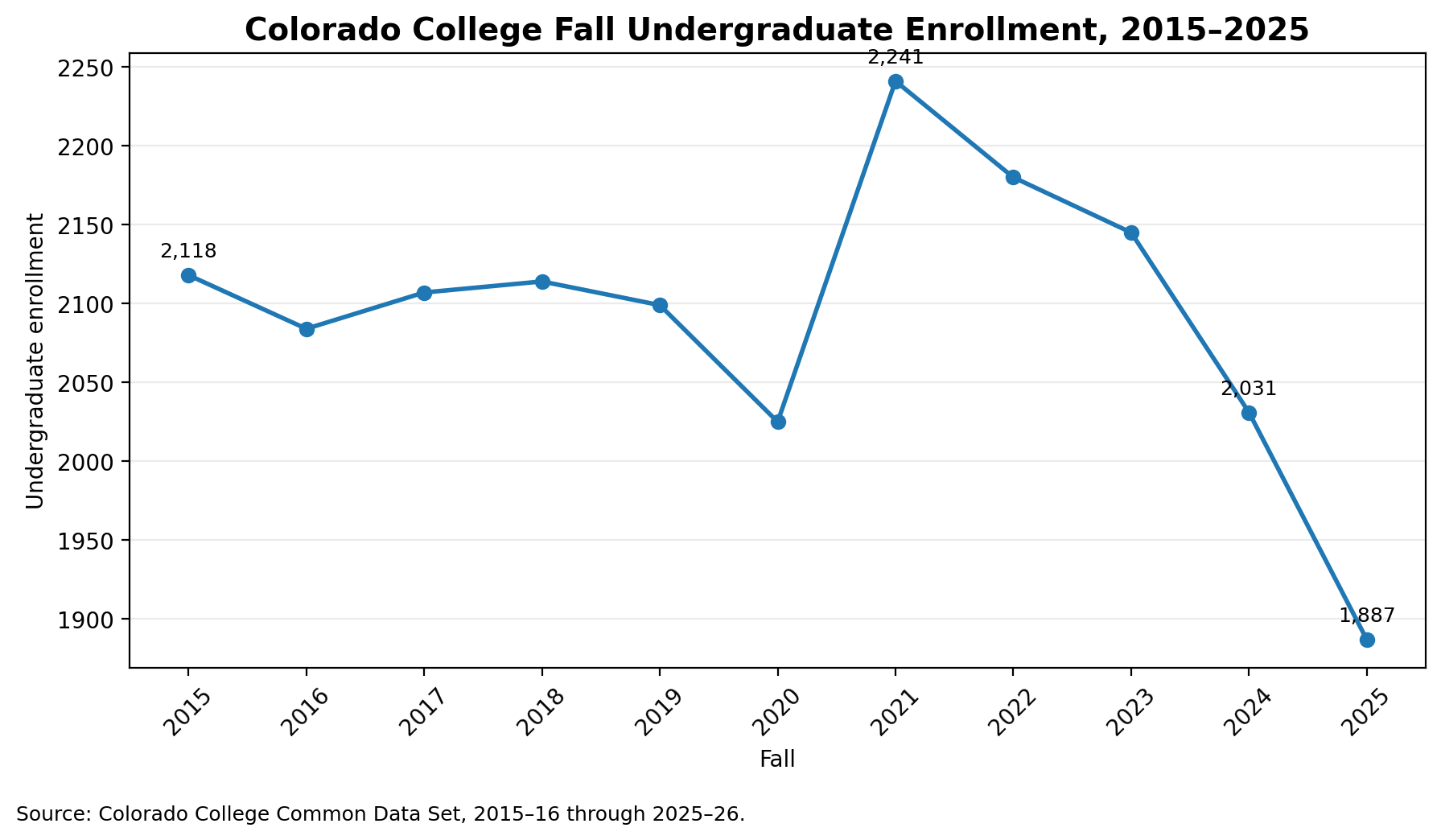
Colorado College Fall Undergraduate Enrollment, 2015–2025
Economic and Community Impact
Colorado College’s relationship with Colorado Springs is unusually important because the college and city have developed alongside one another for more than 150 years.
Colorado Springs today is far more than a college town. It has a significant military presence, aerospace and technology employers, tourism and cultural organizations, and immediate access to the Rocky Mountains.
It is also Olympic City USA. Colorado Springs is home to the U.S. Olympic & Paralympic Committee and its flagship Olympic & Paralympic Training Center. Roughly 15,000 athletes train at the center annually, and the city is home to more than two dozen national governing bodies and Paralympic sport organizations.
Colorado College has increasingly connected with this sports community. It has hosted events including the Department of Defense Warrior Games and USA Weightlifting competitions, while students have had opportunities for internships and other connections with the city’s sports organizations.
The college’s relationship with the broader community extends further. Colorado College has reported partnerships with more than 200 community organizations and substantial student participation in community-based work. The Colorado Springs Fine Arts Center at Colorado College provides another significant connection between campus and community.
The Block Plan strengthens these relationships. A class can spend several consecutive days working with a community organization or conducting research away from campus without students worrying about missing three or four other courses.
Small colleges often describe themselves as being in a community. The more important question is whether they are of that community. For Colorado College, Colorado Springs and the broader Rocky Mountain West are increasingly part of the institution’s identity.
Beyond the Brochure
Enrollment and financial statistics tell part of a college’s story. Traditions and campus lore tell another. Colorado College’s signature end-of-year student music festival is called Llamapalooza.
The festival began in 1991, the same year Lollapalooza debuted nationally. A group of first-year Colorado College students decided to create their own campus version. Then someone apparently reached the logical conclusion that if the event was going to be called Llamapalooza, it needed a llama. Student government reportedly provided $150 to rent one. An actual llama appeared at the festival, and bringing llamas to the event continued for several years. More than three decades later, Llamapalooza remains a major campus tradition.
Colorado College has also accumulated the kind of folklore that tends to develop around campuses with buildings more than a century old. Bemis Hall, a Tudor Revival residence hall completed in 1908, has perhaps the best-known story. Campus legend tells of a young girl named Marjorie Delight, supposedly the daughter of benefactor Alice Bemis Taylor, who was murdered and can still be heard skipping and giggling through the hallways. Another story tells of a janitor who saw the bare footprints of a small child appear one at a time across a freshly mopped floor.
Student researchers digging through Colorado College’s Special Collections could find no evidence that Alice Bemis Taylor had a daughter named Marjorie Delight—or that such a murder occurred. Alice did have an adopted daughter, but she lived her life in Maine. Colorado College apparently has a ghost whose biography may have been created after the ghost itself. Sometimes campus mythology is nearly as durable as institutional history.
Alumni
For a college enrolling fewer than 2,000 students today, Colorado College has produced a remarkably diverse group of graduates.
- Economist James Heckman ’65, who majored in mathematics at Colorado College, received the 2000 Nobel Memorial Prize in Economic Sciences.
- Mark Fiore ’91, a political science major, received the 2010 Pulitzer Prize for editorial cartooning.
- Steve Sabol studied art history and played football at Colorado College before going on to a career with NFL Films. Working alongside his father, Ed Sabol, he helped develop the distinctive filmmaking and storytelling style that became the signature of NFL Films. In 2021, he was inducted into the Pro Football Hall of Fame.
- Colorado College’s political alumni include former Wyoming Congresswoman Liz Cheney ’88, former U.S. Senator and Secretary of the Interior Ken Salazar ’77, and U.S. Representative Diana DeGette ’79.
- Scientific alumni include Marcia McNutt ’74, the first woman to lead the U.S. Geological Survey and later president of the National Academy of Sciences, and marine ecologist Jane Lubchenco ’69, the first woman to lead the National Oceanic and Atmospheric Administration.
The breadth—economics, science, politics, journalism, filmmaking, sports, and public service—is perhaps what one would hope to see from a liberal arts college.
Endowment and Financial Standing
Colorado College enters the current period from a position of considerable financial strength.
At June 30, 2025, its endowment and perpetual trusts exceeded $1.1 billion. The investment portfolio returned 11.3% during FY2025 and averaged 10.6% annually over the preceding five years. But an endowment alone doesn’t tell us whether a college is financially healthy.
The Hechinger Report’s Financial Health Tracker provides useful additional context. Inflation-adjusted institutional revenue at Colorado College increased approximately 16.8% between 2019 and 2024, while the median private nonprofit college was essentially flat during the same period. Colorado College recorded an annual loss in only one of the past ten years, another positive indicator.
There is an area of pressure. Inflation-adjusted net tuition revenue per FTE declined approximately 10.9% between 2019 and 2024. The median private nonprofit institution experienced an even larger decline of approximately 17.8%. Colorado College also derived only about 33% of its 2024 revenue from net tuition, compared with approximately 44% for the private nonprofit sector median.
Those numbers do not suggest an institution in financial distress. They suggest a financially strong college encountering real pricing and enrollment pressure, but with considerably more resources than most small private colleges to respond.
Perhaps Colorado College’s greatest financial advantage is not simply its billion-dollar endowment. It is time—the ability to make strategic decisions before financial necessity forces them.
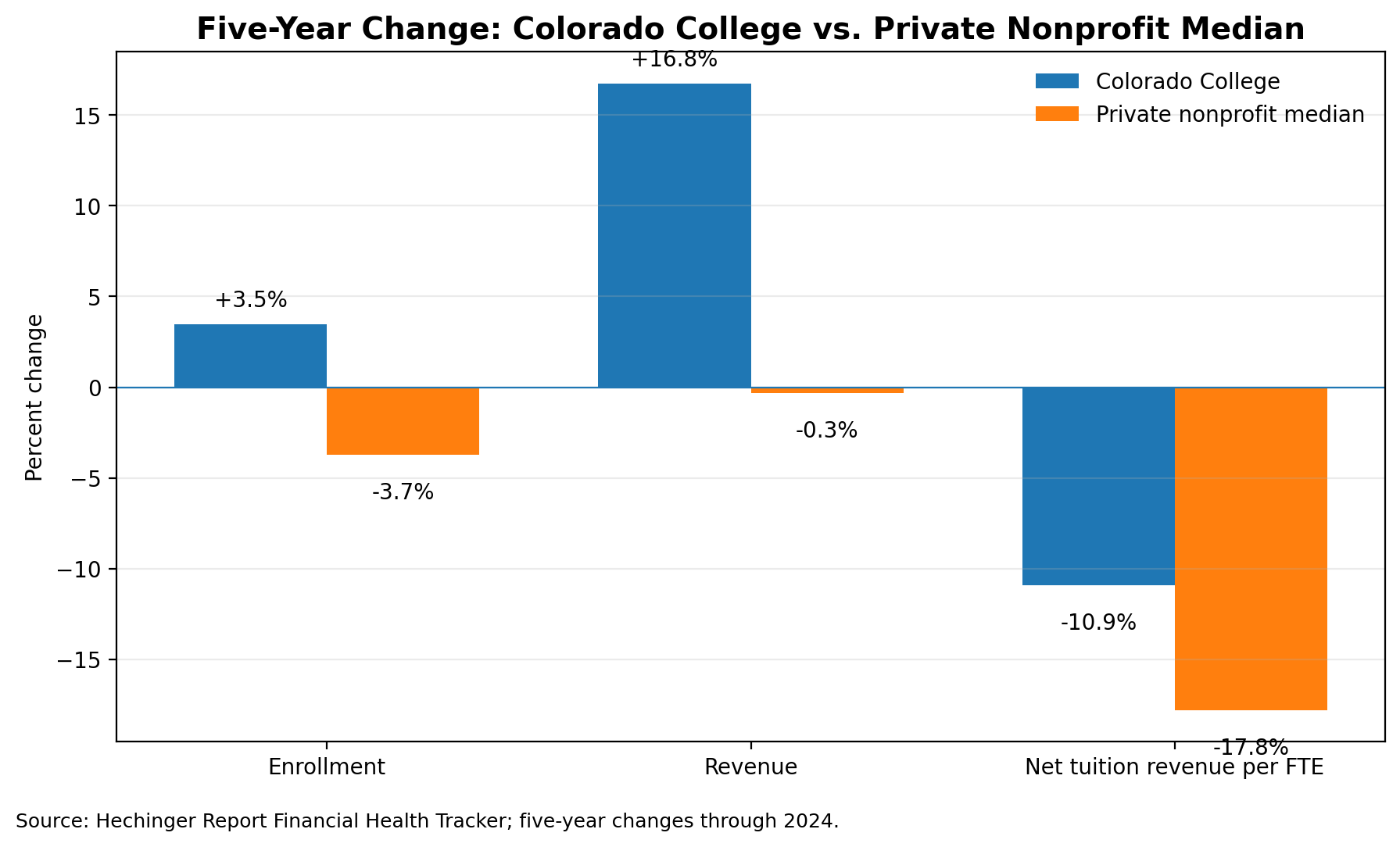
Five-Year Change: Colorado College vs. Private Nonprofit Median
Why Is Colorado College Important?
Colorado College illustrates several lessons that extend well beyond Colorado Springs.
- Distinctiveness Matters. The Block Plan gives Colorado College an identity that prospective students, parents, alumni, and employers can readily understand.
- Innovation Can Become Institutional Culture. What began as a controversial faculty experiment in 1970 became the college’s organizing principle.
- Place Can Be an Educational Asset. Colorado Springs and the Rocky Mountain West are not simply where Colorado College happens to be located. The Block Plan allows the institution to incorporate its surroundings directly into teaching and learning.
- Financial Strength Creates Choices. Colorado College’s endowment and diversified revenue base enable it to address enrollment, affordability, and demographic challenges before they become crises.
These advantages help explain why Colorado College remains in a stronger position than many small private colleges. Its graduates have included a Nobel Prize-winning economist, a Pulitzer Prize winner, prominent scientists and public officials, and the creative force behind NFL Films. The college has significant financial resources, a highly recognizable academic model, and a location that complements the way it teaches.
At the same time, Colorado College is not immune from the pressures facing private higher education. Fall undergraduate enrollment has declined for four consecutive years, affordability remains an issue for families, and net tuition revenue per student has been under pressure. The difference is that Colorado College has the resources and market position to address these issues before they threaten the institution’s future. How it uses that advantage may be one of the more important things to watch in the years ahead.
More than 50 years ago, Colorado College faculty members were willing to question one of higher education’s most basic assumptions: that students needed to take several courses at the same time. Their answer was the Block Plan, an experiment that eventually became the institution’s defining feature.
Perhaps the most important lesson from Colorado College, however, isn’t the Block Plan itself. It is the willingness of a small college to be different.
Photo Credit: Bryan Oiler Colorado College.
Dean Hoke is Executive Producer and co-host of Small College America and Managing Partner of Edu Alliance Group, a higher education consulting firm based in Bloomington, Indiana, and Abu Dhabi, United Arab Emirates. He formerly served as President/CEO of the American Association of University Administrators (AAUA) and has worked with colleges and universities in the United States and internationally throughout his career.
Dean is also a Senior Fellow at the Sagamore Institute in Indianapolis, where his research focuses on the economic and social impact of small colleges in rural communities. He is co-author, with Chet Haskell and Barry Ryan, of the forthcoming book Small Colleges at the Crossroads: Strategic Paths to Growth, Partnership, Merger, or Responsible Closure, scheduled for publication in Fall 2026.

