

November 2, 2026 by Dean Hoke – At Hampden–Sydney College in Virginia, incoming students receive a small book titled To Manner Born, To Manners Bred. It offers advice about introductions, courtesy, dress, and treating others with respect. Alumnus Thomas H. “Tommy” Shomo, Class of 1969, wrote the guide in 1978 and remained devoted to the college until his death in 2025. The Virginia General Assembly honored him in 2026.
The book is one of several traditions that distinguish Hampden–Sydney. Students and alumni still wear jackets and ties to some football games, and the campus bell remains part of college life. These customs might seem quaint, even old-fashioned, in modern American higher education and society. But they reflect an institution that has deliberately made character, courtesy, and personal responsibility part of its educational identity.
A College Born During the American Revolution
Hampden–Sydney opened on November 10, 1775, during the American Revolution. Its founders sought to educate young men for leadership and citizenship. The college continues to define its mission as forming “good men and good citizens in an atmosphere of sound learning.” That mission has remained remarkably consistent over 250 years, even as American higher education and the country have changed.
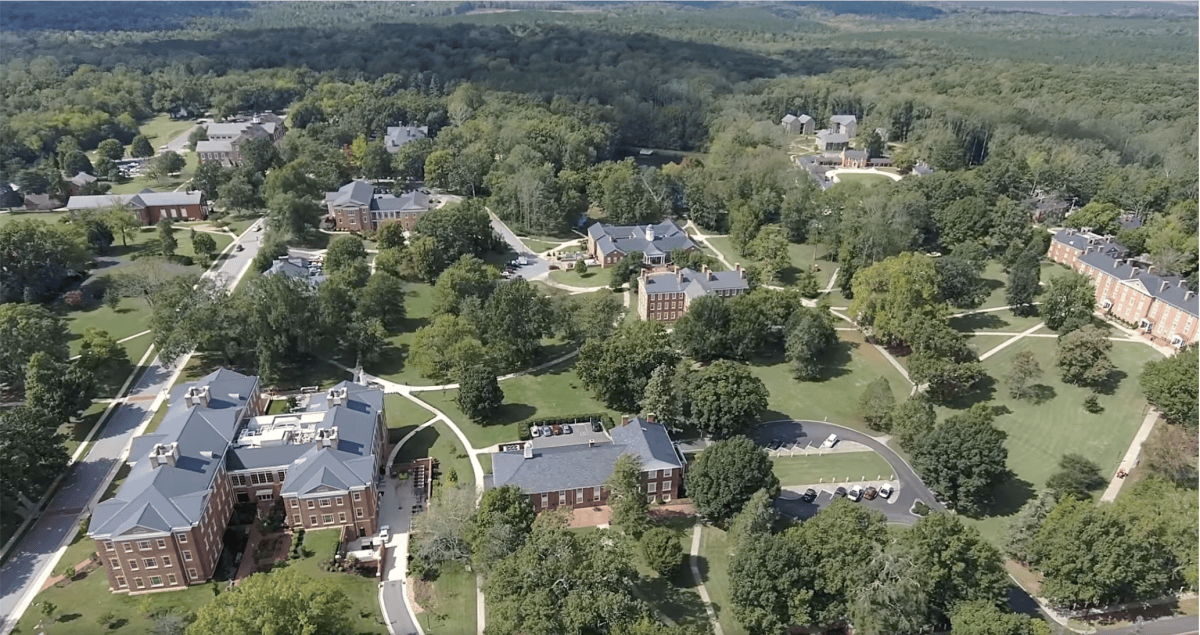
Hampden–Sydney occupies a rural campus near Farmville, Virginia, a community of approximately 7,500 people, about 60 miles southwest of Richmond. Its predominantly residential student body contributes to a close-knit campus where students, faculty, and staff interact regularly. The location and traditions are central to the college’s identity.
In 1996, after considerable debate, Hampden–Sydney’s trustees voted to remain a men’s college rather than become coeducational. It is now one of three traditional four-year men’s liberal arts colleges in the United States, along with Wabash and Morehouse. The institutions differ substantially in history and student population, but each has retained a single-sex mission.
The 1996 decision continues to shape recruitment and campus life. Hampden–Sydney offers a residential undergraduate experience designed specifically for men, emphasizing personal responsibility, leadership, and close relationships with faculty and fellow students. It also competes for students in a higher education market dominated by coeducational institutions.
Character, Rhetoric, and a Particular Kind of Campus Life
The Honor Code and Rhetoric Program give substance to the college’s mission. Students are expected to take responsibility for their conduct and academic work, and communication is central to the curriculum. Students must demonstrate proficiency in speaking and writing. Rhetoric was the most popular minor in fall 2025, with 55 declared students. Hampden–Sydney has emphasized these skills for decades, well before colleges began routinely describing them as essential career competencies.
Hampden–Sydney’s emphasis on rhetoric and public affairs extends beyond the classroom. The Wilson Center for Leadership in the Public Interest, student government, and the Honor Code provide opportunities to practice public speaking, leadership, and personal accountability. These activities complement the college’s academic program and its longstanding mission.
Most students live on campus, and fraternities are an important part of student life. The rural setting helps create a community in which academic, athletic, and social activities overlap. That environment can be attractive to students seeking a traditional residential college experience, though it will not appeal to everyone.
Athletics contribute to campus life and student recruitment. Hampden–Sydney competes in NCAA Division III and the Old Dominion Athletic Conference. Its longstanding football rivalry with Randolph–Macon brings students, alumni, and families together, while the basketball team’s appearance in the 2024 Division III national championship game attracted attention beyond Virginia. Supporting competitive teams also requires investment in coaches, travel, and facilities, significant commitments for a college of fewer than 1,000 students.
Inside the Classroom: What Students Study
Hampden–Sydney offers a traditional liberal arts education with 25 majors and 28 minors across the humanities, social sciences and natural sciences. In fall 2025, economics and business were the largest declared majors, with 139 declarations, followed by history (44), government (38), biology (33), and foreign affairs (30). Economics and engineering physics each recorded 26 declarations, and psychology had 24. Students may declare more than one major, so these counts do not represent separate groups of students. The distribution reflects considerable interest in business and public affairs alongside established science and humanities programs.
The college’s Rhetoric Program is one of its clearest academic distinctions. All students complete rhetoric coursework and must demonstrate writing proficiency through an examination generally taken at the end of the sophomore year. The examination requires a timed essay assessed by faculty readers, with additional instruction and retesting available to students who do not pass on the first attempt. The Pannill Center for Rhetoric and Communication offers support in writing, speaking, and digital communication. Rhetoric was the most popular minor in fall 2025, with 55 declared students. The requirement gives the college’s longstanding emphasis on communication a specific place in the curriculum.
The broader core curriculum requires work in mathematics, foreign language, and courses examining Western and global cultures. These requirements apply across majors and are intended to provide students with a common academic foundation. Students also participate in experiential learning through the Compass Program, which connects classroom work with internships, research, study abroad, service learning, and career planning. Its advising and career resources help students consider how their academic interests may translate into professional opportunities.
Engineering physics grew from 10 declared majors in 2021 to 26 in 2025. Biology, chemistry, physics, mathematics, and related disciplines provide options for students interested in scientific and technical careers. In summer 2025, 43 students participated in research projects with faculty members. For an undergraduate-only institution, those projects offer a direct route into research without competing with graduate students for faculty attention. They also give students considering graduate or professional education experience beyond ordinary coursework.
Small classes and faculty contact are important features of its academic model. Assistant Dean of Faculty and History professor James Frusetta-Ulfhrafn, for example, uses historical role-playing exercises in which students debate constitutional reform and political alliances in ancient Athens. The approach encourages students to examine historical decisions while practicing argument, discussion, and public speaking.
In September 2026, Hampden–Sydney announced the Citrone School of Business and Economics and the Hickok School of Government, History, and Civic Leadership. The Citrone School brings together economics and business, entrepreneurship and political economy. The Hickok School links history and politics with programs in leadership and public history. Both organize existing departments and centers into more visible academic units rather than introducing entirely new disciplines. Rather than introducing new disciplines, Hampden–Sydney is investing in academic programs that have already attracted considerable student interest.
The new schools also draw on alumni philanthropy. Rob Citrone, Class of 1987, and his wife Cindy have supported the college through major gifts, including full-tuition merit scholarships for selected incoming students. The two schools, along with the Compass Program and undergraduate research, are part of Hampden–Sydney’s effort to give students a liberal arts education that also prepares them for careers after graduation.
Who Chooses Hampden–Sydney?
Hampden–Sydney enrolled 1,087 students in fall 2015, compared with 924 in fall 2025, a decline of approximately 15 percent. Enrollment fell to a low of 850 in 2022 before recovering to 946 in 2024, then declining modestly in 2025—the college’s 2015 strategic plan called for enrollment of approximately 1,100 students. Although a more recent numerical target was not identified, President Larry Stimpert reaffirmed the intention to grow enrollment in 2025 while maintaining selectivity and expanding geographic recruitment.
For fall 2025, Hampden–Sydney received 3,284 applications, admitted 1,227 students and enrolled 249 new students, producing an admission rate of 37.4 percent and a yield of approximately 20.2 percent. The college continues to recruit students for a specific residential undergraduate experience rather than competing across the full range of programs offered by larger universities.
The admissions figures tell an interesting story about Hampden–Sydney’s position in the college marketplace. Hampden–Sydney admitted fewer than four in ten applicants, yet approximately one in five admitted students enrolled. The distinction matters: an institution can maintain a selective admissions process while still working to improve the proportion of accepted applicants who choose to attend. Its expanded scholarship programs are intended in part to make that choice more attractive to academically strong prospective students. Whether they lead to sustained enrollment growth will become clearer over several entering classes.
Recruitment remains concentrated in Virginia and neighboring states. Of the 924 students enrolled in fall 2025, 571 were from Virginia and 160 from North Carolina. The college has an established regional alumni network, but expanding enrollment will also require reaching more prospective students outside its traditional markets. In interviews I have conducted with small-college presidents, several have indicated that returning to historical enrollment peaks is not necessarily their objective. Hampden–Sydney, however, has stated that it intends to grow while investing in scholarships, academic programs, and career preparation.
The fall 2025 student body was also predominantly White, with 744 students, or approximately 80.5 percent, identifying as White. The college reported 54 Black students, 59 Hispanic students, and 41 students identifying with two or more races. The figures also suggest that Hampden–Sydney has room to reach a more diverse group of prospective students. Increasing representation from communities historically less prominent in its enrollment could expand its applicant pool. However, the college would still need to compete for students interested in a residential men’s liberal arts education.
Hampden–Sydney has made clear its intention to increase enrollment while maintaining its identity as a small, residential liberal arts college for men. Its investments in scholarships, academic programs, and campus facilities reflect that commitment. The challenge will be attracting students who see value in its distinctive educational experience while improving retention and graduation rates. Enrollment growth would also help the college spread the costs of its academic programs, athletics, and residential facilities across a larger student body.
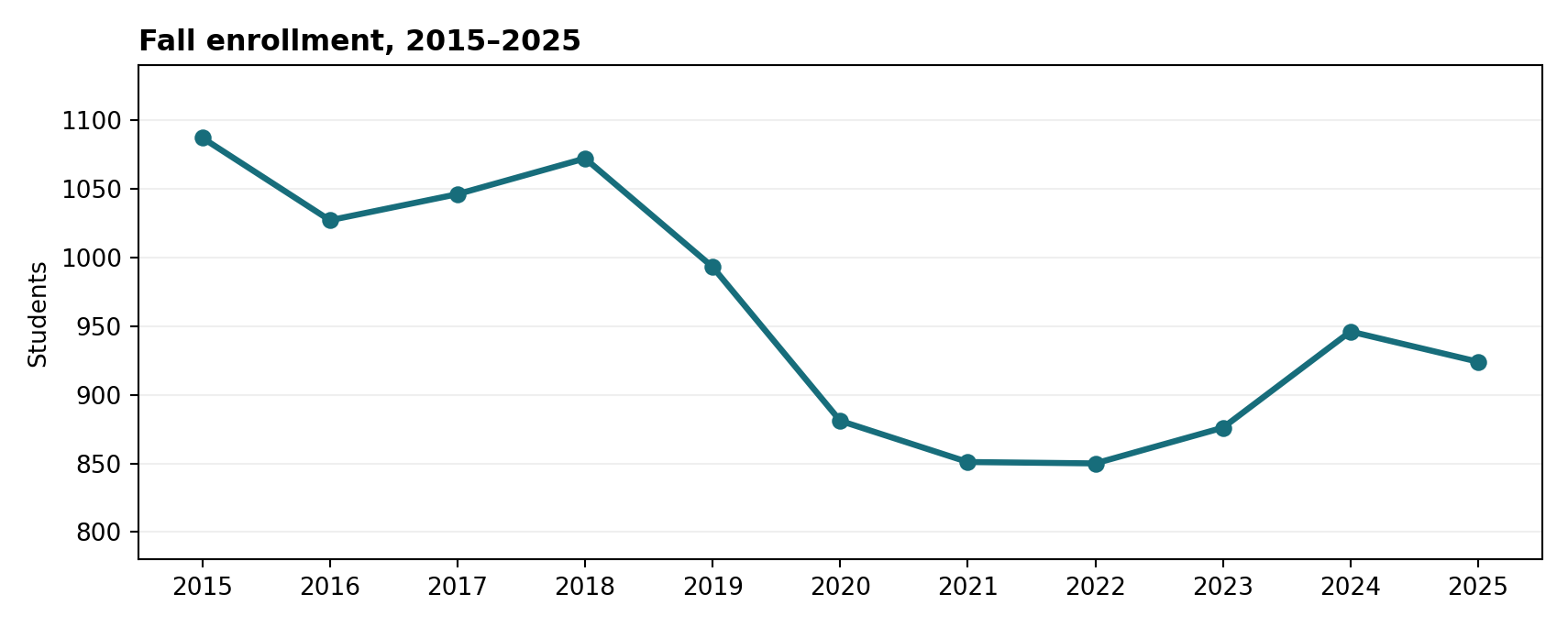
Figure 1. Source: Hampden–Sydney College, 2025–26 Factbook.
Staying, Graduating, and Moving Forward
Student retention and graduation rates also measure Hampden–Sydney’s performance. First-year retention has generally ranged from the upper 70s to the mid-80s in recent years. The most recent reported rate, 78 percent for the fall 2024 entering class, was below the college’s minimum institutional target of 80 percent and its longer-term goal of 90 percent.
Hampden–Sydney reported a six-year graduation rate of 63 percent for students who entered in fall 2019. Its four-year graduation rates were 68 percent for the fall 2020 entering class and 67 percent for the fall 2021 class. The college has established a goal of achieving an 80 percent six-year graduation rate.
The four-year and six-year figures refer to different entering cohorts and should not be read as a single progression. Retention and graduation rates are important measures of whether Hampden–Sydney is meeting its goals for student success. Hampden–Sydney’s comparatively small entering classes also mean that a change affecting a few dozen students can noticeably shift a percentage from one cohort to another. For that reason, trends across several classes are more informative than a single annual result.
Graduates pursue careers in business, government, education, healthcare, and other professions. In recent years, approximately 15 to 20 percent of graduates have entered or planned to pursue graduate or professional education.
Hampden–Sydney has approximately 10,000 living alumni. For a college of its size, the network is an important asset. The Princeton Review ranked the college second among private colleges for alumni networks in its 2027 guide, based on student surveys. Alumni return as mentors, internship contacts, recruiters, volunteers, and donors, sustaining relationships that extend beyond graduation. Many remain in Virginia and the surrounding region, including Richmond and the Washington area, providing connections for students beginning their careers.
The college’s historical connections to public life include William Henry Harrison, the ninth president of the United States, who attended from 1787 to 1790 but did not graduate. Hampden–Sydney also identifies eight former students who became state governors, including four in Virginia. Their terms extended from William H. Cabell’s governorship beginning in 1805 to Elbert Lee Trinkle’s term ending in 1926. Tommy Shomo, the alumnus who wrote the college’s etiquette manual, also wrote about Harrison for the alumni magazine.
More recent graduates and former students have established careers in medicine, business, journalism and entertainment. Dr. W. Randolph Chitwood Jr., Class of 1968, helped pioneer robotic heart-valve surgery in North America. Rob Citrone, Class of 1987, founded Discovery Capital Management and became a leading college benefactor. Maurice Jones, Class of 1986, served as Virginia’s secretary of commerce and trade and held a senior position at the U.S. Department of Housing and Urban Development. Filmmaker Scott Cooper, Class of 1992, directed Crazy Heart, while political journalists Charles Hurt, Class of 1995, and Jonathan Martin, Class of 1999, built national careers in reporting and commentary.
Stephen Colbert, who studied philosophy at Hampden–Sydney for two years before transferring to Northwestern University, is among its best-known former students. He did not graduate from the college, but rose to national prominence through The Daily Show, The Colbert Report, and The Late Show.
Alumni involvement extends beyond notable names. Graduates provide mentoring, internship contacts, and professional introductions for students, while philanthropic support has helped fund scholarships and academic initiatives. These relationships are especially valuable as Hampden–Sydney seeks to recruit students beyond its traditional geographic base.
The college’s fundraising record is another measure of alumni and donor commitment, though the campaign’s financial implications are best considered alongside the college’s operating results.
Financial Strength, Operating Pressure
Hampden–Sydney’s endowment is a substantial financial advantage. The college reported investment endowment assets of approximately $280.4 million at June 30, 2025, up from $245.4 million a year earlier and approximately $154.6 million in 2015. The increase reflects investment performance and philanthropy, and provides resources that many colleges of similar enrollment do not possess. The college’s comprehensive It’s Time, Good Men campaign concluded in 2026 after raising more than $400 million against its original $250 million goal. Its priorities included scholarships, endowment support, academic programs, and campus improvements; campaign commitments should not be equated with unrestricted operating revenue.
What makes the endowment growth particularly interesting is that it occurred while enrollment was declining. The college enrolled fewer students in 2025 than in 2015, yet its reported endowment was substantially larger. That combination provides more financial resources per student, although it does not eliminate the need to balance annual operations. The endowment also supports the college’s ability to fund scholarships and maintain a residential liberal arts education that requires significant staffing and facilities.
Hampden–Sydney’s financial statements provide another perspective on the college’s financial position. According to its 2025–26 Factbook, operating revenue for fiscal 2025 was approximately $59.6 million, compared with operating expenses of $65.8 million, resulting in an operating shortfall of $6.2 million. Although the college benefits from a substantial endowment and strong philanthropic support, much of that funding is restricted to specific purposes. Investment returns and contributions can strengthen the college’s overall financial position without necessarily eliminating an annual operating deficit.
Hampden–Sydney must continue to support small classes, residential facilities, laboratories, student services, and Division III athletics. Its substantial philanthropic resources provide flexibility, but recurring expenses remain an important part of the college’s financial planning.
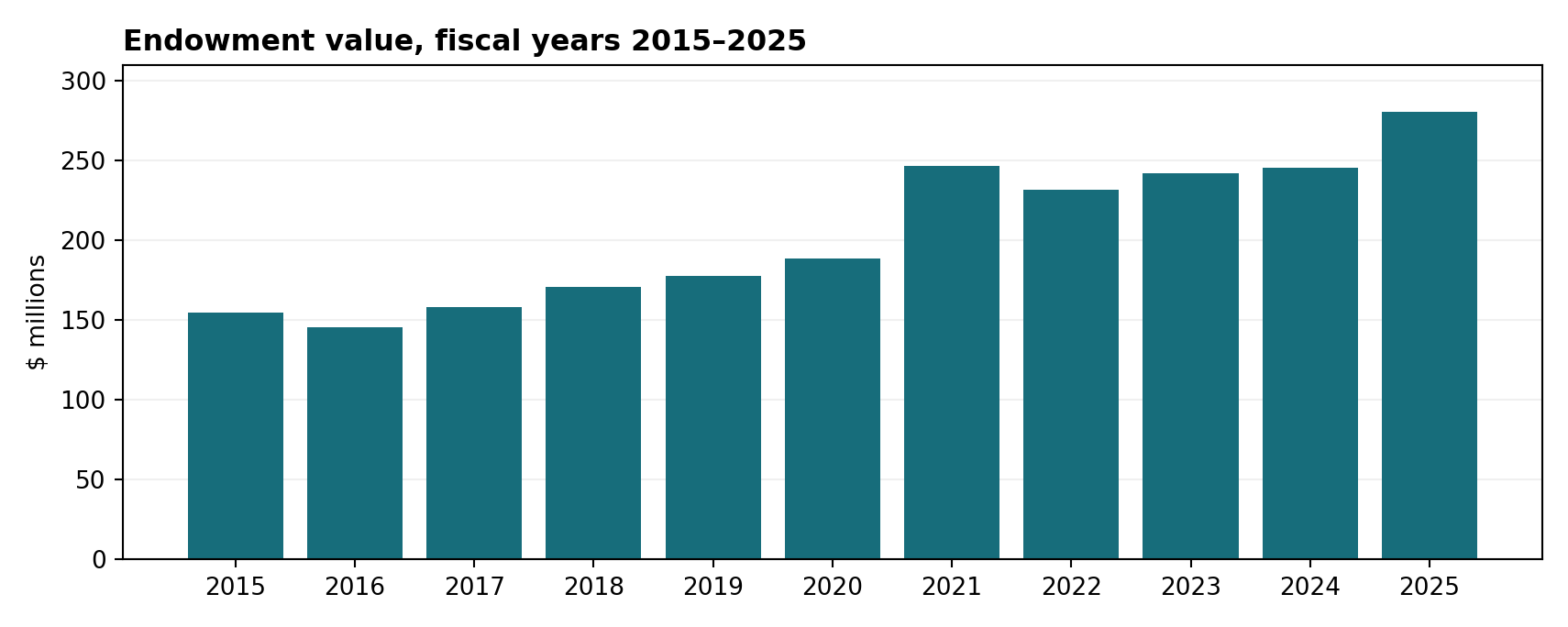
Source: Hampden–Sydney College Factbooks.
The Next 250 Years
Hampden–Sydney enters its next 250 years with a clear institutional identity, a substantial endowment, an established residential culture and a committed alumni community. Its enrollment remains below the level of a decade ago, but the college has invested in scholarships, facilities and academic programs while reaffirming its intention to grow.
The college’s recent fundraising success does not settle every question about its future. It does, however, provide flexibility that many small private colleges lack. Hampden–Sydney can invest in recruiting students, supporting faculty, and developing programs within its existing mission rather than relying solely on enrollment increases to finance those decisions. The question is whether these investments will help Hampden–Sydney attract and retain more students while bringing annual revenues and expenses into better balance.
Hampden–Sydney has fewer obvious opportunities to diversify enrollment than many other private colleges. Its rural location limits the nearby market of working adults seeking undergraduate degrees, while its residential model and lack of graduate programs make online expansion a less obvious strategy. Its future enrollment is therefore likely to depend largely on attracting traditional-age undergraduate men. Recruiting more widely beyond Virginia, reaching students from a broader range of backgrounds, and strengthening scholarships and academic programs are practical avenues for growth.
The new Citrone and Hickok schools build on subjects students already choose in significant numbers. Together with expanded scholarship support, they give Hampden–Sydney additional ways to reach students who value its approach to undergraduate education. Coeducation remains an option in principle, but the college has repeatedly affirmed its commitment to educating men.
Why Hampden–Sydney Matters
Hampden–Sydney demonstrates that a small college can preserve a distinctive educational mission for 250 years while adapting to changing student expectations and the realities of American higher education. Its Honor Code, Rhetoric Program, residential environment, and alumni relationships provide a clearly defined educational experience.
Its challenges remain substantial: attracting and retaining students, supporting an expensive residential model, and maintaining academic quality. Unlike many small private colleges, however, Hampden–Sydney has considerable philanthropic and endowment resources with which to address those challenges.
The etiquette manual handed to incoming students reflects the college’s commitment to its traditions. Hampden–Sydney has made its choice clear: remain a college for men, strengthen its academic programs, and invest in scholarships to attract the next generation of students.
About This Series
This profile is part of Small College America, an ongoing series of independently researched articles examining the history, distinctive characteristics, academic strengths, financial condition, and future prospects of private nonprofit colleges across the United States. The series is intended to inform college leaders, trustees, alumni, and others interested in the challenges and opportunities facing small colleges.
Dean Hoke is co-founder and managing partner of Edu Alliance Group, a senior fellow at the Sagamore Institute, and executive producer and co-host of Small College America. Hoke is also co-author of the upcoming book Small Colleges at the Crossroads: Strategic Paths to Growth, Partnership, Merger, or Responsible Closure.
Sources and Data References
Hampden–Sydney College, 2025–26 Factbook. Enrollment, admissions, student demographics, majors, faculty, research, student outcomes, and financial statements. https://www.hsc.edu/institutional-effectiveness/factbook
Hampden–Sydney College, Goals for Student Achievement (updated January 2026). Retention and graduation benchmarks and peer comparisons. https://www.hsc.edu/institutional-effectiveness/goals-for-student-achievement
Hampden–Sydney College, Graduate Outcomes and Facts and Figures. Employment, salary and graduate study reporting. https://www.hsc.edu/academics/career-center/graduate-outcomes ; https://www.hsc.edu/about-h-sc/facts-and-figures
Hampden–Sydney College, “H-SC Establishes Two New Academic Schools,” September 15, 2026. https://www.hsc.edu/news-index/new-schools
Hampden–Sydney College, “It’s Time, Good Men, to Celebrate,” May 4, 2026. Campaign results and philanthropic priorities. https://www.hsc.edu/news-index/night-of-gratitude
Hampden–Sydney College, Restated Strategic Plan, August 2015. Historical enrollment and academic priorities. https://www.hsc.edu/Documents/StrategicPlan/RestatedStrategicPlanAugust2015.pdf
The Hechinger Report, College Financial Health Tracker. Hampden–Sydney trends in net tuition and institutional finances, 2019–2024. https://financialtracker.hechingerreport.org/school.html?unitid=232256
The Princeton Review, 2027 Best Colleges rankings, as reported by Hampden–Sydney. Alumni network and student survey results. https://www.hsc.edu/news-index/best-colleges-2027
Western Interstate Commission for Higher Education, Knocking at the College Door, 11th edition (2024). National and state high school graduate projections. https://www.wiche.edu/knocking/
U.S. Bureau of Labor Statistics, College Enrollment and Work Activity of Recent High School and College Graduates (2024). Immediate college enrollment by sex. https://www.bls.gov/news.release/hsgec.toc.htm
Peer salary context: Wabash College (CollegeData/Peterson’s institutional profile) and Illinois Wesleyan University (Class of 2024 first-destination outcomes). Methodologies and reporting periods differ.
Hampden–Sydney College, institutional history, alumni publications, and The Record (including September 2010 William Henry Harrison article). https://www.hsc.edu/about-h-sc/history ; https://www.hsc.edu/alumni/record
Hampden–Sydney College, Academic and Core Requirements; Rhetoric Program and Rhetoric Proficiency Examination. https://www.hsc.edu/academics/majors-and-minors/academic-requirements and https://www.hsc.edu/academics/rhetoric-program
Hampden–Sydney College, Compass Program. Internships, undergraduate research, study abroad, and experiential learning. https://www.hsc.edu/compass
Hampden–Sydney College, Citrone Scholars Program. Full-tuition merit scholarships and donor information. https://www.hsc.edu/admission-and-financial-aid/financial-aid/types-of-aid/scholarship-awards/citrone-scholars
Hampden–Sydney College, alumni and institutional profiles; Northwestern University, Stephen Colbert education and career background—historical and contemporary alumni biographies.

