
The Power of Sisterhood
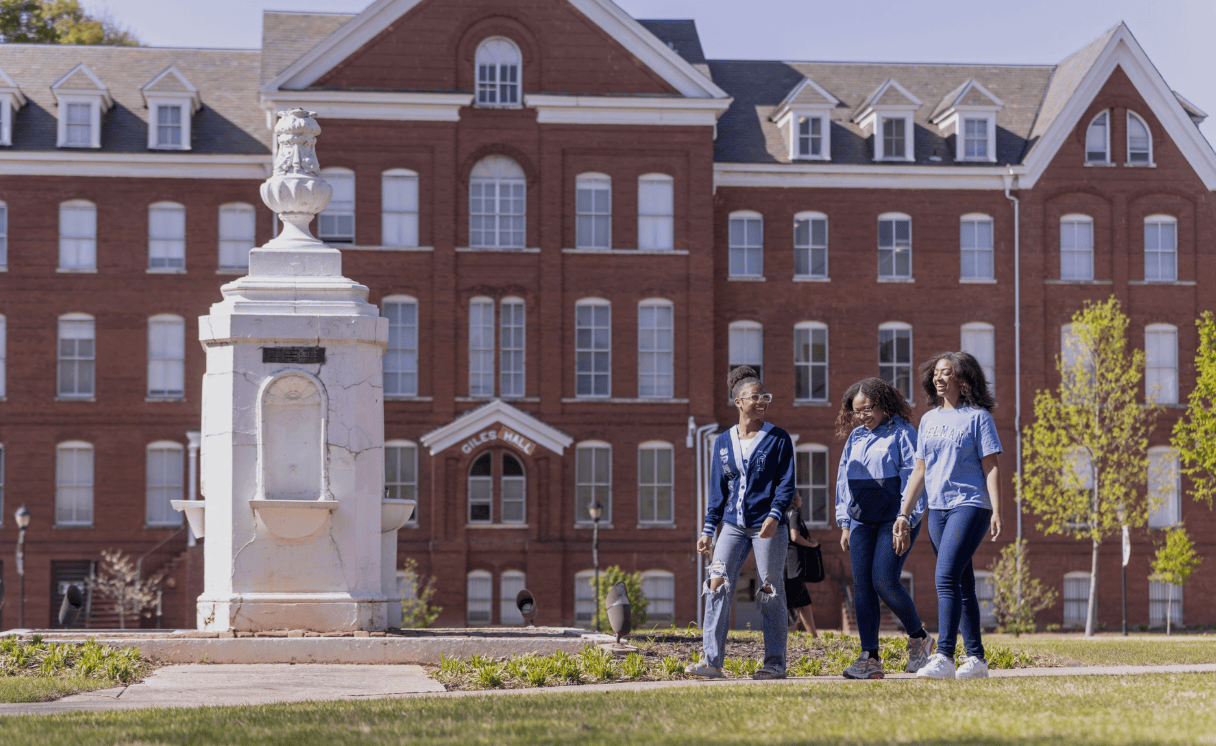
September 28, 2026, by Dean Hoke: Over the years, I have spoken with many small college leaders searching for a clearer sense of what distinguishes their institutions. Some have developed new academic programs, expanded athletics, or reconsidered traditional missions to attract students. Spelman College offers a different perspective, having built its national reputation around an identity that has remained remarkably consistent since its founding in 1881.
Located in Atlanta, Spelman is a historically Black liberal arts college dedicated to the education of women. It enrolls approximately 2,600 undergraduates, attracts more than 11,000 applications for its entering class, and retains approximately 95 percent of first-year students. Its reputation extends well beyond the HBCU community, but those measures tell only part of the story.
Central to understanding Spelman is the Sisterhood, a connection that begins when students arrive and continues long after graduation. Through traditions, faculty relationships, mentoring, and an alumnae community of more than 21,000 women, the College has developed a culture in which the student–institution relationship is intended to last a lifetime. Graduates contribute professional networks, leadership, and a continuing sense of belonging.
For small colleges confronting questions about enrollment and identity, Spelman offers a useful example. Rather than redefining its mission to appeal to a broader market, it has built upon the purpose established by its founders 145 years ago. Sometimes a college’s greatest strength lies in understanding what has made it distinctive all along.
The Origins of Spelman College
Spelman’s history begins in the years following the Civil War, when educational opportunities for Black women in the South were severely limited. On April 11, 1881, Sophia B. Packard and Harriet E. Giles opened the Atlanta Baptist Female Seminary in the basement of Friendship Baptist Church. With just 11 students and $100, they established an institution dedicated to providing Black women and girls with educational opportunities largely denied to them.
Financial support from John D. Rockefeller helped the school expand and acquire property. In 1883, it moved to its present site; in 1884 it was renamed Spelman Seminary for Laura Spelman Rockefeller and her parents, Harvey Buel and Lucy Henry Spelman, who had been active in the antislavery movement. It became Spelman College in 1924.
From its earliest years, Spelman combined liberal education with professional preparation. Teacher education developed early, nursing instruction began in 1886, and the college awarded its first degrees in 1901. Those milestones are worth remembering because the founders did more than open another school. They were creating opportunities for Black women to enter professions, support their families, and exercise influence in communities where such opportunities had long been restricted.
That purpose remains evident 145 years later. Spelman has expanded into science and technology while retaining its commitment to preparing Black women for leadership and professional achievement.
A Small College with Considerable Demand
Spelman’s enrollment experience differs from that of many small private colleges. For the Class of 2029, entering in fall 2025, the College received more than 11,500 first-year applications, admitted fewer than one-quarter of applicants, and enrolled approximately 650 new students. The entering class represented 37 states and U.S. territories and three foreign countries, with only about 22 percent coming from Georgia.
Spelman’s appeal is national rather than primarily regional. While many small colleges depend upon nearby populations, its mission, reputation, and alumnae network attract students from well beyond Atlanta.
Enrollment Trend
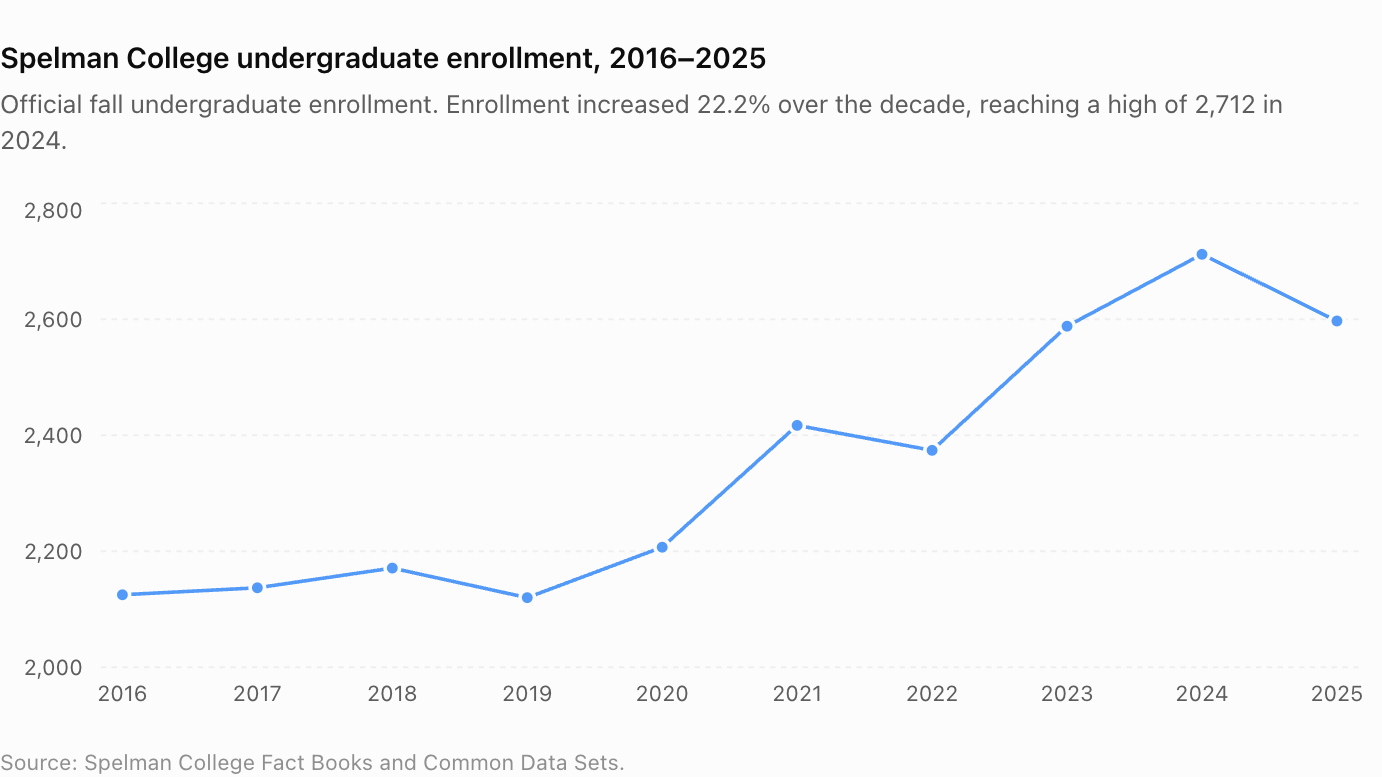
Spelman enrolled 2,125 undergraduates in fall 2016 and 2,597 in fall 2025, an increase of approximately 22.2 percent. Growth was not perfectly linear: enrollment reached 2,417 in 2021, slipped to 2,374 the following year, and then rose to 2,712 in 2024 before declining to 2,597 in 2025. A one-year decline warrants attention, but it does not erase the larger pattern. Over the decade, Spelman added nearly 500 students while continuing to receive many more applications than it could accommodate.
Spelman and the Changing Landscape of Women’s Colleges
In the mid-20th century, more than 200 women’s colleges existed in the United States. By fall 2022, 31 remained. Some institutions closed or merged, while others became coeducational in response to changing student preferences, enrollment pressures, and financial circumstances.
Enrollment across the sector has also contracted. Between 1998 and 2022, total enrollment at women’s colleges declined 40 percent, from approximately 112,500 students to 67,300. The decline was 18 percent during the final decade of that period alone. Spelman’s documented fall enrollment increased between 2020 and 2024, although this shorter period should not be treated as directly comparable with the sector-wide 1998–2022 trend.
Spelman is one of only two remaining women’s colleges that are also historically Black colleges, the other being Bennett College in North Carolina. Nevertheless, some of its useful academic peers are institutions such as Wellesley, Smith, Mount Holyoke, Bryn Mawr, and Scripps. These colleges share longstanding commitments to undergraduate liberal arts education, selective admissions, and influential alumnae communities, although their histories, student populations, and financial resources differ considerably.
Spelman has not responded to the contraction of women’s colleges by abandoning its identity. Its experience suggests that a specialized mission need not limit demand when students understand the community and education it offers.
Student Success Beyond Admission
Application numbers tell only part of the story. Spelman’s second-year retention rate is approximately 95 percent, and its six-year graduation rate has generally remained in the mid-to-upper 70s in recent cohorts.
For students who entered in 2018, Spelman reported a six-year graduation rate of 78 percent, compared with 58 percent nationally and 39 percent among four-year HBCUs. That result substantially exceeded the four-year HBCU average, although several of its selective women’s-college peers report higher rates.
Those outcomes reflect a strong record of student persistence, although important differences remain. For the 2019 entering cohort, the six-year graduation rate for Pell Grant recipients was 67 percent, below the rate for students who did not receive Pell Grants. Affordability is therefore a question of degree completion as well as admission.
STEM Within a Liberal Arts Education
One of the more interesting aspects of Spelman is its record in science and technology. The College is not a technical institute, nor does it operate an engineering or medical school. Its mission instead describes an institution dedicated to “academic excellence in the liberal arts and sciences and the intellectual, creative, ethical, and leadership development of its students.” It also emphasizes educating the whole person, while its formal Statement of Purpose encompasses the fine arts, humanities, social sciences, and natural sciences.
Spelman reports that, over a five-year period described on its STEM webpage, an average of 34 percent of students pursued STEM majors and approximately one-quarter of graduates earned STEM degrees. The webpage does not specify the reporting years.
Spelman has developed STEM strength without replacing its liberal arts environment. Students preparing for scientific careers also study writing, communication, and disciplines concerned with human behavior, culture, and ethics. It reflects the College’s longstanding expectation that a graduate should be able to bring several ways of thinking to bear on a problem, whether she is working in a laboratory, a classroom, a business, or public life.
That breadth may become increasingly important as artificial intelligence changes professional work. AI can already assist with tasks in software development, research, and analysis, but technical expertise remains essential. What may become more distinctive is the ability to apply that expertise with judgment.
Scientists and engineers who assume broader responsibilities must decide which problems deserve attention, assess incomplete information, communicate across specialties, and understand the human consequences of their work. Creativity, ethical reasoning, and leadership complement rather than replace technical skills.
A Spelman student may become a biologist, mathematician, or computer scientist while also studying history, philosophy, literature, and the arts. That breadth does not guarantee professional success, but it may help graduates adapt as technologies and occupations change.
Spelman’s current institutional priorities suggest that the College recognizes this opportunity. Its Spelman Forward campaign calls for integrating AI literacy, computational reasoning, and ethical leadership across the curriculum while modernizing its liberal arts foundation. The emphasis is not on replacing the liberal arts with technology, but on preparing students to understand and use technology within a broader intellectual and human context.
The Faculty and Research Behind the Results
Spelman’s STEM accomplishments also depend upon faculty and research opportunities. The College reports 54 full-time faculty members in its STEM departments and programs, 83 percent of whom are members of racial or ethnic minority groups and 52 percent of whom are women. Nearly two-thirds of the women on its STEM faculty are African American.
Students can work with faculty engaged in research rather than encounter science only in the classroom. In a smaller undergraduate setting, the relationship between a professor and a student can extend from introductory coursework to laboratory work, mentoring, and conversations about graduate study. Spelman also participates in externally supported research and undergraduate research programs.
Spelman has also attracted federal research support, including participation in grants that expand research opportunities for its students and faculty. In 2024, it led an Atlanta University Center consortium awarded $14 million through the National Science Foundation’s GRANTED program, an initiative intended to strengthen research infrastructure and competitiveness at participating HBCUs. The award was made to the consortium, not to Spelman alone, but it illustrates how the College uses collaboration to expand what its faculty and students can undertake.
Faculty, external support, and partnerships extend research opportunities beyond Spelman’s own campus.
An Engineering Program Built Through Partnership
Spelman’s approach to engineering offers another example of expanding educational opportunities without attempting to become a larger institution. Through the Atlanta University Center’s Dual Degree Engineering Program, students generally complete at least three years at Spelman and two years at a partner engineering institution. Those who satisfy both institutions’ requirements receive a bachelor’s degree from Spelman and an engineering degree from the partner.
The program includes 15 engineering partners, among them Georgia Tech, Columbia University, Purdue University, and the University of Michigan. Students can therefore begin their undergraduate education within Spelman’s liberal arts environment and complete specialized engineering study at institutions with established programs and facilities.
The arrangement illustrates a practical distinction between the size of an institution and the range of opportunities available to its students. An engineering school requires specialized faculty, laboratories, equipment, and continuing investment. By working with established partners, Spelman can preserve its own undergraduate educational model while offering students a route into a field that would otherwise require resources beyond its campus.
The Spelman Sisterhood
The College’s academic record explains only part of its influence. Spelman’s alumnae community, which the institution reports numbers 21,785 women, has become another important source of professional opportunity, philanthropy, and institutional continuity.
Its graduates include Marian Wright Edelman, Class of 1960, founder of the Children’s Defense Fund; Audrey Forbes Manley, Class of 1955, a physician and former Acting Surgeon General who later became Spelman’s first alumna president; and Rosalind Brewer, Class of 1984, whose corporate leadership career included serving as CEO of Walgreens Boots Alliance. Brewer subsequently returned to Spelman as a trustee leader and interim president.
Other graduates include economist Lisa D. Cook, Class of 1986, who became a member of the Federal Reserve Board of Governors, and Evelynn Hammonds, Class of 1976, a historian of science and medicine who served as Dean of Harvard College. Their careers span public service, medicine, business, economics, and higher education, reflecting the breadth of opportunities Spelman graduates pursue.
The alumnae network extends beyond prominent names. Graduates mentor students, provide professional contacts, contribute financially, and help lead the College, connecting current students with women who followed similar paths. The presence of alumnae in campus life gives undergraduates examples of what a Spelman education can lead to, while shared traditions encourage graduates to see themselves as continuing participants in the College’s story rather than former customers of an educational institution.
Rosalind Brewer’s return as interim president offers a particularly tangible example. When Spelman needed leadership during a presidential transition, it turned to a graduate who understood the institution and had accumulated extensive experience elsewhere. The Sisterhood, in that instance, became more than a tradition or professional network; it became an institutional resource.
Beyond the Brochure
One of Spelman’s most recognizable traditions is wearing white. Dating to around 1900, the practice began when students were expected to have a conservative white dress for formal occasions. Spelman describes the tradition as creating a uniform appearance and marking the importance of formal occasions.
The tradition has endured for more than a century. First-year students wear white during their induction into the Spelman Sisterhood, while white attire also appears at Founders Day and major commencement-related events. Alumnae returning for Reunion participate in the March Through the Alumnae Arch, maintaining a connection with customs observed by generations before them. Students encounter its history in ways that are visible, shared, and repeated across generations.
These traditions make the idea of Sisterhood tangible.
Atlanta and the Atlanta University Center
Spelman’s location provides educational opportunities that would be difficult to duplicate in a more isolated setting. The College belongs to the Atlanta University Center, a consortium of historically Black institutions that includes Morehouse College and Clark Atlanta University. Cross-registration and institutional cooperation expand the academic and social opportunities available to students while allowing Spelman to maintain its own identity and relatively small enrollment.
Atlanta itself offers access to major corporations, health systems, cultural institutions, research organizations, and an extensive Black professional community. The city’s history also provides an important educational context. Spelman students participated in the Atlanta Student Movement during the 1960s, linking the College to the broader struggle for civil rights and the development of the city.
Students thus experience a small college within a much larger educational and metropolitan community.
Financial Strength and the Challenge of Access
Spelman possesses financial resources that distinguish it from many small private colleges. At June 30, 2025, it reported more than $1 billion in total assets, approximately $964 million in net assets, and an endowment of roughly $609 million. According to the Hechinger Report’s Financial Fitness Tracker, net tuition represented 19 percent of its 2024 revenue, versus a 45 percent median among private nonprofit colleges. That lower dependence on tuition provides context for assessing its financial position.
Financial Trends
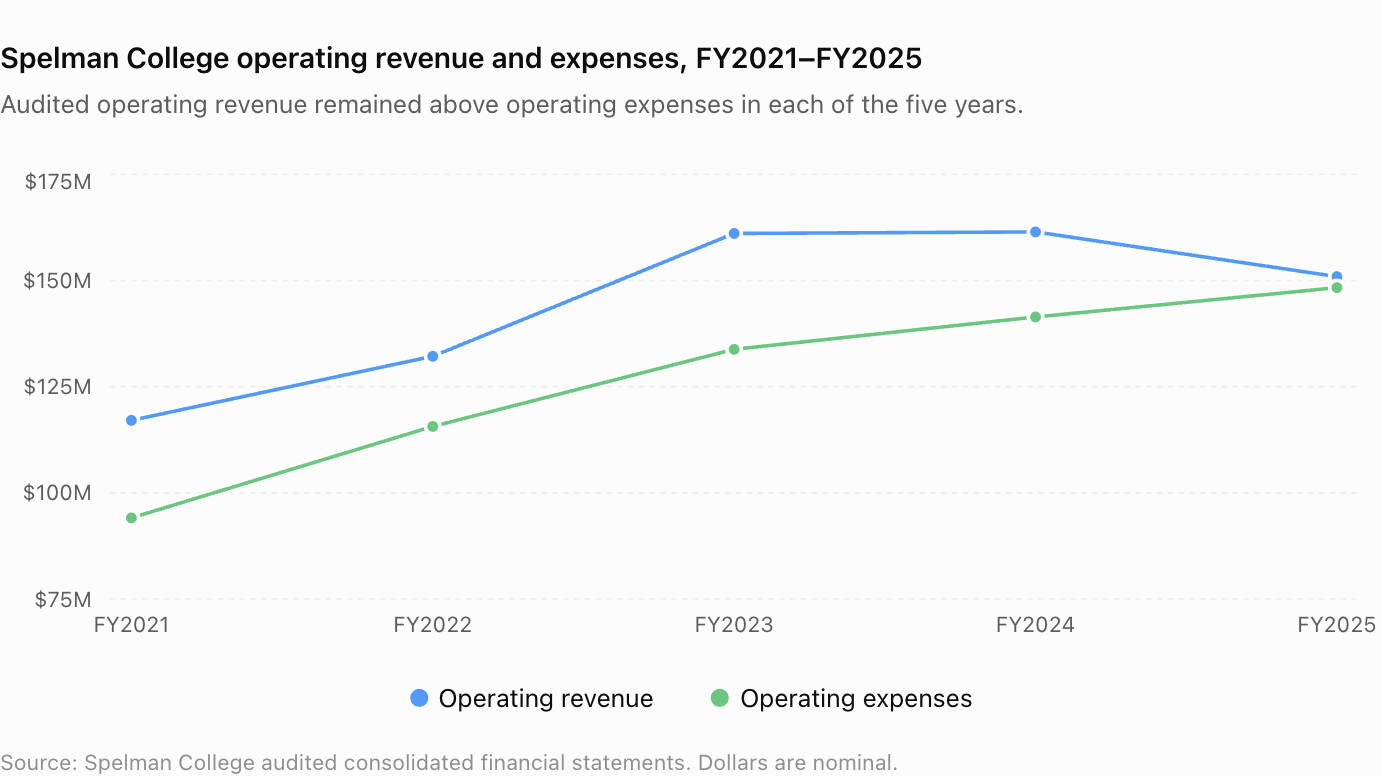
Spelman’s operating revenue increased substantially between FY2021 and FY2024 before declining in FY2025. Operating expenses also rose over the five-year period, narrowing the positive operating margin considerably in FY2025.
Restricted gifts, endowment activity, and capital projects can affect annual results, so a single year should not be mistaken for a sustained trend.
Spelman’s recent fundraising has been substantial. In January 2024, trustee Ronda Stryker and her husband, William Johnston, announced a $100 million gift, including $75 million for endowed scholarships. MacKenzie Scott contributed $38 million in unrestricted support in 2025, following a $20 million gift in 2020. The Arthur M. Blank Family Foundation has also committed $16.5 million over ten years to support scholarships for Spelman juniors and seniors with significant financial need.
Among Spelman’s 2024 graduates, 62 percent borrowed, with average cumulative student debt of $34,425 among borrowers. For 2023–24 graduates of private nonprofit four-year institutions nationally, the College Board reports an almost identical average of $34,420 among borrowers, but only 49 percent of graduates borrowed.
In April 2026, Spelman launched its $500 million *Spelman Forward* campaign. Approximately $325 million—65 percent—is designated for access and affordability, with another $100 million for academic transformation, including AI literacy and ethical leadership.
Despite strong demand and philanthropy, affordability remains central to Spelman’s strategy, alongside investment in a liberal arts curriculum suited to technological change.
A New President and the Next Chapter
Spelman enters this period of academic and financial investment under new leadership. Mary Schmidt Campbell served as president from 2015 until her retirement in 2022. Her successor, Helene Gayle, left the presidency in 2024, after which Rosalind Brewer served as interim president. Brewer’s appointment brought an experienced corporate leader and Spelman graduate back to the institution during an important transition.
On August 1, 2026, Ayanna Howard became Spelman’s 12th president. A roboticist and artificial intelligence researcher, Howard previously worked at NASA’s Jet Propulsion Laboratory, held a faculty position at Georgia Tech, co-founded the robotics company Zyrobotics, and served as dean of the College of Engineering at Ohio State University.
Howard inherits established STEM programs, research partnerships, and an ambition to integrate AI literacy into a liberal arts education; she is not creating a scientific identity from scratch.
It is too early to evaluate her presidency, but her background makes the relationship between scientific education and Spelman’s broader mission especially interesting. Her appointment brings the story back to a question that has shaped Spelman since its founding: how to prepare women for emerging opportunities without losing the educational purpose that distinguishes the College.
Why Is Spelman College Important?
Spelman’s experience offers several lessons for small private colleges, particularly those confronting questions about enrollment, academic identity, financial resources, and the future of liberal arts education.
Distinctiveness Is More Powerful When It Is Authentic. Spelman’s mission has remained remarkably consistent while the number of women’s colleges has declined dramatically. Its history, academic programs, student experience, and alumnae community reinforce an identity that prospective students can readily understand. The College’s experience suggests that differentiation is most effective when it reflects an institution’s actual educational purpose rather than a marketing response to changing circumstances.
Liberal Arts and STEM Can Strengthen One Another. Spelman demonstrates that a small liberal arts college can prepare substantial numbers of students for scientific careers without abandoning a broader education. As artificial intelligence changes professional work, the combination of technical knowledge with communication, creativity, ethical reasoning, adaptability, and leadership may become increasingly valuable. Spelman’s commitment to bringing AI literacy into its liberal arts curriculum makes this an especially relevant part of its story.
Partnership Can Substitute for Scale. The dual-degree engineering program, Atlanta University Center, and external research relationships allow Spelman to offer educational opportunities that would be difficult to provide entirely on its own. These arrangements suggest that a small institution need not become a comprehensive university to give students access to specialized fields and facilities.
Alumnae Can Be Part of the Educational Model. The Sisterhood extends the relationship between student and institution beyond graduation. Through mentoring, professional connections, philanthropy, and leadership, alumnae contribute to the experience of current students and the continuing development of the College. Rosalind Brewer’s service as interim president demonstrates how those connections can become particularly valuable during institutional transitions.
Financial Strength Creates Choices, Not Immunity. Spelman’s assets, endowment, and recent philanthropic support give it options that many small colleges do not possess. Yet its decision to direct nearly two-thirds of a $500 million campaign toward access and affordability shows that financial resources must still align with students’ needs and the institution’s mission.
What makes Spelman interesting is the coherence of its mission, academic programs, traditions, and alumnae relationships.
A student can enter the Sisterhood, study across disciplines, conduct research, and pursue engineering through a partner institution. Along the way, she encounters an academic community that expects both professional preparation and broader intellectual development. At graduation, she passes through the Alumnae Arch into a network that may shape her life for decades.
The college that began with 11 students in an Atlanta church basement remains relatively small 145 years later, but its influence reaches far beyond campus.
Additional sources: Spelman College, 2025–26 Common Data Set, Section H5 (student debt); FY26 Student Achievement Report (Pell graduation); The Hechinger Report, Financial Fitness Tracker (2024 net-tuition share); College Board, Trends in College Pricing and Student Aid 2025, Figure SA-14A (national debt comparison).
Dean Hoke is Executive Producer and co-host of Small College America and Managing Partner of Edu Alliance Group, a higher education consulting firm based in Bloomington, Indiana, and Abu Dhabi, United Arab Emirates. He formerly served as President/CEO of the American Association of University Administrators (AAUA) and has worked with colleges and universities in the United States and internationally throughout his career.
Dean is also a Senior Fellow at the Sagamore Institute in Indianapolis, where his research focuses on the economic and social impact of small colleges in rural communities. He is co-author, with Chet Haskell and Barry Ryan, of the forthcoming book Small Colleges at the Crossroads: Strategic Paths to Growth, Partnership, Merger, or Responsible Closure, scheduled for publication in Fall 2026.


Nice article!
Jim Boyce
LikeLike
Thanks, Jim. Spelman is a very interesting school and doing great things in higher education
LikeLike